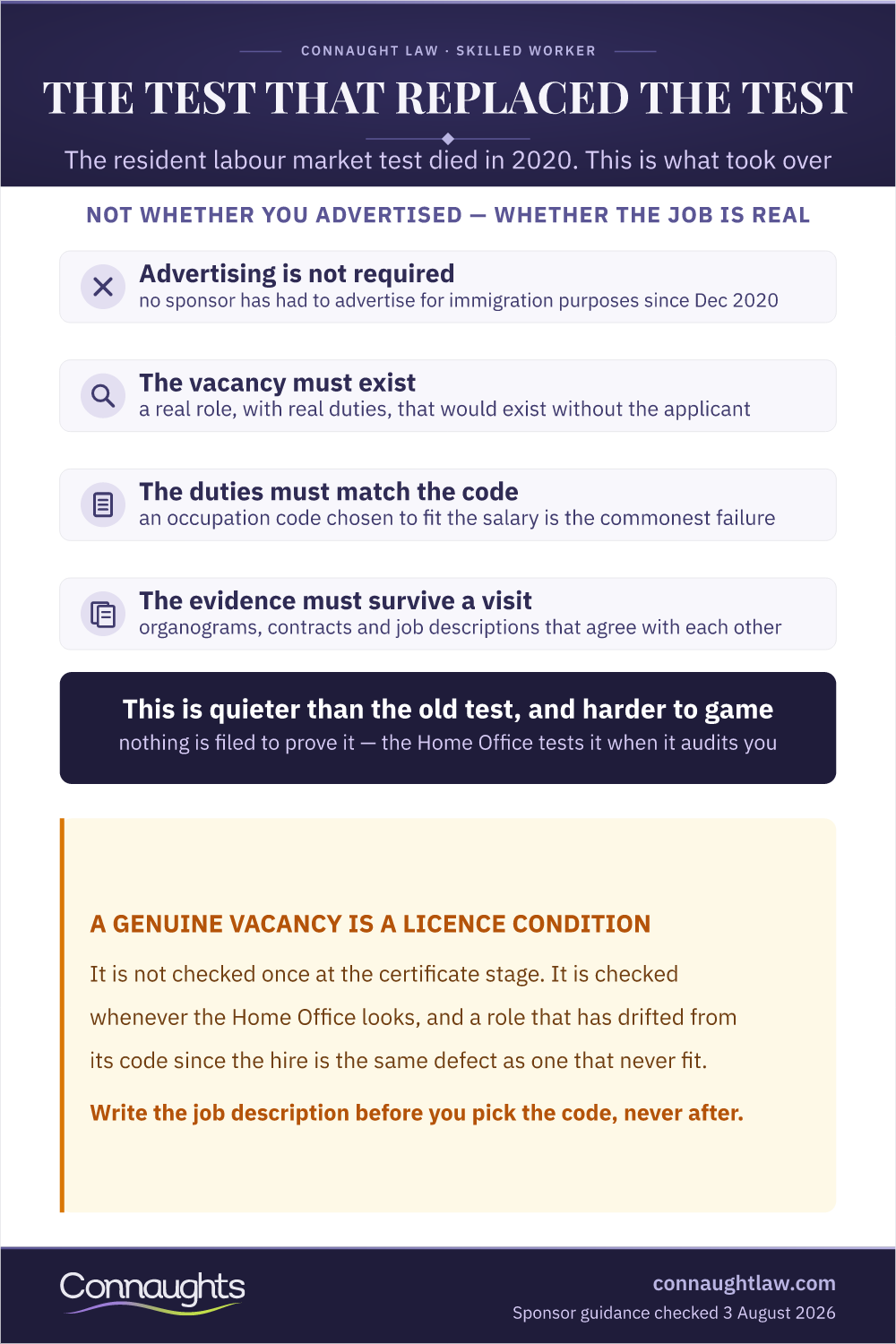
The resident labour market test died in December 2020, and no sponsor has had to advertise a role for immigration purposes since. What replaced it is quieter and harder to game: the genuine vacancy requirement, under which the Home Office asks not whether you advertised the job but whether the job is real — and revokes licences in record numbers where it decides the answer is no. This guide explains the test, the red flags and the evidence that satisfies it.
On This Page

The Test That Replaced the Test
The RLMT was procedural: advertise for 28 days, keep the tearsheets, tick the box. Its successor is substantive: the role on the certificate must be a real vacancy the business genuinely needs, at the skill level claimed, on terms that make commercial sense. That shift moved the risk from application stage to audit stage — a sponsor can pass every form and still lose the licence when a compliance visit finds the jobs do not match the paperwork.
What Replaced the Resident Labour Market Test
How the Two Tests Differ
RLMT and Genuine Vacancy Compared
| Aspect | RLMT (pre-2020) | Genuine vacancy (now) |
|---|---|---|
| Advertising | Mandatory 28-day campaigns | None required — recruitment records still help |
| Focus | Process compliance | Whether the role and the business need are real |
| Timing | Before the application | Continuous — at application and every compliance visit |
| Character | Rigid, checkable, gameable | Discretionary, evidence-driven, harder to stage |
Defining a Genuine Vacancy
Legal Framework and Context
The test lives in the sponsor guidance on duties and compliance and the Skilled Worker caseworker guidance: the role must involve the duties of its occupation code, not consist mainly of lower-skilled work, and be appropriate to the sponsor's size and business model. Three questions distil it — does the business need this role, is the role really at this level, and would this job exist without this applicant?
Home Office Assessment Criteria
Assessment Triggers and Red Flags
- Small organisations sponsoring senior management roles their scale cannot explain.
- Requirements visibly tailored to one individual, or job descriptions misaligned with the SOC code claimed.
- Repeat sponsorship in identical roles, and salaries out of step with the market for the work.
- New or largely virtual businesses with no operational history to anchor the claimed need.
None of these is fatal alone — startups legitimately hire senior people, and niche roles legitimately carry unusual terms. What they share is that each invites the follow-up questions, and sponsors who cannot answer them with contemporaneous evidence lose licences to inference.
The Enforcement Record
Sector Enforcement Patterns
Enforcement has moved from warning letters to removal: the Home Office announced 1,948 sponsor licence revocations between July 2024 and June 2025 — more than double the 937 of the previous twelve months, against 247 in 2022–23. Care, hospitality, retail and construction absorb the heaviest attention, with artificial job creation the recurring finding. The full enforcement picture, including visit and arrest data, lives in our compliance crackdown analysis.
Enforcement Trend Table
| Period | Revocations |
|---|---|
| 2021–22 | 261 |
| 2022–23 | 247 |
| July 2023 – June 2024 | 937 |
| July 2024 – June 2025 | 1,948 |
Documentation and Compliance
Essential Documentation Categories
The evidence that answers a genuineness challenge is the evidence Appendix D already requires kept: job descriptions and contracts matching the certificate, recruitment records showing how the hire actually happened, payroll proving the certificate salary is paid, and the organisational context — structure charts, business plans, client contracts — that shows why the role exists. Built at hiring time it is a filing exercise; reconstructed under a compliance visit deadline it is an emergency, and it reads like one.
Sector-Specific Considerations
Common Compliance Challenges
Technology and professional services firms evidence need through projects and client demand; manufacturers through production capacity; care providers — under the heaviest scrutiny — through rosters and commissioned hours. The shared trap for smaller employers is the senior-title certificate: sponsoring a "manager" a six-person business cannot plausibly need. Where the questions have already arrived, our refusal and revocation guide covers the response; where they have not, the cheapest compliance is a role that genuinely is what its certificate says, priced by our CoS guide and grounded in the requirements of the Skilled Worker route itself.
Frequently askedQuestions about the genuine vacancy requirement
Is there still a resident labour market test?
No — the RLMT was abolished for applications from December 2020. No advertising period is required for any sponsored role. The genuine vacancy requirement replaced it, testing whether the role itself is real rather than whether it was advertised.
Do I need to advertise jobs at all?
Not for immigration purposes. But genuine recruitment records — adverts, shortlists, interview notes — remain some of the best evidence that a vacancy is real, so sponsors who recruit normally and keep the paperwork answer genuineness questions almost by accident.
How does the Home Office decide a vacancy is genuine?
Against the sponsor guidance: the role must involve its occupation code's duties, not mainly lower-skilled work, and fit the organisation's size and model. Assessment happens at the application and again at compliance visits, on documents and interviews rather than declarations.
What happens if a role is found not genuine?
Refusal of the application at best; at worst suspension or revocation of the sponsor licence, curtailing every sponsored worker's leave. The 1,948 revocations in the year to June 2025 — double the prior year — show how readily that outcome now follows.
Which sectors face most scrutiny?
Adult social care, hospitality, retail and construction — sectors where enforcement found artificial roles at scale. But the requirement applies to every sponsor, and small businesses sponsoring senior titles attract questions in any sector.
How can a job seeker spot a genuine sponsored role?
Real duties in the advert, a salary consistent with the market, a licensed sponsor on the public register, and no request for payment for sponsorship — selling certificates is illegal. If a role exists only as a visa, walking away protects your own immigration record.
Tell us your roles, your codes and your evidence position. We'll audit the genuineness file the way a compliance officer would — before one does.
Get Expert Advice