
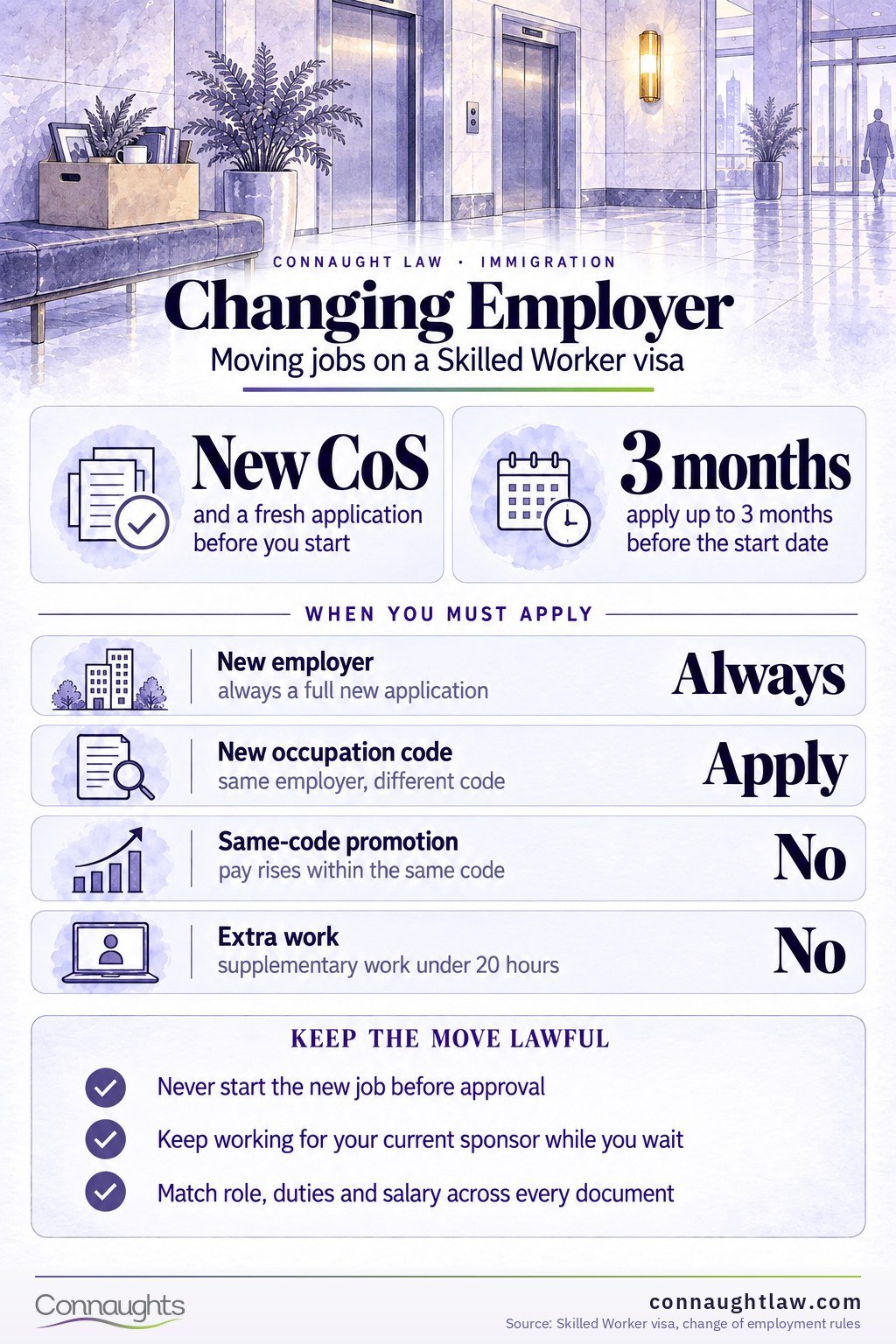
Changing employer on a Skilled Worker visa means a full new application, approved before day one at the new job — the same "change of employment" rule Tier 2 workers will remember. Role changes with your current employer need an update only when the occupation code changes, and supplementary work under 20 hours needs none at all. This guide covers when an application is required, what it costs each side in 2026, and the timing that keeps the move lawful.
On This Page

When a Job Move Needs the Home Office
The update rules draw clean lines: a new employer always means a new application; a new role with your current employer means one only if the occupation code changes (graduate training programmes excepted); and leaving an Immigration Salary List job for an unlisted one triggers an application even with the same employer. Pay rises, promotions within the same code, and a job whose listing lapses around you require nothing. Everything else in this guide hangs off those lines.
The July 2025 Changes and Employer Moves
A change of employer is assessed under today's rules, not the rules when you arrived: the new certificate must carry an eligible occupation and a salary meeting the current thresholds — £41,700 or the going rate for most, with the discounted floors where they genuinely apply, all mapped in our salary guide. The move is also where workers in roles that fell below RQF Level 6 discover their protections' limits.
Transitional Protections and Grandfathering
Two protections matter here. Workers sponsored in below-degree-level roles before 22 July 2025 can still change employer within those occupations. And workers whose first certificate predates 4 April 2024, with continuous Skilled Worker leave since, keep the transitional salary framework — £31,300 or the lower going rate — for applications made before 4 April 2030. Neither protection transfers to a different occupation code: step outside the protected role and the full current rules apply.
The Employer Change, Step by Step
Pre-Application Planning
Before resigning anything, verify three things: the new employer's licence is active, the occupation code for the new role is defensible against its actual duties, and the salary clears both legs of the test. The certificate of sponsorship the new employer assigns — covered in our CoS guide — is where those three answers become fixed.
Employer Change Stages
| Stage | What happens | Key discipline |
|---|---|---|
| Offer | Licensed sponsor identified, role and salary agreed | Check the register and the occupation code first |
| Certificate | New employer assigns the CoS and pays its fees | Details must match the real role exactly |
| Application | Online application, up to 3 months before the start date | Submit before resigning where notice allows |
| Biometrics | ID Check app or UKVCAS appointment | Book promptly — appointments drive the timeline |
| Decision | Standard in-country processing, typically 8 weeks | Keep working the old job; do not start the new one |
| Start | New employment begins after approval | Start promptly — sponsors must report a start delayed beyond 28 days |
Document Preparation and Submission
The applicant's bundle is light — passport, CoS reference, and English already banked from the original grant — because the heavy lifting sits on the certificate. What deserves care is consistency: the role title, duties and salary must read identically across the offer letter, the certificate and the application form, since discrepancies between them are the cheapest refusal the Home Office ever issues.
What the Move Costs
Employer Cost Obligations
- Employer: the £525 certificate fee, plus the immigration skills charge — £480 then £240 per six months for small sponsors, £1,320 then £660 for larger ones.
- Worker: the in-country application fee — £943 for up to three years, £1,865 for longer — plus the £1,035-a-year health surcharge (£776 for children).
- Optional: priority processing at £500 (five working days) or super priority at £1,000 (next working day).
- Dependants updating alongside pay their own fees and surcharge — budget the family total, not the main fee.
Common Mistakes
Avoiding Technical Application Errors
The catastrophic mistake is starting the new job before approval — a breach that damages both the worker's record and the new sponsor's licence. The expensive-but-recoverable ones: resigning before the application is in, letting the old employer withdraw sponsorship early (reported withdrawal starts a curtailment clock), and codes chosen from job titles. Workers leaving a struggling sponsor should read our care sector guide where relevant, and move before a licence revocation moves first.
Timelines and Managing the Gap
Working Rights During Processing
You keep working for the current sponsor on your existing terms while the application is pending — in-country decisions typically arrive within 8 weeks, or days on the paid services via the UKVCAS process. The new role starts only after approval. Where notice periods and start dates will not reconcile with the standard timeline, the priority fee is usually cheaper than the alternative conversations.
London Factors
London concentrates licensed sponsors, which widens options for anyone changing employer — and London salaries clear thresholds that regional offers miss, a real factor now the general threshold sits at £41,700. The counterweights are competition and the cost of the city itself. None of it changes the law of the move; it changes the odds of the offer, which is where our business immigration team spends most of its time on these cases.
Frequently askedQuestions about changing employer
Can I change employer on a Skilled Worker visa?
Yes — with a new certificate of sponsorship from the new employer and a new application approved before you start. The visa is tied to the sponsor, so the move is a fresh grant of permission, not a notification.
Do I need to apply if my job changes with the same employer?
Only if the new role sits in a different occupation code (outside a graduate training programme), or you leave an Immigration Salary List job for an unlisted one. Promotions and pay rises within the same code need no application.
Can I work while the change application is pending?
For your current sponsor, yes — your existing permission continues. Starting work for the new employer before approval is a serious breach that endangers your record and the new sponsor's licence, however confident everyone feels about the outcome.
What does changing employer cost in 2026?
The worker pays £943 (up to three years) or £1,865 in-country plus £1,035 a year in health surcharge; the employer pays the £525 certificate and the skills charge of £480 or £1,320 for the first year by sponsor size. Priority decisions cost £500 or £1,000 more.
Do the new salary rules apply to my move?
Yes — a change of employer is assessed at today's thresholds. The exceptions are cohort-based: pre-July-2025 workers can move within their below-degree occupations, and pre-April-2024 workers keep the £31,300 transitional framework until April 2030.
Do my family need new applications too?
Dependants' permission is linked to yours, not to your employer — an employer change alone does not force dependant applications. They update alongside you when your own leave is extended or reissued, each paying their own fee and surcharge.
Tell us the new role, its occupation code and salary, and your notice position. We'll confirm whether the move clears today's rules, sequence the application against your dates, and keep both jobs lawful throughout.
Get Expert Advice