
Skilled Worker settlement turns five years of sponsored residence into indefinite leave to remain: continuous residence within the 180-day absence rule, a sponsor confirming the job and salary continue, B1 English — normally already banked from the original visa — and the Life in the UK test, and the £3,226 fee. This guide covers each requirement as it stands in 2026 — including where the proposed ten-year "earned settlement" reforms actually are, and why today's applications still run on the five-year rules.
On This Page

Five Years Done Right
Settlement is where every earlier compliance decision gets audited at once: the absences logged in year two, the employer change handled properly in year three, the salary kept at the right level throughout. Applications built on a clean, reconciled five-year record are routinely granted; applications assembled in a rush the month before filing are where the route's failures concentrate. The requirements below are each simple — the discipline is running them together for five years.
The Five-Year Residence Requirement
Calculating Qualifying Residence
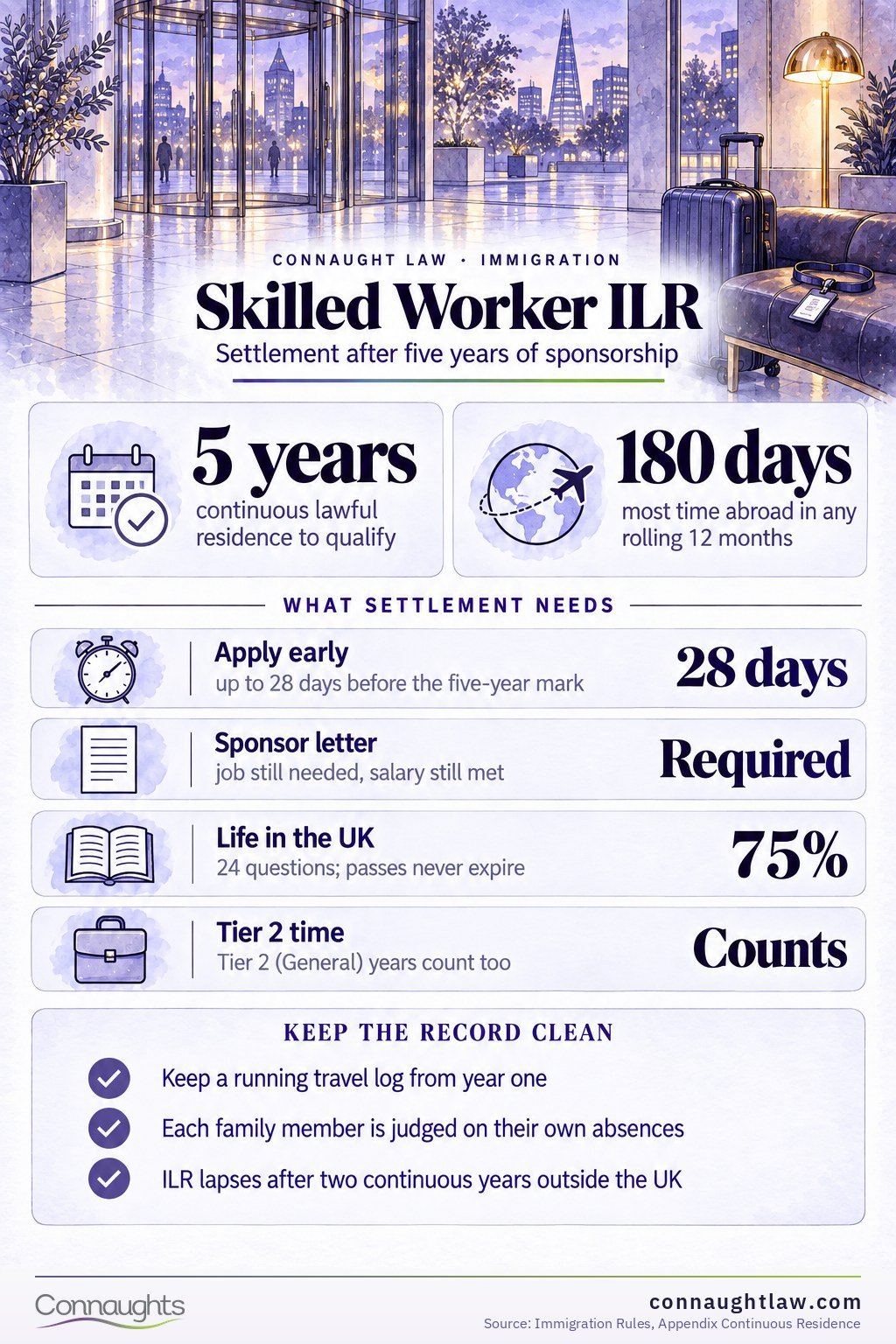
The qualifying period is five years of continuous lawful residence in the Skilled Worker route or compatible predecessors — Tier 2 (General) time counts — and the application can go in up to 28 days before the five-year mark. Gaps between visas, out-of-time extensions and time in incompatible categories are what break the chain, and they are far cheaper to diagnose in year one than to argue about in year five.
Qualifying Residence Components
| Component | Requirement | Where it goes wrong |
|---|---|---|
| Duration | 5 years' continuous residence; apply up to 28 days early | Applying early by more than 28 days; gaps between grants |
| Absences | No more than 180 days outside the UK in any 12-month period | Accumulated travel nobody was counting |
| Lawful status | Valid leave throughout, in qualifying categories | Late applications and category switches mid-period |
| Sponsorship | Sponsored employment continuing at the point of application | Redundancy or employer licence loss near the five-year mark |
Absences and the 180-Day Rule
Under Appendix Continuous Residence, absences must stay within 180 days in any rolling 12-month period — not per calendar year — with whole days outside the UK counted. The rolling basis is what catches people: two moderate trips in different calendar years can still sit inside one heavy 12-month window. Limited exceptions exist for serious compelling reasons, assessed case by case and never to be planned around.
Managing and Evidencing Absences
Keep a running travel log against passport stamps and boarding passes from year one, and check it before every long trip. At application stage the log becomes the absence schedule; reconstructed travel histories are the single most common cause of settlement delay, and an unexplained discrepancy against Home Office records reads far worse than the travel itself.
Employment at the Point of Settlement
Settlement is not just a residence test — the sponsor must confirm in writing that the job continues to be needed and that the salary meets the requirements that apply to you. Which threshold that is depends on your cohort and occupation code; the current figures and the pre-April 2024 transitional framework are set out in our salary requirements guide. A salary that has drifted below the applicable rate through pay freezes or reduced hours is a settlement problem best found a year early.
Sponsor Changes Along the Way
Employer moves during the five years do not break continuity when done properly — new certificate, new application, then the new job, as our change of employer guide sets out. What damages settlement files is the improper version: duties changed without a new certificate, or a licence-losing sponsor discovered late. Each employment change should leave a clean documentary seam, because the settlement caseworker will look for exactly those seams.
English and Life in the UK
English at B1 is usually already banked from the original visa — once proved, it is not proved again. What remains is the Life in the UK test: book it well before the application window, because test-centre availability is the classic avoidable bottleneck in an otherwise ready application.
Life in the UK Test
Twenty-four questions on British history, institutions and life, with a 75% pass mark, taken at an approved centre. Passes never expire, and there is no limit on retakes beyond rebooking. Treat it as an exam with a syllabus — the official handbook — rather than a general-knowledge quiz, and take it early enough that a bad day costs nothing.
Applying: Timing, Fee and Decision
The fee is £3,226 per person, and a standard decision usually arrives within six months of biometrics — with the priority service (£500 extra) targeting five working days and super priority (£1,000 extra) the next working day. You keep working on your existing status while the application is pending. Given the fee multiplies across a family, the application bundle deserves assembling once, properly.
Documentation and Evidence Standards
- The sponsor's letter confirming the ongoing role and qualifying salary.
- The absence schedule, reconciled against passports and travel records.
- Employment record across the period: payslips, P60s and contracts spanning every employer.
- English evidence and the Life in the UK pass certificate, plus identity documents for every applicant.
Family Settlement
Partners and children who have accompanied you as dependants apply alongside, each paying the fee and each measured against their own absence record — a partner's heavy travel can fail while the main applicant's record passes. Adult applicants among them face their own English and Life in the UK requirements. Synchronising the family's applications, and their travel discipline, is settlement planning at its most practical.
Children and Adult Dependants
Children who turn 18 during the qualifying period can still settle as dependants while they remain part of the household and meet the requirements that apply at their age. Children born in the UK after both parents hold ILR are born British; children born before that point can usually be registered once the parents settle — sequencing worth checking before, not after, a birth.
After Settlement
ILR ends sponsorship: any employer, any role, no salary rules, full access to the labour market. It persists indefinitely while the UK remains home, but lapses after two continuous years outside the country. The proposed "earned settlement" reforms — a ten-year baseline with contribution-based reductions — remain at consultation stage and change nothing for current applications; the implemented-versus-proposed map lives in our White Paper status guide, and our settlement and citizenship team tracks it so applicants do not have to.
Citizenship Planning
Naturalisation typically follows twelve months after ILR, with its own absence limits calculated differently from settlement's — the five-year citizenship look-back includes stricter caps that heavy travellers can fail even with a clean ILR. Anyone planning citizenship should run both calculations together from the start; our business immigration team and refusal specialists see the cost of running them separately.
Frequently askedQuestions about Skilled Worker settlement
When can I apply for ILR?
After five years' continuous residence in the Skilled Worker route (Tier 2 General time counts), applying up to 28 days before the anniversary. You must still be sponsored, within the absence limits, and hold B1 English and a Life in the UK pass.
How do the absence limits work?
No more than 180 days outside the UK in any rolling 12-month period across the five years, counted in whole days under Appendix Continuous Residence. The rolling calculation — not calendar years — is what catches frequent travellers, so keep a live travel log.
Is there a salary requirement at settlement?
Yes — your sponsor must confirm the job is still needed and the salary meets the rates applicable to your cohort and occupation code. Pay that has drifted below the applicable threshold is among the commonest late-discovered settlement problems.
What does ILR cost and how long does it take?
£3,226 per person, with a standard decision usually within six months of biometrics. The priority service (£500 extra) targets five working days and super priority (£1,000 extra) the next working day. You continue working while it is pending.
Is the qualifying period changing to ten years?
A ten-year "earned settlement" baseline was proposed in the 2025 White Paper and consulted on, but it is not law — applications today run on the five-year rules. Anyone within reach of five years should not delay an application waiting for clarity.
When can I apply for citizenship?
Usually twelve months after ILR. Citizenship applies its own absence caps over its own qualifying period, calculated differently from settlement's rolling rule — run both calculations together early if a British passport is the end goal.
Tell us your visa history, your travel record and your current salary. We'll reconcile the qualifying period, flag anything that needs fixing before you file, and build the bundle once — properly.
Get Expert Advice