
The UK shortage occupation list no longer exists under that name — it became the Immigration Salary List in April 2024, and gained a companion, the Temporary Shortage List, in July 2025. Between them the two lists decide which roles get a lower salary threshold, which mid-skill jobs can still be sponsored at all, and who can bring family. This guide covers both lists as they stand in 2026, and what a listing is actually worth.
On This Page

A List That Changed Its Name Twice
Searchers still ask for the shortage occupation list, and the instinct is right — a list still decides which occupations get favourable treatment. What changed is the machinery: the old list's going-rate discounts died with it in April 2024, its successor trades under stricter terms, and a second, temporary list now exists purely to keep selected mid-skill jobs inside a route that otherwise demands degree-level work. Knowing which list a role sits on, and what that listing buys, is the whole game.
What Replaced the Shortage Occupation List
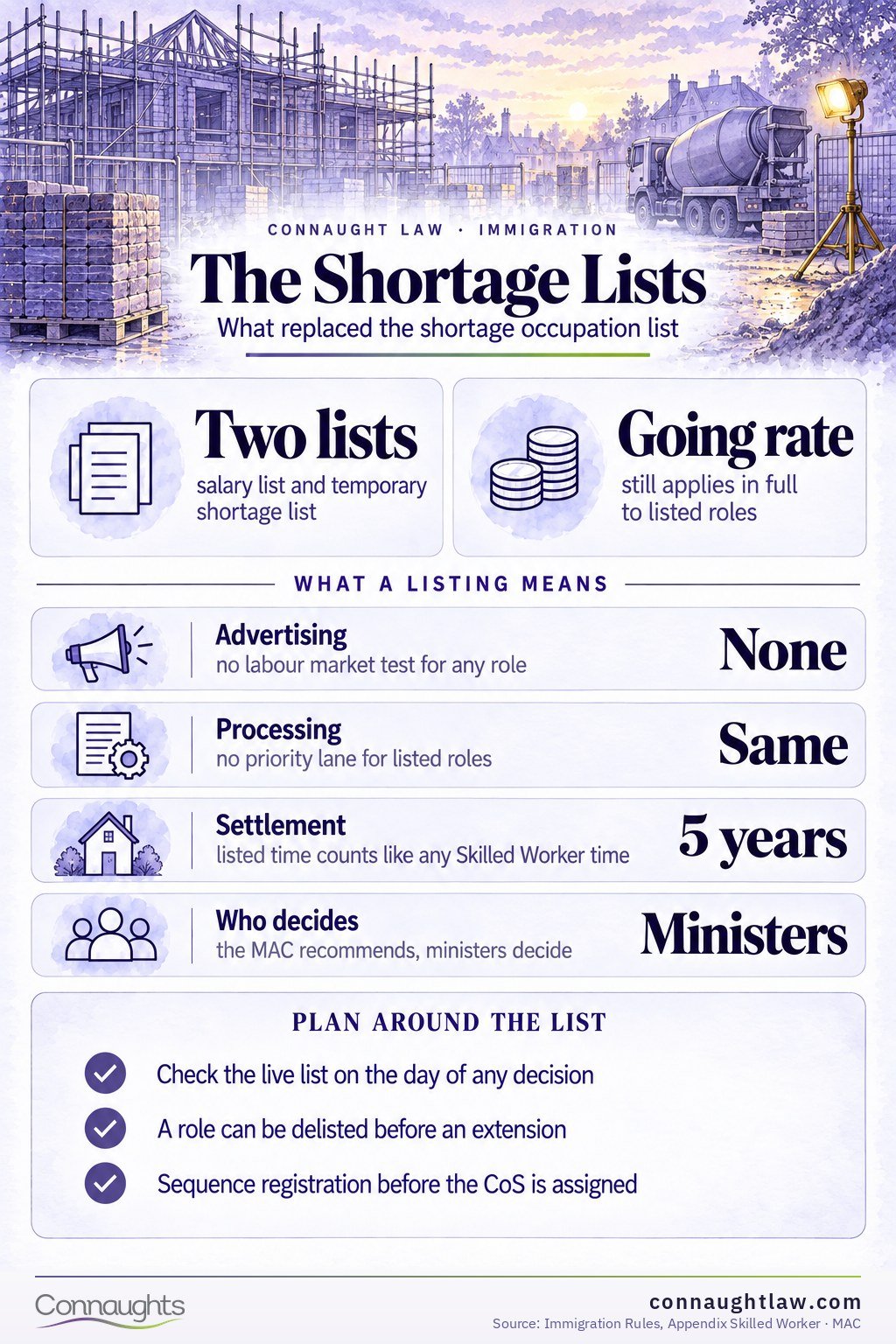
The Shortage Occupation List was abolished in April 2024 and replaced by the Immigration Salary List, which lowers the flat salary threshold to 80% of the usual minimum but leaves the going rate untouched. The Temporary Shortage List, added on 22 July 2025 and holding around 50 occupation codes, does a different job: it keeps listed medium-skilled roles sponsorable despite the RQF Level 6 rule.
Health and Care Codes on the List
The Immigration Salary List, updated 11 November 2025, carries around two dozen codes with a strong care presence: care workers and home carers (6135), nursing auxiliaries and assistants (6131), and residential and domiciliary care managers (1232) all appear, alongside biological scientists (2112). The care listings come with a hard caveat — new overseas recruitment of care workers closed in July 2025, so those codes now serve in-country applicants, a story told in full in our care worker closure guide.
Listed Occupations and SOC Codes
| SOC code | Occupation | Scope of listing |
|---|---|---|
| 1232 | Residential, day and domiciliary care managers | All jobs |
| 2112 | Biological scientists | All jobs |
| 5213 | Welding trades | High integrity pipe welders only |
| 5313 | Bricklayers | All jobs |
| 5316 | Carpenters and joiners | All jobs |
| 6131 | Nursing auxiliaries and assistants | All jobs |
| 6135 | Care workers and home carers | All jobs — in-country applicants after the 2025 closure |
| 9119 | Fishing and elementary agriculture occupations | As listed |
Construction and Technical Trades
The construction trades dominate the lists' blue-collar end — bricklayers, carpenters and specified welders on the Immigration Salary List, with the Temporary Shortage List adding roles like electricians (5241), pipe fitters (5214), laboratory technicians (3111) and logistics managers (1243). For a sponsor, the practical question is always which list the code sits on, because the two confer different things and the temporary list carries harder conditions.
What Listing Is Worth in Money
An Immigration Salary List role drops the flat threshold to £33,400 — 80% of the route's usual £41,700 minimum — while still requiring the occupation's full going rate, and it cuts the application fee to £628 for up to three years or £1,235 for longer. That is the entire benefit. The going-rate discount that made the old shortage list famous is gone: a listed role paying below its going rate fails, however severe the shortage. The full calculation mechanics live in our salary requirements guide.
Discounts That No Longer Stack
Under the current rules you pick one salary option — standard, listed occupation, new entrant or PhD — and its floor and percentage apply as a package. The old habit of stacking a shortage discount on top of a new entrant discount has no modern equivalent, and offers priced on that folk memory come in thousands of pounds short.
What Employers Actually Get
The Labour Market Test Is History
The resident labour market test was abolished for the whole system in December 2020 — listed and unlisted roles alike need no advertising period. What replaced it is the genuine vacancy requirement: the Home Office tests whether the role is real and matches its code, not whether a settled worker could have filled it. Any guide still promising an "RLMT exemption" for shortage roles is describing a system that no longer exists.
No Priority Lane for Listed Roles
Listing confers no processing advantage — applications queue with everyone else's, and the standard paid priority services are the only acceleration available. The honest employer benefits are the lower flat threshold, the reduced fee, and for temporary-list roles the bare fact of sponsorability below degree level.
Registration Still Rules the Professions
Overseas Qualification Recognition
Where a listed role sits in a regulated field — care management, science, welding certifications — professional registration and qualification recognition run on their own tracks alongside the visa. Ecctis comparability statements and regulator registrations should be sequenced before the certificate of sponsorship is assigned, because a visa granted for a role the worker cannot lawfully perform helps nobody.
The MAC's Role
How Occupations Get Listed
The Migration Advisory Committee recommends additions and removals on labour-market evidence — vacancy data, recruitment difficulty, pay trends — and ministers decide. Listings are therefore reviewable positions, not permanent statuses: an occupation can leave the list between a job offer and an application, which is a real timing risk for slow-moving recruitment.
Where the Lists Go Next
- The Temporary Shortage List is explicitly interim — kept under MAC review, with no promise of renewal for any code on it.
- Workers newly sponsored in medium-skilled listed roles since 22 July 2025 cannot bring partners or children as dependants; those already in medium-skilled roles before that date keep the right.
- Care workers carry the earlier cut-off — dependant rights persist only for those continuously employed in care roles on the route since before 11 March 2024.
- Every listing has a hard stop. Under SW 6.1A of Appendix Skilled Worker a temporary-list role only counts where the certificate of sponsorship was issued before 31 December 2026. The salary list carries the same removal date for every occupation except care workers and home carers (SOC 6135) and senior care workers (SOC 6136), which run to 22 July 2028.
- The next move is with ministers. On 23 July 2026 the Migration Advisory Committee recommended 28 occupations for eighteen months of access to the temporary list, and none for longer. No government response has been published and the Rules are unchanged.
- Both lists change on their own cycles — the ISL was last amended on 11 November 2025, and the Temporary Shortage List has not been touched since it came into force on 22 July 2025. Check the live publication on the day of any decision.
Planning Around a Listed Role
Settlement from a Listed Role
Time in listed roles counts towards the five-year settlement clock like any Skilled Worker time — the requirements are in our settlement guide, and the wider journey in our settlement and citizenship practice. The strategic risk is the list itself: a role delisted before extension can leave a worker needing the full threshold at the worst moment. Workers and sponsors should plan salaries towards the unlisted figures over time — treating the discount as a runway, not a permanent address. Our business immigration team builds exactly those plans, and where an application has already gone wrong our refusal team picks up the pieces.
Frequently askedQuestions about the shortage occupation lists
Does the UK shortage occupation list still exist?
Not under that name. It became the Immigration Salary List in April 2024, joined by the Temporary Shortage List in July 2025. The ISL lowers the flat salary threshold to £33,400; the TSL keeps around 50 medium-skilled occupation codes sponsorable despite the degree-level rule.
What salary discount does a listed job get?
The flat threshold falls to £33,400 — 80% of the usual £41,700 — and the application fee drops to £628 or £1,235 by length. The full going rate for the occupation still applies in every case; going-rate discounts ended with the old list in 2024.
Do employers still need to advertise jobs first?
No — and not because of any listing. The resident labour market test was abolished for all roles in December 2020. Sponsors instead face the genuine vacancy requirement: the role must be real, match its occupation code, and not be created for the application.
Can workers in listed jobs bring family?
Degree-level listed roles: yes, as normal. Medium-skilled roles: only workers already employed in them on the route since before 22 July 2025 — new entrants to those codes cannot bring dependants, and care workers carry an earlier March 2024 cut-off.
How often do the lists change?
On no fixed calendar — the Immigration Salary List was last amended on 11 November 2025, and the Temporary Shortage List has not changed since it came into force on 22 July 2025. Both close to new certificates of sponsorship on 31 December 2026, apart from the two care codes, which run to 22 July 2028.
Do listed roles lead to settlement?
Yes — listed Skilled Worker time counts towards five-year settlement on the same terms as any other. The risk to manage is delisting: extensions after a role leaves a list face the full salary requirements, so plan pay progression towards the unlisted figures.
Tell us the job title, the SOC code on the certificate and the salary offered. We'll confirm which list the role sits on today, what that listing is worth, and the conditions — dependants included — that come with it.
Get Expert Advice