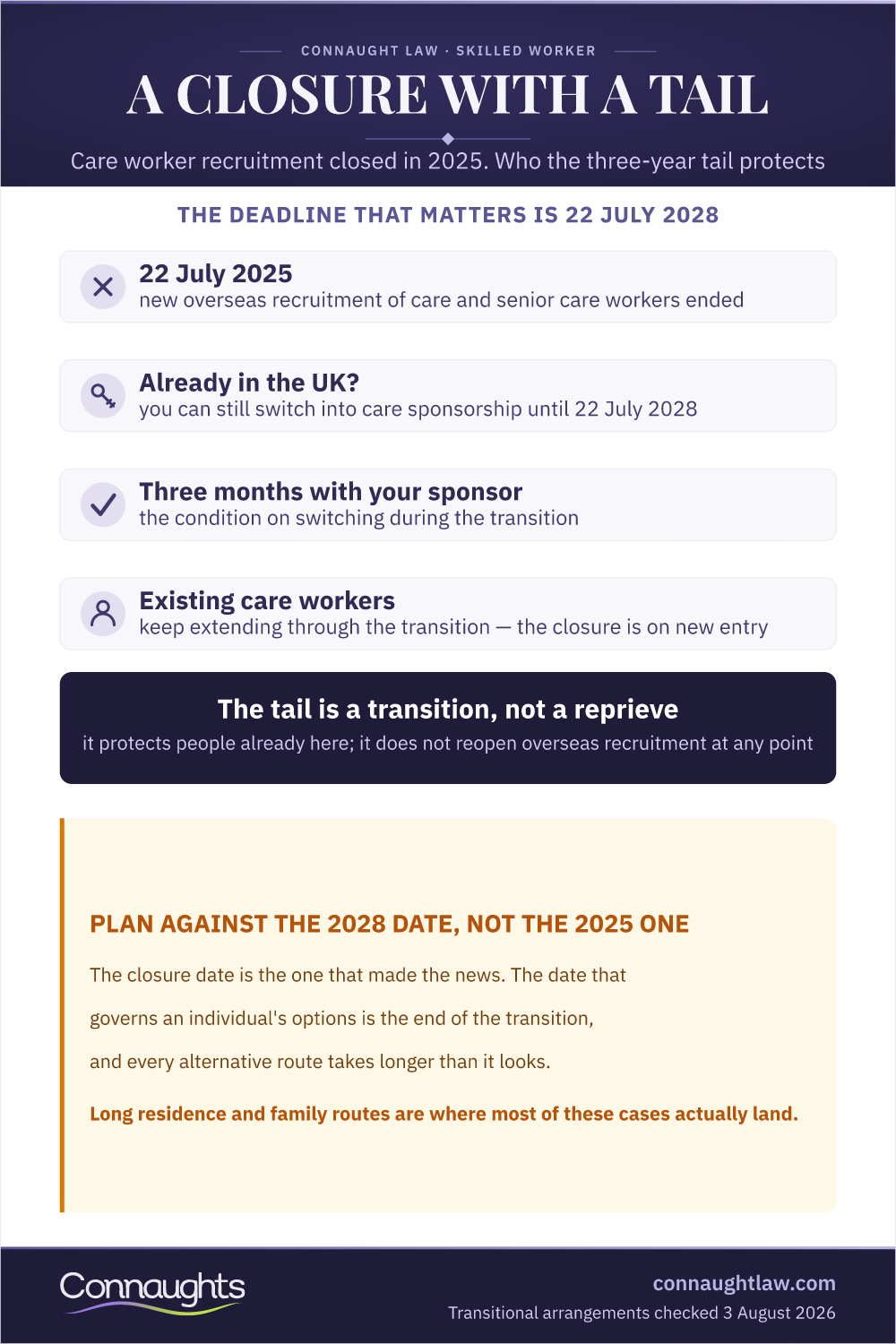
New overseas recruitment of care workers and senior care workers ended on 22 July 2025 — but the closure came with a three-year tail: workers already in the UK can still switch into care sponsorship until 22 July 2028, provided they have worked for their sponsor for at least three months, and existing care workers keep extending through the transition. This guide covers who is protected, what the deadlines mean, and the realistic routes beyond them.
On This Page

A Closure With a Three-Year Tail
The care worker closure is widely misreported as a slammed door. The rules — made by the July 2025 statement of changes — actually drew two lines: entry clearance from abroad ended at once, while the in-country population received a reviewable transition running to 22 July 2028. Which side of those lines a worker stands on determines everything in this guide, so start there.
Understanding the Closure
Scope and Implementation
From 22 July 2025, no new entry clearance applications for care workers (SOC 6135) or senior care workers (6136). Until 22 July 2028, people already lawfully in the UK on other routes can still switch into care sponsorship — if they have been legally employed by their sponsor for at least three months — and existing care workers keep extending. After the transition, the care codes leave the shortage lists entirely.
Affected Positions and Exemptions
The closure covers care workers and senior care workers — the roles that drove the 2022–23 recruitment boom — and sits within the wider tightening tracked in our White Paper system changes guide. It does not touch registered professions: nurses, midwives, allied health professionals and medical staff remain fully sponsorable on the Health and Care Worker visa, with its reduced fees and surcharge exemption intact. A care assistant and a registered nurse now live in different immigration systems.
Alternative Immigration Routes
Staying in Health Work
For care workers, the strongest long-term play is usually upward rather than sideways: qualifying into a registered profession that the system still wants. For everyone else the options are the standard ones — a degree-level role on the Skilled Worker route, a family route where the relationship is real, or the long-residence clock where the years are already banked.
Alternative Routes Compared
| Route | Core requirement | Settlement position |
|---|---|---|
| Skilled Worker (degree-level role) | Sponsorship, RQF6 occupation, qualifying salary | 5 years |
| Health and Care (registered profession) | Professional registration + sponsor | 5 years |
| Partner route | British or settled partner, £29,000 income requirement | 5 years |
| 10-year long residence | 10 years' continuous lawful residence | ILR directly |
| Care sponsorship until 22 July 2028 | In-country switch, 3 months with the sponsor | Counts towards 5 years while it lasts |
Where Sponsorship Still Works
Qualifying Healthcare Positions
Senior care management (SOC 1232) remains on the Immigration Salary List, and experienced care staff sometimes fit genuine team-leader or management roles that clear the skill bar properly. The word genuine carries weight: re-badging a care worker as a "manager" without management duties is the kind of certificate the Home Office now audits hardest, and it endangers the sponsor's licence along with the worker's status.
Professional Registration and Qualification Routes
The care-to-nursing pathway is the closure's constructive answer: nursing degrees and registered nursing associate routes convert care experience into a profession the route still serves. It is a multi-year plan that needs status maintained throughout — which is exactly what the 2028 transition window and extension rights are for.
Family Routes
Partner and Spouse Visa Routes
A worker with a British or settled partner can move to the partner route: £29,000 minimum income, genuine-relationship evidence, and a five-year path to settlement independent of any employer — costs and evidence are mapped in our spouse visa fees guide. It suits real couples and rescues nobody else; relationship evidence is tested precisely because closures like this create pressure to manufacture it.
Private Life and Exceptional Circumstances
Private life applications exist but are narrow for working-age adults — the rules are built around very long residence and cases where return would be genuinely untenable, not around employment loss. They belong in the conversation only after the sponsored, family and long-residence options are exhausted, and always on advice rather than hope.
Transition Arrangements for Existing Workers
Extension Rights and Planning
Existing care workers extend through the transition on the usual terms, and those continuously employed in care roles on the route since before 11 March 2024 keep their dependant rights. Every extension buys time that should be spent deliberately: each year of care sponsorship still counts towards the five-year settlement clock, so workers who reach five qualifying years before the music stops can settle outright — the arithmetic in our settlement guide decides who can.
Long Residence Options
Qualifying for the 10-Year Route
Ten years of continuous lawful residence — in any combination of visas — opens indefinite leave to remain without employer or family requirements, subject to absence limits, good character and the standard tests. Many care workers arrived after student years and are further along this clock than they realise; our 10-year ILR guide covers the continuity rules that make or break it.
Upgrading Your Qualifications
Professional Registration Pathways
Nursing associate programmes, degree apprenticeships and part-time nursing degrees all convert care experience into registrable status, and employers facing domestic recruitment pressure increasingly fund them. Timed well, a worker extends within the transition, qualifies before 2028, and re-enters sponsorship as a registered professional — the one path that ends stronger than it started.
Legal Challenges and Human Rights
Article 8 and Private Life
Article 8 protects family and private life; it does not guarantee a work visa. Where removal would separate established families or uproot children, human-rights arguments have force — but they are case-specific, evidence-heavy and slow, and they sit behind the rule-based routes in any sensible strategy. The honest advice is to treat human-rights litigation as the last resort it is, and to spend the transition years making it unnecessary.
Strategic Planning Timeline
Action Priority Framework
- Count your qualifying years now: anyone reaching five years of sponsored time before their leave ends should plan a settlement application, not a route change.
- Switchers need the 3-month employment condition and a certificate before 22 July 2028 — a hard deadline that recruitment timelines must respect.
- Qualification upgrades take years: nursing pathways started in 2026 finish inside the window; those started in 2028 do not.
- The transition is "kept under review" — plan against the published deadline, not against hoped-for extensions of it.
Questions about the care worker closure
Can care workers still come to the UK?
Not from abroad — entry clearance for care workers and senior care workers closed on 22 July 2025. People already lawfully in the UK can still switch into care sponsorship until 22 July 2028 if they have worked for their sponsor for at least three months.
What happens to care workers already on the route?
They keep extending through the transition and their time keeps counting towards five-year settlement. Those sponsored in care roles continuously since before 11 March 2024 also retain the right to bring dependants; later arrivals do not.
What is the 2028 deadline exactly?
22 July 2028 is when the in-country switching transition ends and the care codes leave the shortage lists, subject to government review. Certificates and applications need to be complete before it — recruitment started in mid-2028 will miss it.
Which health roles can still be sponsored from overseas?
Registered professions — nurses, midwives, doctors, allied health — on the Health and Care Worker visa, plus degree-level roles across the wider Skilled Worker route and listed positions such as senior care management. The closure is specific to the two care worker codes.
Does care worker time count towards settlement?
Yes — sponsored care work is Skilled Worker time for the five-year settlement calculation, and any lawful residence counts towards the 10-year long residence route. Counting those clocks accurately is the first step in any post-closure plan.
Should I make a human rights application instead?
Only as a last resort with advice. Article 8 arguments turn on established family and private life, not on employment, and they are slower and less certain than the rule-based routes — sponsorship, partner, long residence — that most workers can still reach.
Tell us your visa history, your role and your family position. We'll count your settlement clocks, test the routes that survive 2028, and build the plan while the transition still gives you choices.
Get Expert Advice