
The Graduate visa's reduction to 18 months is no longer a proposal — gov.uk now confirms two years for applications made on or before 31 December 2026 and 18 months for applications from 1 January 2027, with PhD holders keeping three years. That start date turns post-study planning into a timing exercise: which cohort you fall into, and how fast you convert unsponsored time into a Skilled Worker future. This guide is the playbook for both cohorts.
On This Page

The Two-Year Window Is Closing
The Graduate route buys time to work in the UK without a sponsor — and how much time now depends on a calendar date. Apply on or before 31 December 2026 and you hold two years; apply from 1 January 2027 and you hold 18 months; finish a doctorate and you hold three years either way. The route still starts no settlement clock, which is why every month of it should be spent building towards the visa that does.
What Changed and When
Policy Timeline: From Proposal to Rule
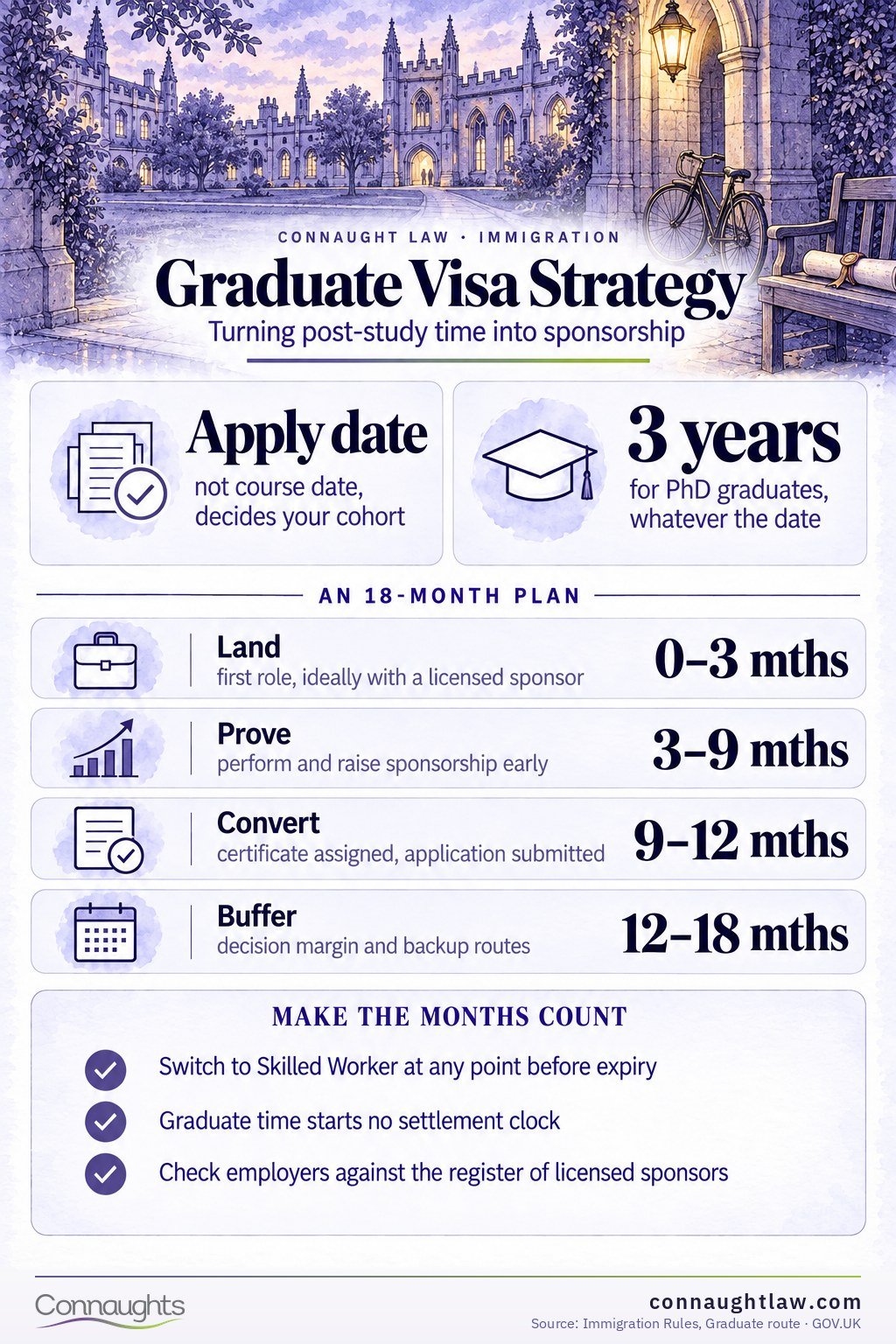
The reduction travelled from the 2025 White Paper into the Immigration Rules with a clean transition: the application date, not the course date, decides your cohort — one of several White Paper measures now in force, tracked in our system changes guide. A student finishing in autumn 2026 can still bank the full two years by applying before the new year — potentially the single most valuable deadline in their immigration life, worth six months of lawful work.
Impact on Career Planning
Eighteen months changes the arithmetic more than it first appears. After the job search consumes its opening months and the Skilled Worker application needs weeks at the far end, the true window for proving yourself to a sponsoring employer shrinks to roughly a year. The strategy sections below assume that compressed reality; holders of the two-year visa simply get more slack at each stage, not a different plan.
A Framework for the Shorter Runway
Pre-Graduation Planning
The Graduate visa is best treated as a bridge you design before stepping onto it. Final-year students who research licensed sponsors, target graduate schemes at sponsoring employers and line up applications before results day consistently convert faster — and some skip the bridge entirely by switching straight from the Student visa when an offer lands early.
Planning Phases and Milestones
| Phase | Months | The work of the phase |
|---|---|---|
| Land | 0–3 | Visa granted, first role secured — ideally with a licensed sponsor |
| Prove | 3–9 | Perform, raise sponsorship early, build the salary case |
| Convert | 9–12 | Certificate assigned, Skilled Worker application submitted |
| Buffer | 12–18 | Decision margin, backup routes if sponsorship falls through |
Building Employability Fast
Rapid Skill Development
Prioritise the skills that move a sponsorship decision: the technical stack the employer's job adverts actually name, and progress towards any professional qualification that grounds new entrant status. Certifications chosen at random pad a CV; qualifications tied to a regulated profession cut the required salary by thousands — the better investment every time.
Performance and Value Demonstration
Sponsorship is a business case made by your manager to someone who controls a budget. Feed that case deliberately: measurable output, client feedback, the things a licence-holding employer can put in writing. The conversation about sponsorship should happen in month three or four — raised by you, calmly, as a planning question rather than a plea.
The Switch That Matters Most
Securing Employer Sponsorship
Graduate visa holders can switch to the Skilled Worker route at any point before expiry, qualify as new entrants at a £33,400 floor and 70% of the going rate, and — unlike student switchers — their sponsor pays the immigration skills charge. Employers already licensed say yes far more readily than employers asked to obtain a licence for one hire, which is why the sponsor register belongs in your job-search filters from day one, as our switching guide explains.
Application Timing and Requirements
Work back from expiry: in-country applications typically decide within 8 weeks, so an 18-month holder wants the certificate assigned by month eleven and the application in by month twelve. The requirements are the standard ones — degree-level occupation code, qualifying salary, genuine role — mapped in our Skilled Worker hub with the money mechanics in our salary guide. Remember Graduate time burns the four-year new entrant cap while adding nothing to settlement.
Employer Engagement
Identifying Licensed Sponsors
The public register of licensed sponsors is the most underused job-search tool in the country: filter target employers against it before applying, and weight applications towards organisations with visible international hires. An employer new to sponsorship faces licence costs and the sponsorship system from scratch — possible, but slower than your runway likes.
Value Proposition Development
Frame sponsorship costs honestly and they shrink: the certificate and skills charge are a fraction of a recruitment agency's fee for the same role. Graduates who arrive at the conversation with the numbers — and with the new entrant discount that makes their salary requirement manageable — turn an awkward ask into a routine hiring decision.
Alternative Routes
Family Route Opportunities
Graduates with a British or settled partner may fit the partner route — the £29,000 minimum income requirement and evidential rules apply, with the costs mapped in our spouse visa fees guide. It is a genuine alternative for genuine couples and a dangerous improvisation for anyone else; the evidential bar on relationship genuineness is high and the refusal consequences long-lived.
Long Residence and Private Life
Student and Graduate years do count towards the 10-year long residence route — our 10-year ILR guide covers the continuity rules — but ten years is a marathon route, not a plan for an 18-month visa. Treat it as background context: a reason to avoid status gaps, never a reason to relax about sponsorship.
Networking and Professional Development
Professional Body Engagement
Membership of the profession's body does double duty: it signals seriousness to employers, and study towards its qualifications can ground new entrant status at the switch. Choose the body attached to your actual target occupation code rather than the most prestigious acronym available.
Digital Presence
Recruiters at sponsoring employers search for candidates who already understand the visa position. A profile that states your status plainly — Graduate visa, eligible to switch, new entrant salary discount applies — filters out the employers who would have wasted your time and shortens conversations with the ones who matter.
Financial Planning
Application Cost Planning
The Graduate visa costs £937 plus the £1,035-a-year health surcharge, all payable upfront for the full duration. The switch then costs the Skilled Worker fee — from £943 in-country for up to three years — plus the surcharge again for the new grant. Budget the full journey at the start; the pattern of scraping together each fee as it arrives is how people miss the timing that actually mattered.
Career Investment and Funding
Spend development money where it compounds: qualifications that unlock new entrant status, skills named in sponsors' job adverts, and — where the budget is tight — the travel costs of showing up where your industry actually gathers. The certification nobody asked for is the classic Graduate-visa false economy.
Timeline Checklist
Monthly Milestone Framework
- Months 0–3: role secured, sponsor register checked, sponsorship raised at interview stage.
- Months 3–9: perform, document value, get the sponsorship commitment in principle.
- Months 9–12: certificate assigned, Skilled Worker application submitted with 8-week processing margin.
- Months 12–18: decision buffer — and the window for alternatives if the sponsorship fell through.
Action Priority Matrix
When time runs short, priority follows immigration consequence: anything affecting the switch application outranks anything affecting career polish. A certificate of sponsorship in hand beats a better job title; an application submitted beats both. Two-year and PhD holders can afford more refinement — the ordering never changes, only the slack.
Frequently askedQuestions about the 18-month Graduate visa
When does the 18-month Graduate visa take effect?
For applications made on or after 1 January 2027, per gov.uk. Applications made on or before 31 December 2026 still receive two years, and PhD or doctoral graduates receive three years regardless of application date.
Can I still get the two-year version?
Yes — by applying on or before 31 December 2026. The application date controls, not your course dates, so anyone completing an eligible course in late 2026 should weigh applying before the new year rather than waiting.
When should I apply to switch to a Skilled Worker visa?
On an 18-month visa, aim for the certificate by month eleven and the application by month twelve, leaving the typical 8-week processing comfortably inside your leave. You can switch at any point before expiry — earlier starts the settlement clock sooner.
Does Graduate visa time count towards settlement?
Not towards the five-year Skilled Worker route — though it does count within the 10-year long residence calculation. It also consumes the four-year cap shared with new entrant status, which is the hidden cost of lingering on the route.
What does the route cost end to end?
£937 for the Graduate visa plus £1,035 per year in health surcharge, then the in-country Skilled Worker fee — from £943 — and the surcharge again on switching. Families multiply each figure per dependant, so budget the whole journey at the outset.
What if I cannot find a sponsor in time?
Assess the genuine alternatives early rather than at month seventeen: the partner route where a real relationship qualifies, other work routes matching your profile, or further study restoring student status. Overstaying converts a planning problem into a legal one.
Tell us your visa grant date, your role and whether your employer holds a licence. We'll map your cohort's timeline, the switch requirements and the fallbacks — before the calendar makes the choices for you.
Get Expert Advice