
RQF Level 6 is the degree-level skill bar that Skilled Worker jobs have had to clear since 22 July 2025 — and the most misunderstood rule in the system. It measures the job, not the applicant: you do not need a degree to be sponsored, but your occupation code must sit at Level 6 unless it survives on a shortage list. This guide explains what the level means, which occupations qualify and where the exceptions run.
On This Page

Degree-Level Jobs, Not Degree-Holding Applicants
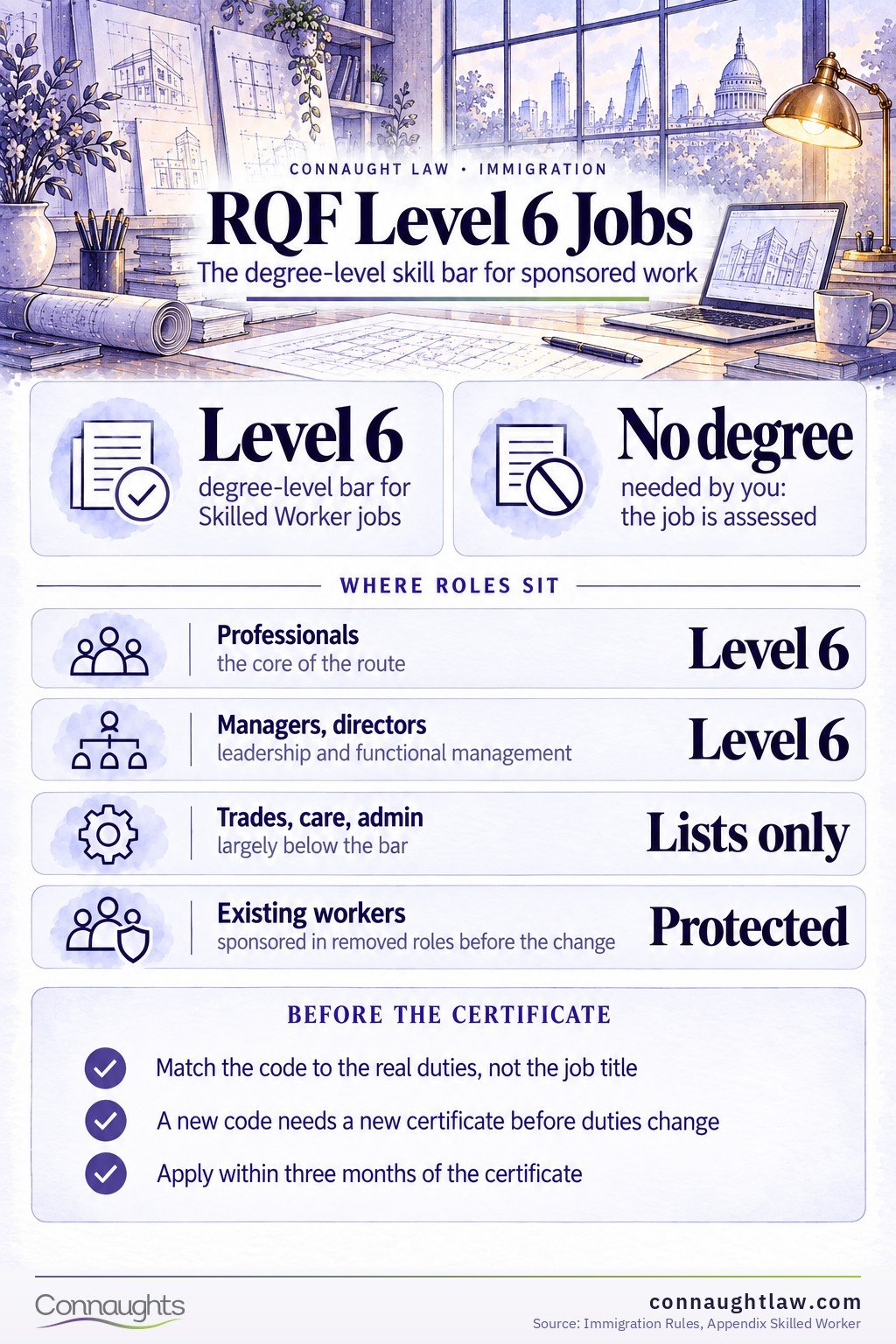
The single most important thing to know about RQF Level 6 is what it does not require: a degree certificate from you. The Home Office assesses the skill level of the occupation code on the certificate of sponsorship, not the qualifications of the person filling it. A self-taught software engineer is sponsorable in a Level 6 role; a PhD holder in a below-Level-6 role is not, unless the role sits on a shortage list. Everything else in this guide flows from that distinction.
What RQF Level 6 Means
The Framework and the Common Misreading
The Regulated Qualifications Framework grades qualifications from entry level to 8, with Level 6 corresponding to a bachelor's degree. Appendix Skilled Worker borrows that scale to classify jobs: each SOC occupation code is deemed to sit at a level, fixed in the rules themselves. The misreading — repeated all over the internet — is that applicants must evidence a Level 6 qualification. They must not; no qualification evidence is submitted for the skill-level points at all.
What It Changed in Practice
The July 2025 statement of changes lifted the bar from RQF Level 3, where it had sat since 2020, back to Level 6 — stripping a long list of mid-skill occupations out of the route for new applicants.
- Mid-skill roles on the Immigration Salary List or the interim Temporary Shortage List remain sponsorable below Level 6.
- Workers already sponsored in removed occupations before 22 July 2025 keep extending and changing employer within them.
- Roles that fit no list sometimes fit a Temporary Work route instead — a different system with no skill-level bar and no settlement path.
Which Occupations Qualify
Major Occupation Groups
Occupation Groups at Level 6
| SOC major group | Character | Typical sponsored roles |
|---|---|---|
| 1 — Managers and directors | Leadership and functional management | IT managers, finance directors, operations managers |
| 2 — Professional occupations | The core of the route | Software engineers, doctors, solicitors, teachers, accountants |
| 3 — Associate professional | Level 6 codes only in part | Selected technical, analyst and specialist roles |
| 4–6 — Administrative, trades, care | Largely below Level 6 | Sponsorable only via the shortage lists or transitional cover |
The controlling document is the eligible occupations list read with the going-rates tables — check the actual four-digit code, because neighbouring codes split across the line: in construction, bricklayers and carpenters qualify through listing while general labourers are excluded entirely.
Technology and Digital Roles
The Sponsored Tech Occupations
Software development, data science, cybersecurity, cloud and infrastructure engineering all sit comfortably at Level 6 and dominate private-sector sponsorship. The codes matter commercially as well as legally: code 2134 carries a £54,700 going rate, so a sponsor's choice between neighbouring tech codes changes the minimum salary by five figures — the mechanics live in our salary requirements guide.
Progression Inside the Route
Because the assessment is of the role, promotions within the same code need no new application, while a move into a different code — developer into management, say — needs a new certificate before the duties change. Tech workers planning towards settlement should treat code changes as immigration events, not just career ones.
Healthcare Professionals
Clinical Roles at Level 6
Doctors, nurses, midwives and most allied health professions sit at Level 6 and are sponsored through the Health and Care Worker visa — the Skilled Worker variant with reduced fees, covered in our Health and Care Worker guide. The major exclusion since July 2025 is new overseas recruitment of care workers and senior care workers, whose codes fell below the line.
Professional Registration First
Clinical sponsorship runs through the regulators — GMC for doctors, NMC for nurses and midwives, HCPC for allied professions — and registration sequencing drives the timeline. The registration is the profession's requirement, not the visa's skill-level evidence; the two systems interlock but never merge.
Engineering and Technical Roles
Core Engineering Disciplines
Civil, mechanical, electrical and chemical engineering codes all sit at Level 6 with going rates around the £50,000 mark — civil engineers under code 2121 carry £50,400. Engineering's persistent UK shortage keeps sponsor demand high, and several engineering codes carry Immigration Salary List listings that reduce the flat threshold for employers.
Chartered Status and Development
Chartered or incorporated status with the engineering institutions is never a visa requirement, but working towards professional registration can qualify a worker as a new entrant — a 70% going-rate discount worth thousands a year during training. That interaction between professional development and salary compliance is routinely missed at offer stage.
Finance, Business and Professional Services
Where the Roles Sit
Accountancy, actuarial work, management consultancy, legal practice and most analyst roles sit at Level 6, concentrated in London's professional services market. The trap in this sector is title inflation: "analyst" and "consultant" titles spread across codes at different levels, and the duties on the certificate — not the business card — decide which code is defensible, just as the genuine vacancy requirement tests whether the role itself is real.
Finance Professional Qualifications
ACCA, ACA, CFA and equivalent tracks matter twice over: study towards a regulated profession can ground new entrant status, and completed qualifications strengthen the genuineness of senior appointments. Neither substitutes for the occupation code sitting at the right level in the first place.
Salary Rules at Level 6
Occupation-Specific Requirements
Clearing the skill bar is only half the test — the salary must reach £41,700 or the code's going rate, whichever is higher, with discounted floors for new entrants, PhD holders and listed occupations. Every figure and worked example lives in our salary guide; the point here is simply that skill level and salary are separate hurdles, each capable of sinking an application alone.
Salary Ranges by Sector
We deliberately publish no market salary ranges: they date within months and none of them binds a caseworker. The numbers that decide applications are the published going rates for the specific code and the flat thresholds — check those, at today's figures, rather than any sector table on any website, this one included.
When Qualifications Do Matter
Professional Body Recognition
Overseas qualifications enter the picture where a regulated profession requires registration, or where English is proved by a degree — assessed through Ecctis (formerly UK NARIC) statements of comparability. For everyone else, qualification recognition is a career asset rather than a visa requirement, and money spent on unnecessary equivalency certificates is money wasted.
Additional Study Options
Skilled Worker holders can study alongside work, and study towards chartered or regulated status carries the new entrant interaction above. Students planning the other direction — study first, sponsorship second — should read our Graduate route strategy guide before choosing course dates, because the sponsorship clock and the academic calendar rarely align by accident.
Finding the Sponsor
Identifying Licensed Sponsors
Only licensed sponsors can assign certificates, and the register of licensed sponsors is public — filter it before investing in applications, prioritising employers with visible international hiring. Sponsors also budget beyond salary: the immigration skills charge and certificate fees sit with the employer, and employers who know that are faster to commit — the cost side is mapped in our employers' guide.
From Offer to Application
Once an offer lands, the sequence is fixed: code confirmed against duties, salary checked on both legs, certificate assigned, application within three months. The wider system context — what the 2025 White Paper has implemented and what is still coming — is worth a read before long-term planning, and our business immigration team handles the sequencing for both sides of the sponsorship.
Frequently askedQuestions about RQF Level 6 and sponsorship
Do I need a degree for a Skilled Worker visa?
No. RQF Level 6 describes the job's skill level, fixed by its occupation code in the Immigration Rules — no qualification evidence is required for the skill-level points. Degrees matter only for regulated professions, English-language exemptions or PhD salary discounts.
What does RQF Level 6 actually mean?
It is the Regulated Qualifications Framework level equivalent to a bachelor's degree. Since 22 July 2025 a Skilled Worker job must sit at this level unless the occupation appears on the Immigration Salary List or Temporary Shortage List, or transitional protection applies.
Is there a list of RQF Level 6 jobs?
Yes — the eligible occupations tables in Appendix Skilled Worker, read with the going-rates publication, define exactly which four-digit SOC codes qualify. Check the code against the actual duties of the role; the job title itself proves nothing.
What happened to jobs below Level 6?
They left the route for new applicants in July 2025 unless listed on the Immigration Salary List or the Temporary Shortage List. Workers already sponsored in those roles before the change keep extending and moving employer within them under transitional cover.
Which sectors sponsor most at this level?
Technology, healthcare, engineering and professional services dominate — all fields whose core occupations sit naturally at degree level. Healthcare runs through the Health and Care Worker variant with reduced fees and its own exclusions for care worker codes.
Does a foreign degree need UK recognition?
Only where something specific turns on it: registration with a professional regulator, an English-language exemption, or a PhD salary discount — assessed via Ecctis. For the skill-level requirement itself, no recognition exercise is needed at all.
Tell us the job title, the actual duties and the salary on offer. We'll confirm the defensible occupation code, whether it clears the skill bar or needs a list, and what the certificate must say.
Get Expert Advice