
Fifteen months after the white paper, the useful question is no longer what it proposed but what has actually become law — and whether it reaches you. Some measures are in force. One is laid but does not bite until 2027. The headline settlement change is still only a closed consultation. And whether you are protected turns on a handful of transitional provisions that most summaries never mention.
On This Page

Proposal, Rule and the Gap Between
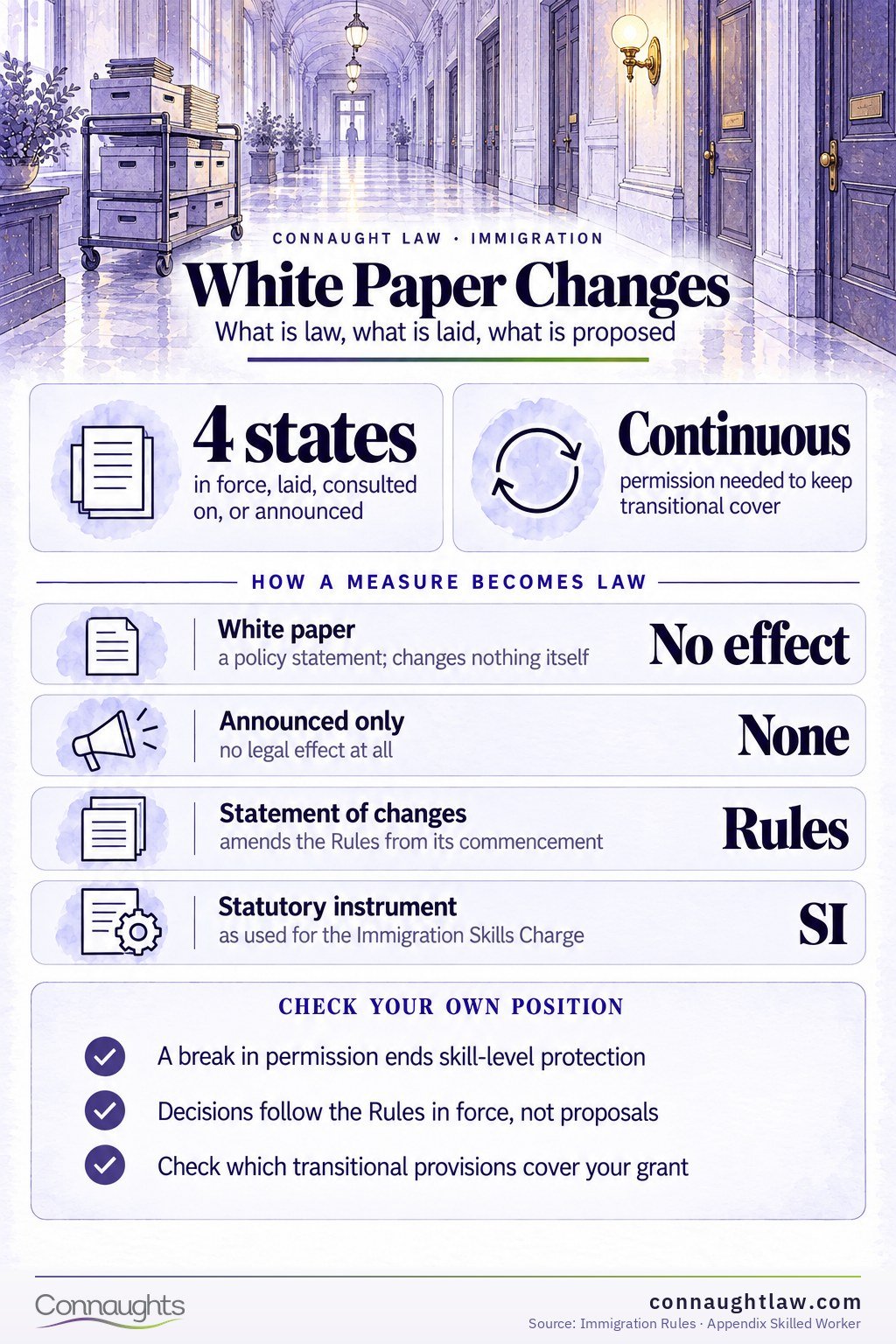
Partly. A white paper is a policy statement and changes nothing by itself. Measures reach you only through a statement of changes to the Immigration Rules or a statutory instrument, each with its own commencement date. Several have now done so. The most-discussed measure — a ten-year qualifying period for settlement — has not: it remains a closed consultation with no government response and nothing in the Rules.
Restoring Control over the Immigration System was published on 12 May 2025. Since then the useful distinction has not been between old rules and new, but between four different states: in force, laid but not yet commenced, consulted on, and merely announced. A measure in the fourth category has no legal effect at all, and a good deal of published commentary still treats all four as though they were the same thing.
This page sorts them, and then answers the question that follows from it. If a change is in force, does it apply to you — someone who already holds permission, or who applied before the change — or only to people entering the system afterwards? That is a question about transitional provisions, and the answer is different for almost every measure.
What Is In Force Today
Three statements of changes have carried white paper measures into the Rules: HC 997 of 1 July 2025, HC 1333 of 14 October 2025, and HC 1691 of 5 March 2026. The Immigration Skills Charge moved separately, by statutory instrument. Nothing laid in 2026 touches settlement qualifying periods.
Commencement at a Glance
| Measure | Status | Date |
|---|---|---|
| Skilled Worker skill threshold raised to RQF 6 | In force | 22 July 2025 |
| Care worker route closed to overseas recruitment | In force | 22 July 2025 |
| Immigration Skills Charge increase | In force | 16 December 2025 |
| B2 English for Skilled Worker, HPI and Scale-up | In force | 8 January 2026 |
| Graduate route reduced to 18 months | Laid, not yet in effect | 1 January 2027 |
| B2 English at settlement | Laid, not yet in effect | 26 March 2027 |
| Ten-year qualifying period for settlement | Consultation closed, no response | No date set |
| English requirement for adult dependants | Announced only, not implemented | No date set |
Announced Is Not Enacted
Two of the eight rows above carry no legal weight today, and both are widely reported as though they do. The dependants' English requirement was proposed in the white paper and has not been implemented. The ten-year settlement period was put out to consultation, not laid before Parliament. Planning around either as though it were settled law is how people make decisions they cannot reverse.
Skilled Worker: Skill Level and Salary
The Skilled Worker route took the largest share of the reform, and it is also where the transitional position is most generous — and most easily lost.
The RQF 6 Threshold
From 22 July 2025, sponsored roles must sit at RQF level 6 — graduate level — and roughly 180 occupations left the eligible list. Salary requirements moved in the same statement of changes: the general threshold under Option A is now £41,700 a year, and the applicant must also meet the going rate for the occupation code. The two tests are cumulative, and the higher of them governs.
Transitional Protection, and Its Two Conditions
Existing sponsored workers are not swept up by the skill threshold. Appendix Skilled Worker preserves access to the earlier occupation tables where the applicant "was granted permission as a Skilled Worker under the rules in force before 22 July 2025, and they have had continuous permission as a Skilled Worker since then". Those workers can extend, change employer and take supplementary employment in roles below RQF 6.
Two things must both be true: the original grant was under the pre-22 July 2025 rules, and permission has been continuous since. A gap — a late extension, a period on a different route, a refusal followed by a fresh application — breaks the second limb and the protection does not come back. The Home Office has also stated that these arrangements will not remain in place indefinitely and will be reviewed in due course.
Salary is the exception. The uplift applies without transitional relief, so an existing sponsored worker meets the current going rate on extension even where the skill-level protection continues. It is a common and expensive misreading to assume the two travel together.
What the Skills Charge Now Costs
The Immigration Skills Charge rose by statutory instrument rather than by a change to the Rules. The Immigration Skills Charge (Amendment) Regulations 2025 were made on 15 December 2025 and came into force the following day, substituting a new table of amounts.
Charge Rates by Sponsor Size
| Employment period | Small or charitable sponsor | Medium or large sponsor |
|---|---|---|
| 12 months or less | £480 | £1,320 |
| Each further 6 months | £240 | £660 |
Why the Assignment Date Matters
The amending regulations contain no saving provision for certificates of sponsorship assigned before 16 December 2025. For a five-year assignment by a medium or large sponsor the charge is £6,600, against £2,400 for a small or charitable one — a difference that decides whether a role is viable before any salary question arises.
Care Workers and the 2028 Cut-Off
Overseas recruitment into care worker and senior care worker occupations closed on 22 July 2025. What survives is an in-country route, and it has a hard end date.
Who Can Still Switch In-Country
Appendix Skilled Worker allows switching into these occupations from within the UK provided the date of application is before 22 July 2028, and provided the worker has been lawfully working for the sponsoring provider for at least three months ending when the certificate of sponsorship was issued. Those already holding permission in these occupations remain able to extend under the transitional pathway.
For providers, the three-month condition is the operative planning point: it means a worker cannot be recruited and sponsored in the same step, and the clock has to start well before the 2028 date rather than at it.
The Graduate Route Reduction
The Graduate route falls from two years to eighteen months. It has not happened yet, and the trigger is not the date you graduate or the date permission is granted.
Why the Application Date Governs
The statement of changes is explicit: "The change to 18 months will apply to applications submitted on or after 1 January 2027, with PhD graduates continuing to receive three years of leave."
Anyone who applies on the Graduate route before 1 January 2027 receives the current two years, and keeps it. Anyone applying on or after that date receives eighteen months. For a student finishing in late 2026 the decision is simply when to submit, and it is worth half a year of work rights. PhD graduates are unaffected either way.
The same statement of changes raised English to B2 for Skilled Worker, High Potential Individual and Scale-up applications from 8 January 2026, with a transitional protection worth knowing: those who already hold permission granted on a B1 requirement continue to be assessed at B1 when they extend on the same route.
Settlement: A Consultation, Not a Rule
This is the change people most want an answer on, and the honest answer is that there is not one yet. The earned settlement consultation ran from 20 November 2025 to 12 February 2026. The page remains marked as a closed consultation with feedback under analysis, and no government response has been published as at today.
The Proposed Qualifying Periods
The consultation proposed moving the baseline qualifying period for settlement to ten years, with reductions for higher earners and for specified public service roles, and longer periods for some groups. None of it is in the Immigration Rules. Neither statement of changes laid in 2026 contains earned settlement provisions.
The consultation document said that people due to reach settlement in the coming months and years would be subject to the new requirements once the Rules changed. It also said the government "will not, and would never, take away settled status from those who have already been granted it". So: status already granted is safe; a qualifying period still running is not guaranteed. Until rules are laid, nobody can tell you which side of that line you will fall on.
What follows practically is a question of timing rather than of law. If you are close to meeting the current qualifying period, the value of applying as soon as you are eligible is higher than it would otherwise be — not because a change is certain, but because an application decided under today's Rules is decided under today's Rules.
What Changed for Employers
The employer-facing consequences did not all arrive through the Immigration Rules. The largest of them came through primary legislation and takes effect on 1 October 2026, when the prohibition on illegal working extends beyond employees to workers engaged under a worker's contract, individual sub-contractors and online matching services.
Right to Work and the October Extension
For businesses that engage people outside a contract of employment — agency labour, self-employed contractors, platform-sourced work — this is a larger operational change than anything in the Rules, because it reaches a population most employers have never checked. Penalties for the new categories apply only where the engagement began on or after commencement, which makes the intervening weeks the cheap moment to fix onboarding.
Where to Look Next
Our guide to immigration compliance for employers sets out the duties, the penalty levels and the sponsor position in full, and our note on what the white paper means for employers covers the workforce planning consequences. For the care sector specifically, see our analysis of the care worker route closure and the 2028 transition, and for students, the Graduate route timing strategy.
Common questionsFrequently asked questions
When will the immigration white paper be implemented?
In stages, and several stages are already complete. Skill level, care worker closure, the skills charge and B2 English are in force. The Graduate reduction applies from 1 January 2027. The settlement proposal has no date at all.
Will the changes apply retrospectively to people already in the UK?
It depends on the measure. The skill threshold has transitional protection for existing Skilled Workers with continuous permission. Salary uplifts do not. For settlement, no rule exists yet, so no transitional position has been set.
Is the ten-year settlement period now law?
No. It was a consultation proposal. The consultation closed on 12 February 2026, no government response has been published, and nothing on qualifying periods has been laid before Parliament since.
Can my indefinite leave to remain be taken away by these reforms?
The consultation stated that settled status already granted would not be removed. Settlement already held is therefore not the issue; a qualifying period still running is where the uncertainty sits.
My job is below degree level. Can I still extend my Skilled Worker visa?
Yes, if you were granted permission under the rules in force before 22 July 2025 and have held continuous Skilled Worker permission since. You must still meet the current salary requirements on extension.
Should I apply on the Graduate route before January 2027?
If you are eligible and ready, yes. Applications submitted before 1 January 2027 receive two years; those submitted on or after it receive eighteen months. PhD graduates receive three years regardless.
Tell us when your permission was granted, on which route, and whether it has run without a break. We'll tell you which transitional provisions you fall under and what that means for your next application.
Get Expert Advice