
The student visa changes running through 2025 and 2026 land on two audiences at once: students face a shorter Graduate route, tighter financial checks and stricter genuineness testing, while universities face harder compliance thresholds, mandatory action plans and public ratings — with a levy on international fees still on the table. This guide maps what is in force, what is coming, and what each side should do about it.
On This Page

One Reform Wave, Two Audiences
The 2025 White Paper treated international education as an immigration control problem, and the measures that followed reflect it: some already sit in the Student rules and sponsor guidance, others are still being built. Reading the wave measure by measure — in force, confirmed, or proposed — is the difference between planning and panic, for applicants and institutions alike.
The New Rules for International Students
For students, three changes carry the weight. The Graduate route's reduction is confirmed law: applications made on or before 31 December 2026 receive two years, applications from 1 January 2027 receive 18 months, with PhDs keeping three. Financial evidence is checked harder, with verification of funds and their provenance tightened. And the genuine student assessment has sharpened — the credibility interview, covered in our interview guide, is doing more of the gatekeeping than it has for years.
Implementation Timeline
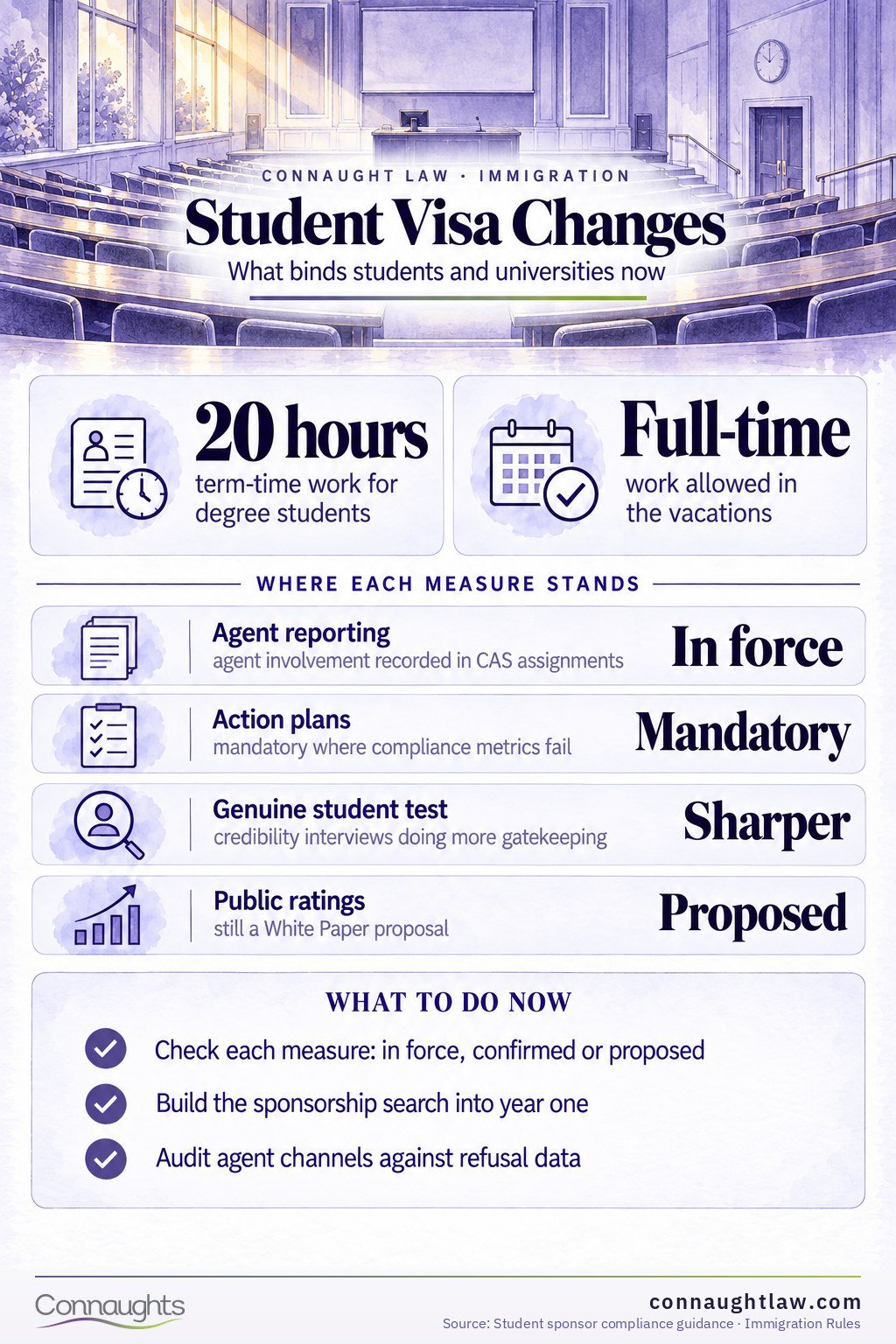
Agent reporting in CAS assignments has applied since 22 May 2025. The Graduate route's 18-month duration applies to applications made from 1 January 2027. The tightened compliance thresholds are in force for assessments from 1 June 2026, with the completion threshold following on 1 June 2027. Public ratings remain a White Paper proposal. The international student levy has moved past proposal: draft legislation was published on 13 July 2026. Check status before relying on any of it — this list has moved twice in a year.
University Fees and the Visa Changes
The commercial backdrop is blunt: international fees fund the sector, and every measure that trims demand — a shorter post-study runway, harder vetting, a possible levy — lands on institutional budgets. Universities are repricing, diversifying recruitment markets and competing harder on employability, while students are reading the same signals and asking sharper questions about what a UK degree buys. Neither side benefits from pretending the changes are cosmetic.
New Compliance Standards
How the Standards Tighten
Sponsor institutions are measured annually through the basic compliance assessment, and the tightening is no longer prospective. Assessments applied for on or after 1 June 2026 already run on the harder numbers — enrolment at least 95% and a visa refusal rate under 5%. The course completion threshold stays at 85% until 1 June 2027, when it rises to 90%. An institution that comfortably cleared the old bars can fail the new ones on the same performance — which is precisely the point of the change.
BCA Compliance Thresholds
| Metric | Before 1 June 2026 | BCAs from 1 June 2026 | BCAs from 1 June 2027 |
|---|---|---|---|
| Enrolment rate | 90% | 95% | 95% |
| Course completion | 85% | 85% | 90% |
| Visa refusal rate | under 10% | under 5% | under 5% |
| Agent reporting | Not required | Agent involvement recorded in CAS assignments since 22 May 2025 | |
University Action Plans
Components of an Action Plan
Institutions falling short face mandatory improvement action plans: a diagnosis of where the metrics failed, recruitment-quality controls, retention and completion interventions, and reporting upgrades — with recruitment restrictions and ultimately sponsor licence action behind them. A credible plan reads like management, not contrition: named owners, dated milestones, and evidence the recruitment funnel has actually changed.
Action Plan Timeline and Milestones
Plans run against the compliance calendar, which means the work starts before the plan is demanded: institutions tracking their own metrics quarterly see the breach coming and fix the pipeline a cycle early. The ones that discover their refusal rate from the Home Office letter have already lost the easy options.
Public Ratings and Accountability
Rating Criteria and Thresholds
The White Paper's red-amber-green rating proposal would make compliance performance public — visible to applicants, parents, agents and competitors. Whatever final form it takes, the direction is fixed: compliance stops being a private conversation with the Home Office and becomes a market signal. Institutions should assume their metrics will one day be marketing material, theirs or a rival's.
Work Rights and the Graduate Route
Impact on Recruitment and Choice
Term-time work rules for students are unchanged — the movement is post-study. The Graduate route at 18 months, mapped in our strategy guide, still works, but with less slack: the realistic sequence is job search from day one and a switch into sponsored work by month twelve. Students choosing courses for late 2026 completion hold a genuine timing decision, since applying by 31 December 2026 banks the two-year version.
Responses to the Work-Rights Changes
The rational responses are already visible: students weighting courses by employability and sponsor-rich sectors, universities building employer pipelines into recruitment pitches, and both sides treating the Graduate route as a planned bridge rather than a default gap year. The route rewards the organised more than it ever did.
Financial Implications and the Levy
Student Financial Planning
The international student levy is now in draft legislation, published 13 July 2026 as part of the Finance Bill: £925 for each international student, charged on the registered higher education provider, for the academic year beginning 1 August 2028 and after. It is a per-head charge on providers, not the percentage of tuition income floated during the White Paper debate. Students should budget against the current verified figures: maintenance of £1,529 a month in London or £1,171 outside for up to nine months, held 28 days, plus first-year fees per the CAS — and assume costs drift up, not down, across a multi-year course.
Recruitment Agent Oversight
Agent Management and Due Diligence
Since 22 May 2025, sponsors record agent involvement in CAS assignments, wiring agent performance into the compliance data. For institutions the consequence is direct: an agent channel with poor conversion or high refusals is now a measurable threat to the licence, and agent contracts, monitoring and exit triggers belong in the compliance framework, not the marketing department. For students, the safe rule is unchanged — an agent who suggests embellishing anything is a liability wearing a lanyard.
Strategic Implementation Guidance
Immediate Action Requirements
- Students: check which Graduate-route cohort your course timeline lands in, and build the sponsorship search into year one, not the final term.
- Applicants: prepare financial evidence to the tightened standard — clean provenance, the 28-day rule, figures matching the CAS.
- Universities: run the new thresholds against last cycle's numbers now, and audit agent channels against refusal data.
- Both: track measure status — in force, confirmed, proposed — before acting on any single headline.
Long-Term Strategic Positioning
The durable read is that the UK is repricing international education around compliance and employability, and the winners on both sides will be those who treat immigration planning as part of the core decision — course choice, recruitment strategy, budgets — rather than an afterthought. Our business immigration team advises institutions on the sponsor-side framework, and where an application has already been refused, our refusal team and administrative review specialists pick up the student side.
Frequently askedQuestions about the student visa changes
What are the new rules for international students?
The confirmed core: a Graduate route of 18 months for applications from 1 January 2027 (two years if you apply by 31 December 2026), tighter financial verification, sharper genuine-student assessment, and agent reporting in CAS assignments since May 2025. Public ratings remain at the proposal stage; the levy is drafted and dated but does not bite until August 2028.
When do the changes take effect?
In stages. Agent reporting has applied since 22 May 2025; the Graduate route change bites for applications from 1 January 2027; the tightened compliance thresholds are phasing through sponsor guidance; the levy is in draft legislation for the 2028-29 academic year. Each measure has its own date, which is why status-checking matters.
What must universities prepare for?
Harder compliance arithmetic — 95% enrolment and refusals under 5% since 1 June 2026, completion rising to 90% in June 2027 — plus mandatory action plans where metrics fail, agent-channel accountability, and the prospect of publicly visible ratings. The preparation is data: institutions should run the new thresholds against their own numbers before the Home Office does.
Do the changes affect work rights during study?
Term-time work rules are unchanged — 20 hours in term for degree students, full-time in vacations. The movement is after study: a shorter Graduate route making early sponsorship planning the difference between a smooth transition and a scramble.
How do university action plans work?
An institution missing compliance thresholds must agree an improvement plan with the Home Office — diagnosis, recruitment controls, retention measures, milestones — with recruitment limits and licence action as the escalation path. Strong plans are early, specific and evidenced; weak ones are apologies with dates.
Will the public rating system affect where students apply?
That is its purpose — compliance performance visible to applicants, parents and agents will steer choices the way league tables already do. Institutions with strong metrics gain a recruitment asset; weak ones acquire a public liability that no prospectus can offset.
Tell us where you stand — applicant choosing a course, student timing a Graduate application, or institution watching its metrics. We'll tell you which measures bind you today and which decisions the calendar makes for you.
Get Expert Advice