
The post study work visa — the PSW, officially the Graduate route since 2021 — lets international graduates stay and work in the UK without a sponsor: £937, no job offer needed, no salary rules, no maintenance requirement. The 2026 question is duration: apply on or before 31 December 2026 and you receive two years; apply from 1 January 2027 and it is 18 months, with PhDs keeping three years. This guide covers the route in full.
On This Page

The PSW Visa by Its Modern Name
Searchers still call it the post study work visa or PSW; the Immigration Rules call it the Graduate route. Either way it is the same offer: finish an eligible UK qualification, and stay to work — any job, any employer, or none — without sponsorship. It is unsponsored freedom with a hard expiry date and no settlement clock, which makes it a bridge to plan across rather than a destination.
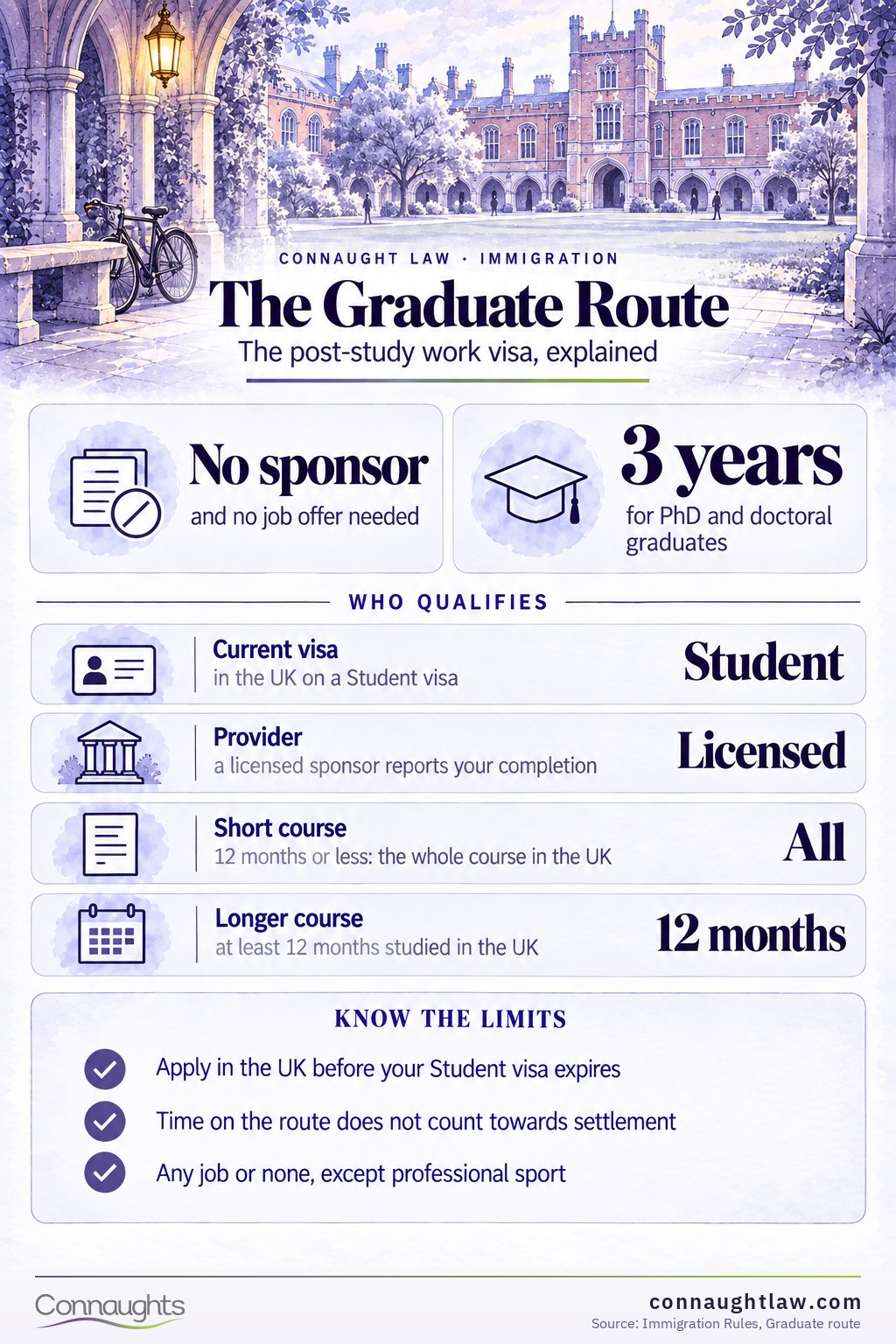
Post Study Work Visa Requirements
Points and the Successful-Completion Test
Eligibility turns on three facts: you are in the UK on a Student visa; your education provider is a licensed sponsor with a track record of compliance; and the provider has reported your successful course completion to the Home Office. There is no English test (the degree proved it), no maintenance requirement, and no job to evidence — the route's paperwork is genuinely light.
Qualifying Institutions and Courses
The qualification must be a UK bachelor's degree, postgraduate degree, or other qualifying award, from a provider on the register of licensed student sponsors with the required compliance status. Most universities qualify; the caution zone is private colleges, where checking the provider's position before enrolment protects the post-study plan two years early.
UK Study Duration Requirements
You must have studied in the UK for a minimum period: the full course where it lasted 12 months or less, or at least 12 months of it for longer courses — the rule that decides how much distance learning or overseas study a Graduate application survives. Study abroad terms within approved programmes are accommodated; degrees completed substantially from abroad are not.
Study Duration Rules
| Course length | UK study required | Grant on approval |
|---|---|---|
| 12 months or less | The whole course in the UK | 2 years now; 18 months for applications from 1 Jan 2027; 3 years for PhDs |
| More than 12 months | At least 12 months in the UK | Same durations |
Applying: Timing and Documents
Application Timing and Deadlines
Apply online from inside the UK, after your provider has reported successful completion and before your Student visa expires — the window that catches people whose visas end shortly after results day. You do not need to wait for graduation ceremonies or certificates; the provider's report is the trigger. Miss the Student visa expiry and the route is gone, because there is no applying for it from abroad.
Required Documentation Checklist
- Passport and your BRP or digital immigration status.
- The CAS reference from your Student visa application — the system links your study record through it.
- Confirmation your provider has reported completion (their letter helps, though the report itself is what counts).
- Dependants' documents where a partner or child already in the UK on your Student visa is extending alongside.
Application Fees and Processing
The fee is £937 plus the £1,035-a-year immigration health surcharge, paid upfront for the whole grant, with in-country decisions typically inside 8 weeks. You can stay and work on your existing conditions while the application is pending, and the usual rule applies: do not leave the Common Travel Area until it is decided.
Work Rights and Conditions
Employment Flexibility and Restrictions
The route's defining freedom: work at any skill level, for any employer, switch jobs at will, or take none — no sponsorship, no salary floor, no reporting. The exception is professional sport. That flexibility is what makes the route valuable for careers that start in roles the Skilled Worker system would not sponsor, from paralegal stints to startup first hires.
Self-Employment and Business Activities
Self-employment and founding a business are permitted — a genuine difference from the Student visa that preceded it and from most sponsored routes. Graduates building ventures should still plan the endgame early: the route ends on schedule regardless of how the business is doing, and switching into the Innovator Founder or Skilled Worker route takes months of preparation.
Public Funds and Study Restrictions
No access to public funds, and study is limited — courses that would qualify for a Student visa belong on a Student visa. The route is for working, and using it as a cut-price study visa is a condition breach with the usual long memory.
The 18-Month Change: Now Confirmed
Policy Rationale and Timeline
What the White Paper proposed, the rules have now fixed: applications made on or before 31 December 2026 receive two years; applications from 1 January 2027 receive 18 months; doctoral graduates keep three years either way. The application date controls — not the course dates — which hands late-2026 completers a genuine decision about when to apply, tracked with the rest of the reforms in our White Paper status guide.
Impact on Career Planning
Eighteen months is enough time to convert a graduate job into sponsorship — but only just, once the job search consumes its opening months and the switch application needs its closing weeks. The compressed timeline rewards graduates who filter employers by sponsor licence from the first application, rather than discovering sponsorship at month twelve.
From Consultation to Rule
The change travelled from proposal to rule without the further consultation some commentary promised, and there is no grandfathering by course start date — only the application-date line. Anyone advising by folk memory of the consultation period is now advising wrongly; the operative facts are on the gov.uk route page and in the rules.
Strategic Career Planning
Early Career Development Framework
Treat the route as a runway with phases: land a role early, build the evidence of value that sponsorship decisions feed on, and open the sponsorship conversation months before you need the answer. The full month-by-month playbook — for both the two-year and 18-month cohorts — is our Graduate route strategy guide.
Employer Engagement and Sponsorship
The single highest-value habit is filtering the job search against the public register of licensed sponsors: an offer from a licensed employer is a visa path, an offer from an unlicensed one is a countdown. Licensed employers also say yes faster, because sponsoring a Graduate-route hire they already employ is routine paperwork rather than a leap.
Professional Development Acceleration
Qualifications chosen on the route should do immigration work as well as career work: progress towards a regulated profession can ground new entrant status at the switch, cutting the required salary substantially. That beats generic certificates every time the two compete for the same budget.
Skilled Worker Transition
Requirements and Salary at the Switch
The standard conversion is the in-country switch to the Skilled Worker route: a licensed sponsor, a degree-level occupation code, and salary at £41,700 or the going rate — with most Graduate-route switchers qualifying as new entrants at 70% of the going rate and a £33,400 floor. The full mechanics live in our student switching guide and switching overview.
Application Timing and Processing
Work back from your expiry date: certificate assigned with at least three months to run, application submitted with the typical 8-week in-country processing comfortably inside your leave, and no travel outside the Common Travel Area while it is pending. Time on the Graduate route counts nothing towards settlement — the five-year clock starts at the Skilled Worker grant, which is the standing argument for switching sooner.
Alternative Route Development
Where sponsorship does not land, the realistic alternatives are the Innovator Founder route for endorsed founders, Global Talent for the exceptional, and the partner route where a genuine relationship qualifies. Assess them from month twelve, not month seventeen — and where an application has already gone wrong, our refusal team triages what is recoverable.
Costs and Financial Planning
Application and Transition Costs
Budget the journey, not the fee: £937 plus the surcharge for the Graduate grant, then the in-country Skilled Worker fee — from £943 — plus the surcharge again at the switch, multiplied across any dependants. The surcharge is the quiet majority of the total on every leg.
Professional Development Investment
Spend development money where it compounds into the switch: skills named in sponsors' adverts and qualifications that unlock new entrant pricing. The route is short enough that every purchase should answer one question — does this make a sponsor's yes easier?
Financial Planning Framework
Hold a reserve for the switch fees from the start, because the moment they are needed is rarely the moment cash is loose. Graduates supporting dependants should model the family's full fee-and-surcharge total for both legs before committing to the route — the arithmetic is unglamorous and decisive, and our business immigration team runs it with clients weekly, alongside the longer settlement planning the switch begins.
Frequently askedQuestions about the post study work visa
How long is the post study work visa in 2026?
Two years for applications made on or before 31 December 2026, 18 months for applications from 1 January 2027, and three years for PhD and doctoral graduates. The application date decides your cohort, not when your course started or ended.
What are the eligibility requirements?
Be in the UK on a Student visa, complete an eligible UK qualification at a licensed provider in good standing, and have that completion reported to the Home Office before your Student visa expires. There is no job, salary, maintenance or English-test requirement.
Can I work without restrictions?
Almost — any employer, any skill level, self-employment and founding businesses included, with professional sport the exception. There is no sponsorship and no salary rule, which is the route's entire point and its distinction from the Skilled Worker system.
How much does it cost?
£937 plus the immigration health surcharge at £1,035 for each year of the grant, paid upfront — for the applicant and each dependant. There is no maintenance requirement to evidence, unlike the Student visa that precedes it.
When should I switch to a Skilled Worker visa?
As soon as a qualifying sponsored offer exists — Graduate time never counts towards settlement, so every month on the route delays ILR. On the 18-month grant, aim to have the switch application submitted by month twelve.
Can I access public funds?
No — the route carries a no-recourse-to-public-funds condition throughout, and claiming them is a breach with lasting consequences. Budget on that basis, including the reserve for switch fees at the route's end.
Tell us your course end date, your visa expiry and whether an offer is in view. We'll confirm your cohort's duration, sequence the application, and map the switch that starts your settlement clock.
Get Expert Advice