Appendix FM contains its own safety valves for families who cannot meet the standard rules: GEN.3.1, which can bring other money into the financial requirement; GEN.3.2, which tests whether refusal would produce unjustifiably harsh consequences; and EX.1, which switches off certain requirements on the ten-year partner and parent route. They are narrow, evidence-hungry and widely misunderstood — this guide explains what each provision actually does.
On This Page

When the Rules Run Out
Appendix FM is the part of the Immigration Rules governing family life with partners, parents and children — and because family life engages Article 8 of the European Convention, the rules carry built-in exceptions for cases where refusing under the ordinary requirements would breach it. Those exceptions are not sympathy clauses. Each has a defined trigger, a defined effect and a demanding standard of proof.
GEN.3.1 lets a decision-maker count other credible sources of money where the financial requirement is not met and refusal would be unjustifiably harsh. GEN.3.2 requires leave to be considered outside the ordinary rules on the same harshness test. EX.1 disapplies the immigration status, financial and English requirements on the ten-year partner and parent route, where a qualifying child or insurmountable obstacles are established.
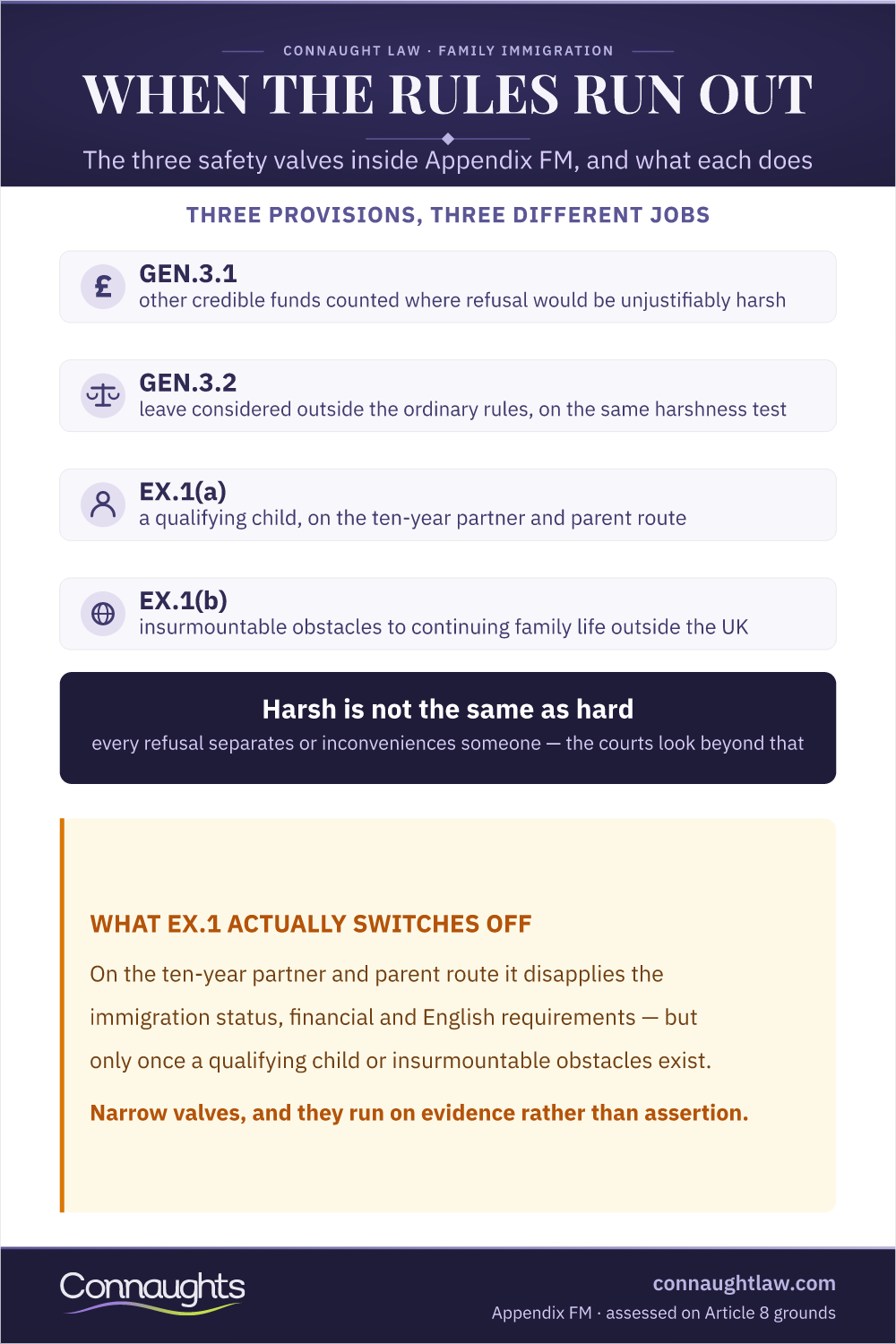
The Framework — Three Safety Valves
GEN.3.1 — Other Money the Rules Can Count
Where an application fails the minimum income requirement on the specified evidence, GEN.3.1 asks whether refusal could produce unjustifiably harsh consequences for the applicant, their partner or a child. If it could, sources the ordinary rules ignore — credible third-party support, prospective earnings, other reliable funds — can be taken into account. It is a two-stage gate: the harshness question first, the alternative money second, and both need evidence rather than assertion.
Exceptions Under Appendix FM
| Provision | When it bites | What it changes |
|---|---|---|
| GEN.3.1 | Financial requirement not met on specified evidence | Other credible, reliable funds can be counted |
| GEN.3.2 | Any requirement not met, refusal would be unjustifiably harsh | Leave considered outside the ordinary rules on Article 8 grounds |
| EX.1 and EX.2 | Ten-year partner or parent route, qualifying child or insurmountable obstacles | Immigration status, financial and English requirements disapplied |
GEN.3.2 — Unjustifiably Harsh Consequences
GEN.3.2 is the broadest valve: where the rules are otherwise not met, the decision-maker must consider whether refusal would result in unjustifiably harsh consequences for the family, such that refusal would breach Article 8. "Harsh" is not "hard" — every refusal separates or inconveniences someone, and the courts expect consequences beyond the ordinary incidents of immigration control: serious medical situations, children whose welfare would be genuinely damaged, dependencies that relocation cannot survive. The Article 8 framework behind it is covered in our family and private life guide.
EX.1 and EX.2 on the Ten-Year Route
EX.1 applies to in-country applications on the ten-year partner and parent route, and its effect is precise: where it applies, certain eligibility requirements — immigration status, finances and English language — do not have to be met. It does not waive suitability, and it does not shorten the route: successful applicants settle after ten years, not five, a trade-off compared in our five-year versus ten-year route guide.
EX.1(a) — Children and Parental Relationships
EX.1(a) is met where the applicant has a genuine and subsisting parental relationship with a child who is British or has lived in the UK continuously for seven years, and it would not be reasonable to expect the child to leave. The reasonableness question is where these cases are fought — the child's integration, schooling, nationality and welfare all count, and our seven-year rule guide covers the case law in detail.
EX.1(b) — Insurmountable Obstacles
EX.1(b) applies where there are insurmountable obstacles to family life with a partner continuing outside the UK — defined by EX.2 as very significant difficulties which could not be overcome or would entail very serious hardship. It is a stringent but practical test: not impossibility, but far more than preference or inconvenience. What actually satisfies it — and what fails — is the subject of our dedicated insurmountable obstacles guide.
What the Courts Have Decided
Agyarko and MM in the Real World
In Agyarko and Ikuga v SSHD [2017] UKSC 11 the Supreme Court upheld the insurmountable-obstacles and exceptional-circumstances framework, describing the obstacles test as stringent but to be applied practically, and confirming that "unjustifiably harsh consequences" is where Article 8 bites outside the rules. In MM (Lebanon) v SSHD [2017] UKSC 10 the court upheld the minimum income requirement itself while requiring the rules to take proper account of children's interests and alternative funding sources — the origin of what is now GEN.3.1.
Read together, the cases explain the modern shape of these provisions: the thresholds are lawful and high, but decision-makers must genuinely engage with harshness, children and credible money rather than reciting the standard requirements back at the family. Cases succeed where the evidence forces that engagement.
Timelines Without the Mythology
What Can Honestly Be Said About Timing
Two figures are published and reliable. In-country partner applications that do not meet the ordinary rules — the human-rights caseload these provisions live in — currently take around 12 months to decide, per gov.uk on the day of writing. And a refusal carries a human-rights appeal, lodged within 14 days in-country or 28 days from abroad. What is not published is a success rate for GEN.3.1 or GEN.3.2 specifically — treat any article quoting precise percentages for these applications with suspicion, because the Home Office does not break the data down that way.
Building the Exceptional Case
- Independent medical and psychological evidence where health or welfare grounds are relied on — from treating clinicians, current and specific.
- For children: school records, professional welfare evidence and anything bearing on the reasonableness of leaving.
- Country evidence tying the claimed obstacles to the actual destination, not generalities about hardship abroad.
- For GEN.3.1, documentation of the alternative funds at the same standard the ordinary rules would demand — credibility is the whole game.
Current Developments
The financial threshold these exceptions orbit is itself under review — the MAC's June 2025 report recommended against the shelved £38,700 rise, with no change implemented since — and the 2026 earned-settlement consultation remains a proposal, not law. Neither alters the exceptional-circumstances framework today, but both are reasons to have current advice rather than an old article; our family visa team runs these assessments before any application is committed.
Frequently askedQuestions about exceptional circumstances
What are exceptional circumstances under Appendix FM?
Situations where refusing an application that fails the ordinary rules would produce unjustifiably harsh consequences, breaching Article 8. They are assessed through defined provisions — GEN.3.1 for finances, GEN.3.2 generally, EX.1 on the ten-year route — not as free-standing sympathy.
What is the difference between GEN.3.1 and GEN.3.2?
GEN.3.1 is financial only: it lets other credible funds count towards the income requirement once potential harshness is shown. GEN.3.2 is general: where any requirement is unmet, it requires consideration of leave outside the rules on the unjustifiably harsh test.
What does EX.1 actually switch off?
Where it applies, the immigration status, financial and English language eligibility requirements do not have to be met on the ten-year partner or parent route. Suitability requirements still apply in full, and the route to settlement is ten years rather than five.
What does "unjustifiably harsh" mean in practice?
Consequences beyond what immigration control ordinarily inflicts: serious untreated medical conditions, real damage to a child's welfare, dependencies that cannot survive relocation. Separation, expense and disruption alone are the ordinary incidents of refusal and do not meet the standard.
How long do these applications take?
In-country applications relying on human-rights grounds currently take around 12 months to decide, per current gov.uk guidance. Published data does not give a success rate for these provisions specifically, so be wary of precise percentages quoted anywhere.
Can exceptional circumstances excuse a criminal record?
No. The exceptions relieve eligibility requirements, not suitability. Character and conduct grounds for refusal continue to apply, and a suitability problem needs its own analysis before any exceptional-circumstances argument can help.
Tell us the date on the decision, which requirement you could not meet and what the refusal says about your family life. We'll tell you whether GEN.3.1, EX.1 or an appeal is the route that fits.
Get Expert Advice