
Partners and parents reach settlement on one of two clocks: the five-year route for those meeting every requirement — income, English, relationship evidence — and the ten-year route for those who qualify only through exceptional circumstances under Article 8. The routes differ in cost, security and endpoint, and switching between them is both possible and frequently the smartest move a family makes. This guide compares them requirement by requirement and maps the switching strategy.
On This Page

Same Family Life, Different Timelines
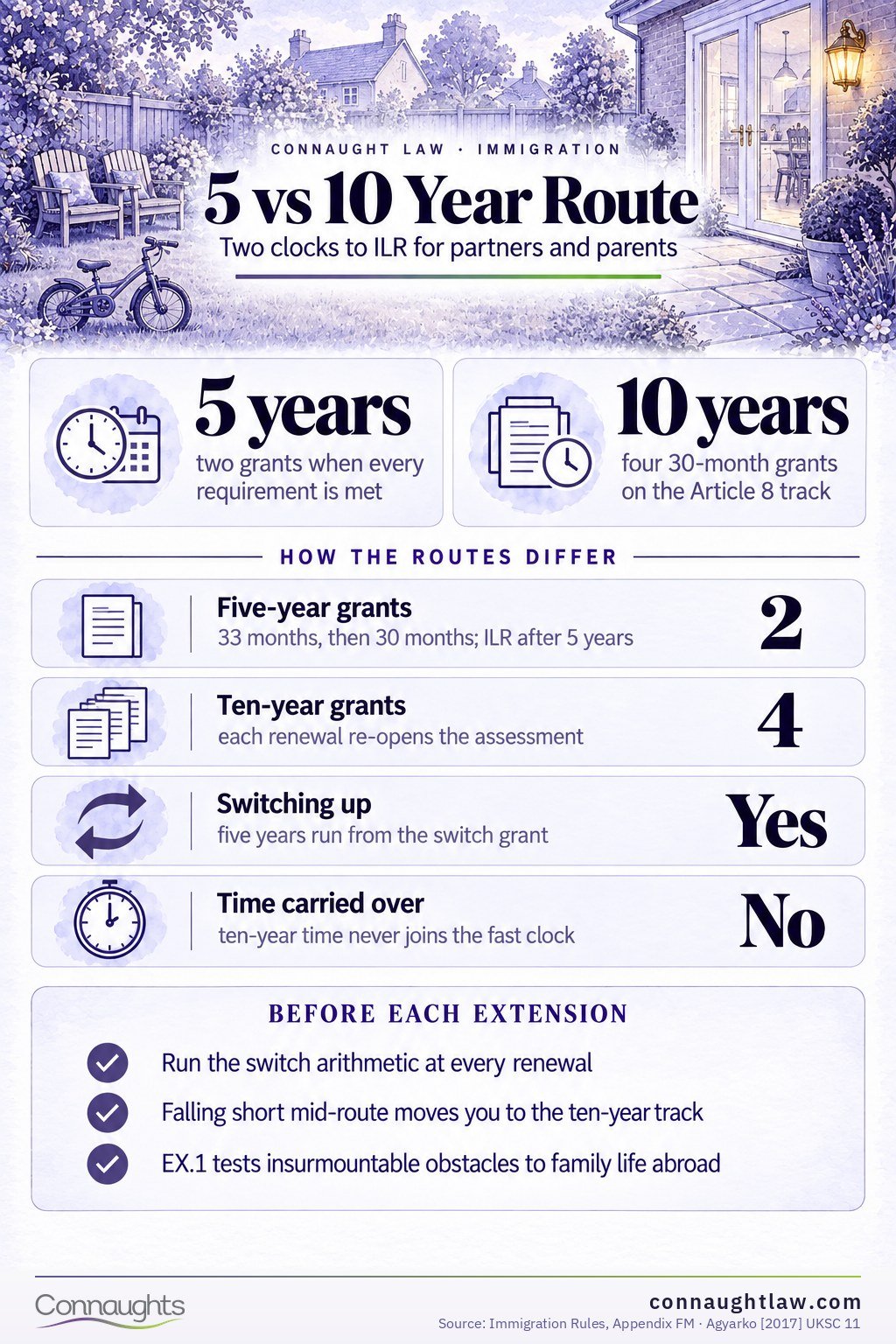
Which clock a family is on is decided by one thing: whether the requirements of Appendix FM can be met with evidence in the specified form. Meet every requirement — income or adequate maintenance, English, relationship — and settlement arrives in five years over two grants. Fall short and leave comes only through EX.1 or exceptional circumstances, in four 30-month grants across ten years. Switching runs both ways, and the years already served decide whether it pays.
The Two Routes
How the 5-Year Route Works
The five-year route under Appendix FM is the rules' preferred path: meet the financial requirement, English requirement and relationship tests at every application, and settlement arrives after five years — two grants of leave, then ILR. It is cheaper across its life, more secure at each renewal, and the only route whose endpoint does not depend on discretionary assessment.
Where the 10-Year Route Fits
The ten-year route exists for families who cannot meet a requirement but whose removal would breach Article 8 — through the EX.1 exceptions or exceptional circumstances. Leave comes in 30-month grants, four times over, each renewal re-opening the assessment, with fees and the health surcharge recurring throughout. It is the safety net, and it is priced like one: roughly double the applications, double the years, and continuing uncertainty.
Requirements Compared
Side by Side
What Each Route Demands
| Requirement | 5-year route | 10-year route |
|---|---|---|
| Financial | £29,000 minimum income, specified evidence | Not required — adequate maintenance assessed |
| English | Rising levels at entry, extension and ILR | Not required until settlement stage |
| Basis of leave | Full rules compliance | EX.1 or exceptional circumstances (Article 8) |
| Grants to ILR | 2 (33 + 30 months) | 4 × 30 months |
| Settlement point | 5 years | 10 years |
Switching Routes
Meet the full requirements and you can move from the ten-year to the five-year route, with five years running from the switch grant. Fall short mid-route and you drop to the ten-year track instead of losing status. Earlier ten-year-route time never joins the fast clock — but it still counts toward ten-year settlement.
How Switching Works
Movement between the clocks runs both ways. Families who fall below the requirements mid-route drop to the ten-year track rather than losing status; families on the ten-year track who come to meet the full requirements can apply onto the five-year route, with five years running from that grant. Time does not transfer onto the faster clock — the five-year route counts only five-year-route time — but combined time still counts toward the ten-year settlement under the combination rules in our family settlement guide.
Timing the Switch
The arithmetic that decides it: years already served on the ten-year clock against five fresh years from a switch. A family three years into the ten-year route with a newly sufficient income usually wins by switching — five more years beats seven. At year six the answer reverses. Run the numbers at every extension, because the switch is cheapest at the natural renewal point.
Parent Route Differences
Parents on the 5-Year Track
Parents qualify on the five-year track through sole or shared responsibility for a British or settled child — with direct access evidenced where the child lives with the other parent — plus English and, distinctively, no minimum income figure: adequate maintenance replaces the £29,000 test. Its requirements are relational rather than financial, so the evidence lives in family court orders, school letters and the practical record of parenting.
When Parents Take the 10-Year Track
Parents who cannot meet the five-year route's eligibility — typically because their immigration status at application barred it — proceed on the ten-year track through the child-focused Article 8 assessment. The child's best interests anchor these cases, and strengthening that evidence at every renewal is what eventually supports both the extensions and any switch up.
Exceptional Circumstances
What Qualifies
How Circumstances Are Weighed
EX.1 asks whether there are insurmountable obstacles to family life continuing abroad, or whether it would be unreasonable for a qualifying child to leave; the wider exceptional circumstances test asks whether refusal would produce unjustifiably harsh consequences. Health, country conditions, children's integration and genuine dependency all weigh; preference and comfort do not.
Article 8 Proportionality
The Supreme Court's framework in Agyarko [2017] UKSC 11 governs: family life built on a precarious status attracts less weight, and the public interest in the rules yields only to compelling cases. Practically, that sets the evidential bar for every ten-year-route application — the file must show why this family's circumstances are the exception the framework contemplates.
Choosing Strategically
The Selection Framework
Three questions settle route choice: can the financial requirement be met with evidence in the specified form; if not now, when realistically; and what does each path cost in fees, surcharge and uncertainty across its life? The five-year route wins whenever it is available — the strategy work is making it available, by structuring income and evidence before applications rather than after refusals.
Common Scenarios
The recurring patterns: the sponsor whose new job will cross £29,000 in four months — usually worth waiting for; the self-employed sponsor whose accounts need a full tax year in specified form; and the ten-year-route family switching at first eligibility. Each is a timing decision our family visa team prices against the processing realities in our family processing times guide.
Frequently askedQuestions about the two routes
What is the difference between the 5 year and 10 year routes?
The five-year route requires full compliance — £29,000 income, English, relationship evidence — and settles in five years over two grants. The ten-year route runs on Article 8 exceptions, four 30-month grants, and twice the time and cost.
Can I switch from the 10 year route to the 5 year route?
Yes, once you meet the full requirements — the five years then runs from the switch grant. The move usually pays for families in the first half of the ten-year clock; run the arithmetic at each extension.
Does time on the 10 year route count toward the 5 year route?
No — the five-year clock counts only five-year-route time. But combined family-route time still counts toward ten-year settlement, so no properly granted years are wasted; they just count on the slower clock.
Is there an income requirement on the 10 year route?
No minimum figure — adequate maintenance without public funds is the test. That relief is the route's purpose, paid for in duration: ten years, four applications, and recurring health surcharge.
What counts as insurmountable obstacles under EX.1?
Very significant difficulties to family life continuing abroad that cannot be overcome or would cause serious hardship — health, protection issues, genuine dependencies. Preference, career and comfort do not reach the threshold.
Which route should a parent of a British child use?
The five-year parent route where eligibility allows — no income figure, settlement in five years. Parents barred by their status at application proceed on the ten-year track, where the child's best interests carry the case.
Send us your grants so far and the household income picture. We'll tell you whether a switch to the five-year route wins — and when to make it.
Get Expert Advice