
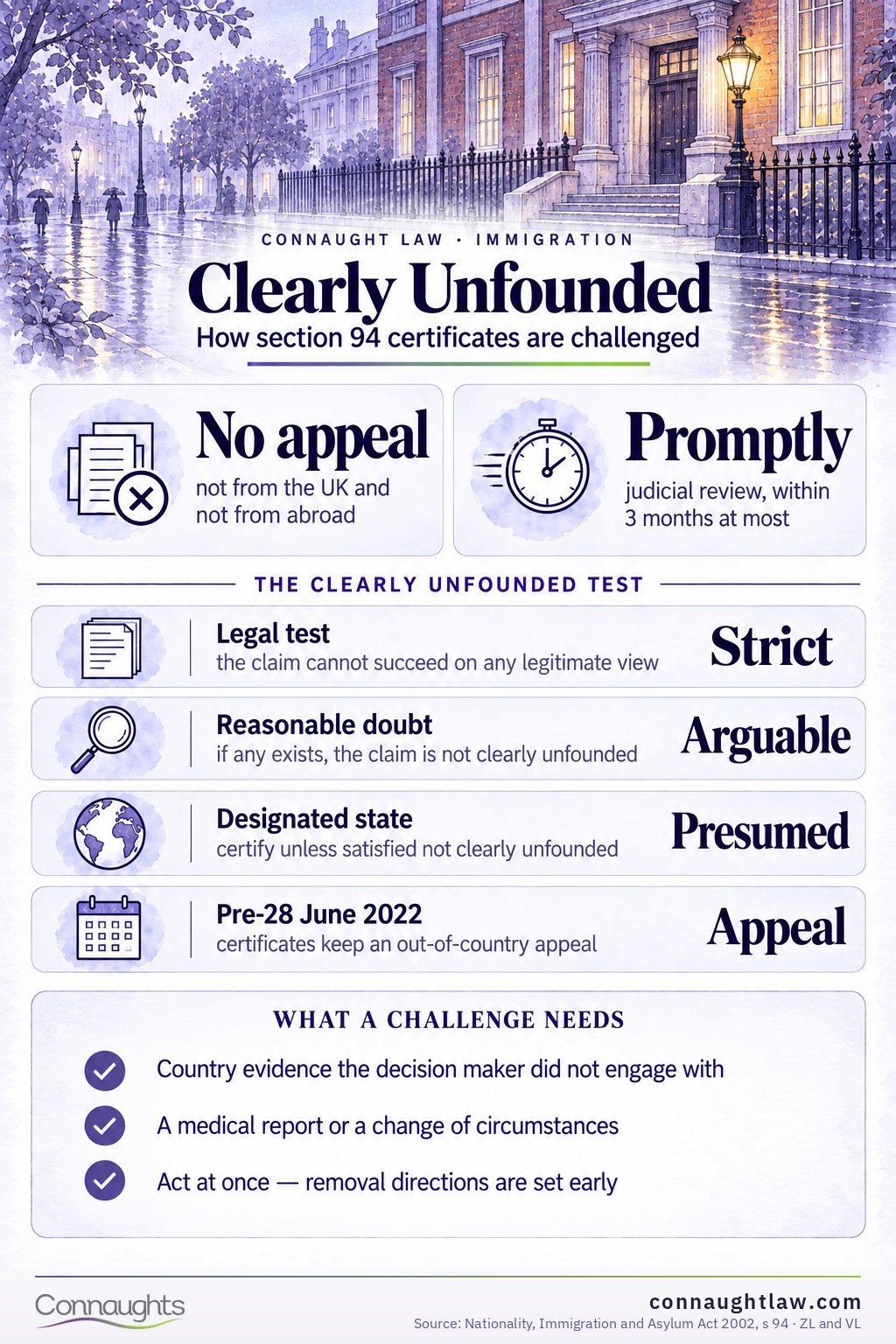
Certification under section 94 is the provision that removes an appeal rather than decides one. If the Secretary of State certifies a protection or human rights claim as clearly unfounded, there is now no appeal at all — not from here, and not from abroad. The only route left is judicial review, and it has to be taken promptly. This is what the section says and how the courts read it.
On This Page

What Section 94 Actually Says
The section is short, and most of what is written about it paraphrases rather than quotes. Section 94 of the Nationality, Immigration and Asylum Act 2002 is headed "Certification of human rights or protection claims as unfounded or removal to safe country" — a heading substituted in 2022, which is why older sources give a different one.
Subsection (1) is the power: "The Secretary of State may certify a protection claim or human rights claim as clearly unfounded." Subsection (3) turns that discretion into a duty for some claimants: where the Secretary of State is satisfied that a claimant is entitled to reside in a State listed in subsection (4), she "shall certify the claim under subsection (1) unless satisfied that it is not clearly unfounded".
Subsection (3A) is the one that matters most, and it is recent: "A person may not bring an appeal under section 82 against a decision if the claim to which the decision relates has been certified under subsection (1)."
Quick answer — what a certificate does to your case
It does not decide that your claim is wrong. It decides that your claim is so clearly without substance that it cannot succeed on any legitimate view, and so removes the appeal that would otherwise have tested it. The refusal and the certificate are separate decisions, and it is the certificate that closes the tribunal door.
The distinction between the refusal and the certificate is worth holding onto when reading a decision letter. The refusal explains why the claim fails on its merits. The certificate is a separate judgment that the claim was never arguable at all, and it is that second judgment, not the first, which a challenge has to dislodge.
No subsection 2 — and the heading moved
Section 94 has no subsection (2): the original (1) and (2) were replaced by a single subsection (1) in October 2014. Any source quoting a "section 94(2)" is working from a version that is more than a decade out of date, which is usually a sign the rest of it is too.
Two Different Section 94s
A great many people looking for "section 94" want a different statute altogether. Section 94 of the Immigration and Asylum Act 1999 is the interpretation provision for Part VI of that Act, which governs support for asylum seekers. It defines "asylum-seeker", "claim for asylum" and "supported person", and it confers no power to certify anything.
If your question is about accommodation, subsistence or who counts as a supported person, that is the 1999 Act and this page is not about it. If your question is about why a refusal letter says you have no right of appeal, you are in the right place. The two provisions share a number and nothing else.
What Changed on 28 June 2022
Before that date, a section 94 certificate left an out-of-country appeal: you could be removed, and then argue the case from abroad. Section 28 of the Nationality and Borders Act 2022 inserted subsection (3A) and stripped section 94(1) out of the provisions that had preserved that appeal. The result is that certification under subsection (1) now removes the appeal entirely.
There is a saving, and it is narrow. Section 28(4) provides that the amendments "do not apply in relation to a protection claim or human rights claim that was certified by the Secretary of State under section 94(1) before the coming into force of this section". So a certificate issued before 28 June 2022 still carries an out-of-country appeal; one issued after it carries none.
Two neighbouring provisions are easy to confuse with this one. Section 94(7) concerns removal to a safe third country and does still produce an out-of-country appeal. So does section 94B, which is a different power altogether — it certifies that removal pending appeal would not breach the Human Rights Act, and Home Office guidance of May 2026 records that its use is being restarted after a period of non-use following Kiarie and Byndloss.
Designated States and the Subsection 4 List
Where a claimant is entitled to reside in a listed State, the presumption inverts: the Secretary of State must certify unless satisfied the claim is not clearly unfounded. The list is on the face of the statute, and it has not been amended since 3 March 2010. Several early entries have since been repealed, so the lettering runs with gaps.
States Listed in Subsection 4
| Designated for all persons | Designated in respect of men only |
|---|---|
| Republic of Albania, Jamaica, Macedonia, Republic of Moldova, Bolivia, Brazil, Ecuador, South Africa, Ukraine, India, Mongolia, Bosnia-Herzegovina, Mauritius, Montenegro, Peru, Serbia, Kosovo, South Korea | Ghana, Nigeria, Gambia, Kenya, Liberia, Malawi, Mali, Sierra Leone |
Two cautions about that table. The first is that being listed does not make certification automatic — subsection (3) is expressly subject to the Secretary of State being satisfied the claim is not clearly unfounded, and an individual case can displace the presumption. The second is that the list is a 2010 snapshot which Parliament has not revisited, and subsection (5) requires satisfaction that there is in general no serious risk of persecution before a State is added. Read against current conditions in some listed countries, that is a point to take rather than to assume.
Two lists — and why they are confused
- Section 94(4) is the designated states list above. It drives the presumption to certify a claim as clearly unfounded.
- Section 80AA is a separate list of safe States for the inadmissibility provision in section 80A. Georgia was added to it in April 2024 — to that list, not to section 94(4).
- India sits in both, which is where most of the confusion starts. It has been in section 94(4) since February 2005 and was added to section 80AA in April 2024.
- Section 80AA is not in substantive force. The provision inserting it is commenced only for the purpose of making regulations, so the section 80A scheme is not operating.
The Clearly Unfounded Test
The test is not a balance and not a discretion. In ZL and VL [2003] EWCA Civ 25 the Court of Appeal set out the steps: consider the factual substance and detail of the claim, how it stands with the known background data, whether in the round it is capable of belief, if not whether some part of it is, and whether if eventually believed it is capable of coming within the Convention. "If the answers are such that the claim cannot on any legitimate view succeed, then the claim is clearly unfounded; if not, not."
The House of Lords adopted that approach in ZT (Kosovo) [2009] UKHL 6 and added the point that decides most challenges. The test is "a black and white test"; where there is no dispute of primary fact the question "is only susceptible to one rational answer"; and "if any reasonable doubt exists as to whether the claim may succeed then it is not clearly unfounded".
That has a consequence worth understanding before instructing anyone. A challenge to a certificate is a rationality challenge, but the court gets there by asking itself the same question the Secretary of State asked. If the court thinks the claim has a realistic prospect of success, it will necessarily conclude that the contrary view was irrational. The court is not confined to reviewing the reasoning at arm's length.
Earlier, in Yogathas and Thangarasa [2002] UKHL 36, Lord Bingham described the exercise as a screening process rather than "a full-blown merits review", and held that the Secretary of State may certify if, having reviewed the material, "he is reasonably and conscientiously satisfied that the allegation must clearly fail" — however much material is submitted or however sophisticated the argument.
How Caseworkers Are Told to Apply It
The operative instruction is the Home Office guidance on certification under section 94, which remains at version 7.0 of 8 November 2023. It restates the test in the courts' own terms: "To be clearly unfounded a caseworker must be satisfied that the claim cannot, on any legitimate view, succeed", and a manifestly unfounded claim is "so clearly without substance that it is bound to fail".
One line in it is more useful than the rest to anyone reading a refusal. The guidance accepts that "it is possible for a claim to be manifestly unfounded even if it takes more than a cursory look at the evidence to come to a view that there is nothing of substance in it". Length of consideration is therefore not itself an argument against certification — but the substance of what was considered is.
The November 2023 update recorded the consequence of the 2022 change: because there is no longer a right of appeal, granting leave does not prevent a claim being certified where it is clearly unfounded. Note also that the guidance's own list of designated states omits Jamaica, which is in the statute. Where the two differ, the statute governs.
Challenging a Certificate by Judicial Review
Because subsection (3A) removes the appeal, the challenge is judicial review, normally in the Upper Tribunal. The certificate and the underlying refusal are challenged together: if the certificate falls, the refusal carries a right of appeal and the tribunal decides the claim in the ordinary way. That is the practical objective — not to win the claim on review, but to recover the hearing.
Promptly, not three months — the deadline that bites
The rules require an application to be made promptly and in any event within three months. In certification cases the three months is close to meaningless, because removal directions are usually set long before it expires. Treat promptness as the operative requirement and the outer limit as irrelevant.
What succeeds is evidence that gives the claim a legitimate view on which it could succeed — country material the decision maker did not engage with, a medical report, a change of circumstances, or a point of law the refusal letter did not address. What does not succeed is disagreement with the assessment. Where the refusal itself is the problem rather than the certificate, our guide to visa refusals is the better starting point.
Frequently askedQuestions about section 94 certification and appeal rights
Can I appeal if my claim has been certified?
No. Section 94(3A) removes the appeal under section 82 altogether where a claim is certified under section 94(1) — from inside the UK and from outside it. The exception is a certificate issued before 28 June 2022, which still carries an out-of-country appeal.
What does clearly unfounded actually mean?
That the claim cannot succeed on any legitimate view. It is a black and white test rather than a balance: if any reasonable doubt exists about whether the claim may succeed, it is not clearly unfounded and should not be certified.
Does coming from a designated state mean automatic certification?
No. Subsection (3) requires certification unless the Secretary of State is satisfied the claim is not clearly unfounded, so an individual case can displace the presumption. Being listed shifts the starting point; it does not decide the outcome.
Is section 94 the same as section 94 for asylum support?
No. Section 94 of the Immigration and Asylum Act 1999 is the interpretation provision for asylum support and defines terms such as asylum-seeker and supported person. It has nothing to do with certifying claims as unfounded.
How quickly do I need to act?
Immediately. Judicial review must be brought promptly and in any event within three months, but removal directions are commonly set well inside that period, so the outer limit is rarely the real constraint.
What is the difference between section 94 and section 94B?
Section 94 certifies a claim as clearly unfounded and removes the appeal. Section 94B certifies that removal pending an appeal would not breach human rights, so the appeal survives but is heard from abroad. They are different powers with different consequences.
Send us the refusal letter and the certificate. We will tell you whether there is a legitimate view on which the claim could succeed, and how quickly the challenge has to be filed.
Get Expert Advice