
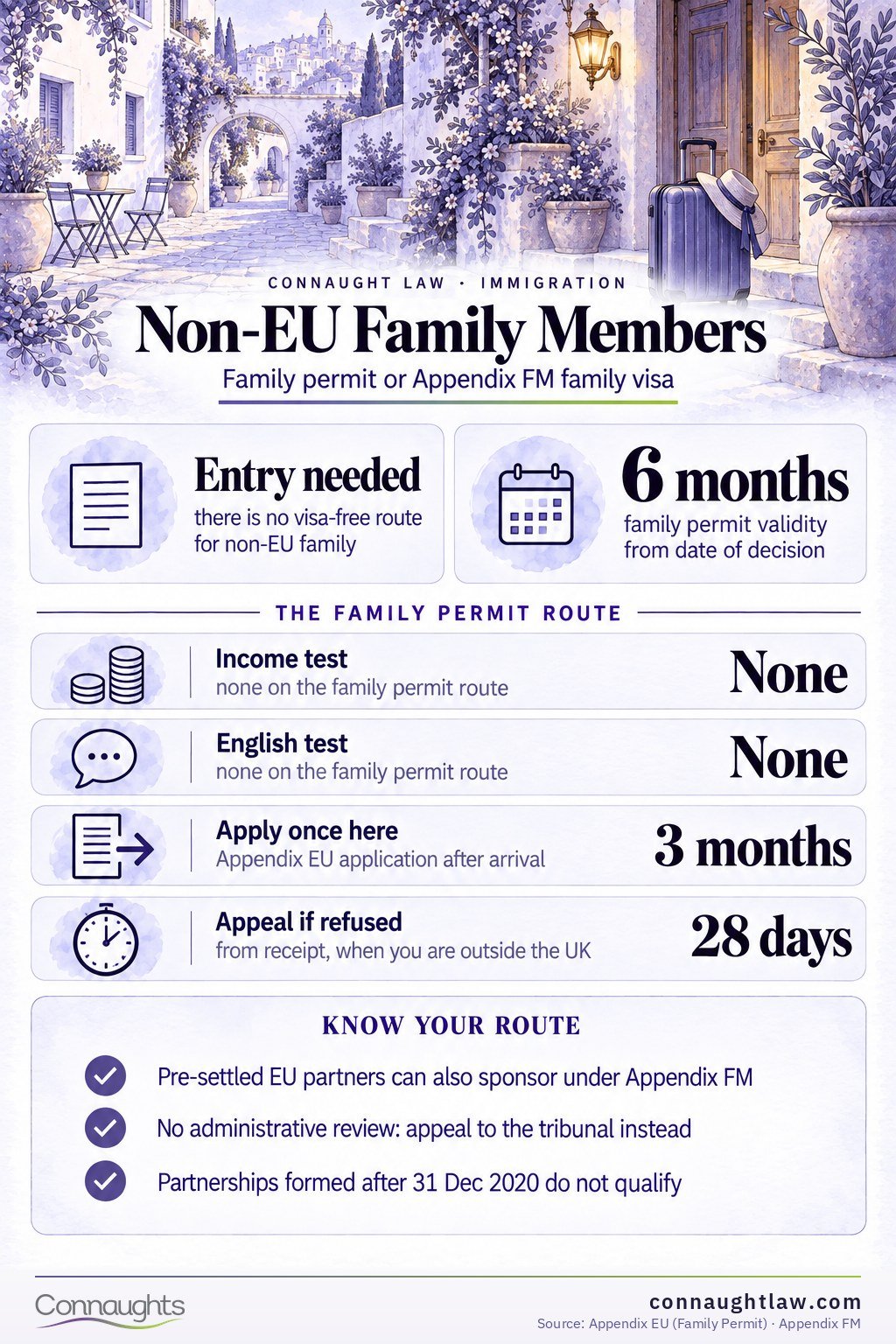
A non-EU family member of an EU, EEA or Swiss citizen needs entry clearance to come to the UK — there is no visa-free route. Which document depends on one question: whether the relationship, or the sponsor’s residence, reaches back to the end of the transition period. That decides between an EU Settlement Scheme family permit and an ordinary family visa under Appendix FM, and the two carry very different requirements and costs.
On This Page

The Two Documents
An EU Settlement Scheme family permit is entry clearance. It is not a visa-free arrangement, and describing it as one causes people to travel without it. Paragraph FP3 grants it as entry clearance valid for six months from the date of decision — not from the date it is issued or used, which is a difference of weeks in practice.
The alternative is an ordinary family visa under Appendix FM, which is what applies where the EU route is not open. It costs more, it carries an income requirement and an English language requirement, and it leads to settlement on a five or ten year route rather than through the settlement scheme.
The two are not mutually exclusive in the way most guidance suggests. An EU citizen sponsor with pre-settled status can sponsor a partner under Appendix FM — E-ECP.2.1(d) read with GEN.1.3(d) — so a family that misses the settlement scheme has not necessarily lost every route.
Which One Applies
The family permit route turns on the sponsor’s position, not on when the couple met. The sponsor must be a relevant EEA citizen or relevant sponsor — someone with leave under paragraph EU2 or EU3 of Appendix EU, or with a continuous qualifying period that began before 2300 GMT on 31 December 2020. Where that is satisfied, the settlement scheme route is available; where it is not, Appendix FM is the route.
One limb has closed. A family member of a qualifying British citizen — the Surinder Singh position, where the couple lived together in an EU member state — could apply under FP4(d) only where the application was made before 9 August 2023. It is no longer available, whatever the history.
Spouses and Partners
A spouse or civil partner married before the end of the transition period is a family member of a relevant EEA citizen. A marriage after it can still qualify the applicant as a joining family member, provided the sponsor holds status. A durable partnership formed after that date does not, which is the sharpest edge in this area.
- EU Settlement Scheme family permit. No fee. No income requirement. No English language requirement. Six months’ entry clearance from the date of decision.
- Appendix FM partner visa. £2,064 from outside the UK and £1,407 from inside, from 8 April 2026, plus the immigration health surcharge at £1,035 a year.
- Appendix FM financial requirement. £29,000 gross annual income, or savings of £16,000 plus two and a half times the shortfall.
- Appendix FM English. A1 at entry clearance, A2 at the first extension, B1 at settlement.
The three-month rule catches families who do everything else right. After arriving on a family permit, the application under Appendix EU must be made within three months of arrival — the required date at Annex 1 paragraph (a)(ii)(aa). Late applications can be accepted on reasonable grounds, but that is a discretion rather than a right.
What It Allows
A family permit holder can work and study in the UK while it is valid. That is what gov.uk states, and it is worth keeping to. Broader claims about eligibility for most public benefits are not supported by any published source and should not be relied on when planning a household budget.
The permit itself is a bridge rather than a destination. It gets the holder here; status under Appendix EU is what gives them the right to stay, and that has to be applied for separately within the three-month window.
Children and Relatives
Children under 21, and children over 21 who are dependent, fall within the Annex 1 definition of a child. It covers adopted children under a relevant adoption decision and children of the spouse or civil partner. There is no separate test of family unit integration, whatever some guidance suggests.
Dependent parents and grandparents sit in the dependent parent definition. Dependent relatives are a different and much narrower category requiring a relevant document issued before 2021 — our guide to the EU Settlement Scheme family permit sets out where each category sits.
Applying and Refusals
Apply online from outside the UK with the sponsor’s status details and evidence of the relationship. From 8 April 2026 this is a validity requirement, not an evidential one. Under FP4(e) and FP5, an application without the sponsor’s unique application number or equivalent, and without relationship evidence, is rejected as invalid — there is no decision, nothing to appeal, and the process starts again.
Administrative review is not available against refusal of an EU Settlement Scheme family permit. AR(EU)1.1 lists the eligible decisions and a family permit refusal is not among them. The remedy is a statutory appeal under regulation 5 of the Immigration (Citizens’ Rights Appeals) (EU Exit) Regulations 2020, with 28 days from receipt of the decision where the applicant is outside the UK. Anyone applying for administrative review is filing in a forum that cannot hear it while the appeal clock runs down. Our litigation team handles the appeal.
On timing, an Appendix FM application from outside the UK usually gets a decision within 12 weeks. For EU Settlement Scheme family permits the Home Office publishes no service standard at all, so any figure quoted in working days is not official.
Frequently askedQuestions about non-EU family members
Can an EU family member travel to the UK without a visa?
No. A non-EU family member needs entry clearance. The EU Settlement Scheme family permit is entry clearance — it is not a visa-free arrangement, and travelling without it is refused at the border.
How long is the family permit valid?
Six months from the date of decision under FP3, not from the date it is issued or first used. Once here, the Appendix EU application must follow within three months of arrival.
What does a non-EU spouse visa cost?
The EU Settlement Scheme family permit is free. An Appendix FM partner visa is £2,064 from outside the UK and £1,407 from inside, from 8 April 2026, plus the health surcharge at £1,035 a year.
Do I need to meet the £29,000 income requirement?
Only on the Appendix FM route. The settlement scheme family permit has no income requirement and no English language requirement.
Can my pre-settled EU partner sponsor me under Appendix FM?
Yes. E-ECP.2.1(d), read with GEN.1.3(d), allows a partner with limited leave under Appendix EU to sponsor. The two routes are not mutually exclusive.
What if I married after Brexit?
You may still qualify as a joining family member if your sponsor holds status and the marriage existed before the application. A durable partnership formed after 31 December 2020 does not qualify.
Can I apply for administrative review if refused?
No. Administrative review does not cover family permit refusals. The remedy is an appeal to the First-tier Tribunal, 28 days from receipt of the decision if you are outside the UK.
How long does a decision take?
An Appendix FM application from outside the UK usually takes 12 weeks. For the settlement scheme family permit, no service standard is published, so plan without one.
Tell us when the relationship began, what status your partner holds and where you are applying from. We'll tell you which route is open to you and what it will cost.
Get Expert Advice