
Some children are born British, some become British automatically when a parent settles — and many more can be registered: by entitlement when a parent gets settled status or citizenship, by the ten-year birth route, or by discretion where registration serves the child's future. The fee is £1,000 since April 2026, waivable for families who cannot pay. This guide maps every route by birth date and circumstance, the EUSS implications, and the MN1 process.
On This Page

Born British, Made British, Registered British
Citizenship at birth depends on the parents' status: a child born here to a British or settled parent is British automatically, as is a child born abroad to a citizen otherwise than by descent. Everyone else registers later — by entitlement once a parent settles or naturalises, by the ten-year birth route, or by discretion. Birth date and the parents' dates decide which applies, and several entitlements close at 18.
Automatic Citizenship
Children Born in the UK
Birth in the UK has not conferred citizenship automatically since 1983 — the question is the parents on the day of birth: a child born here to a parent who is British or settled (ILR or EUSS settled status) is British from the first breath, needing only a passport application to prove it. Everything else in this guide exists for the children who missed that test by timing.
Births Outside the UK
Children born abroad to a British citizen "otherwise than by descent" are British automatically; children of citizens by descent generally are not, and route through registration provisions with their own residence conditions — the classic trap for British families living abroad across two generations, applied for through the British parent routes.
Born Before the Parent Settled
The commonest modern case: the child arrived before the parents' status did. That child is not automatically British — but becomes registrable by entitlement the day a parent settles, which is the provision families most often discover years late.
Registration Entitlements
Route by Birth and Circumstance
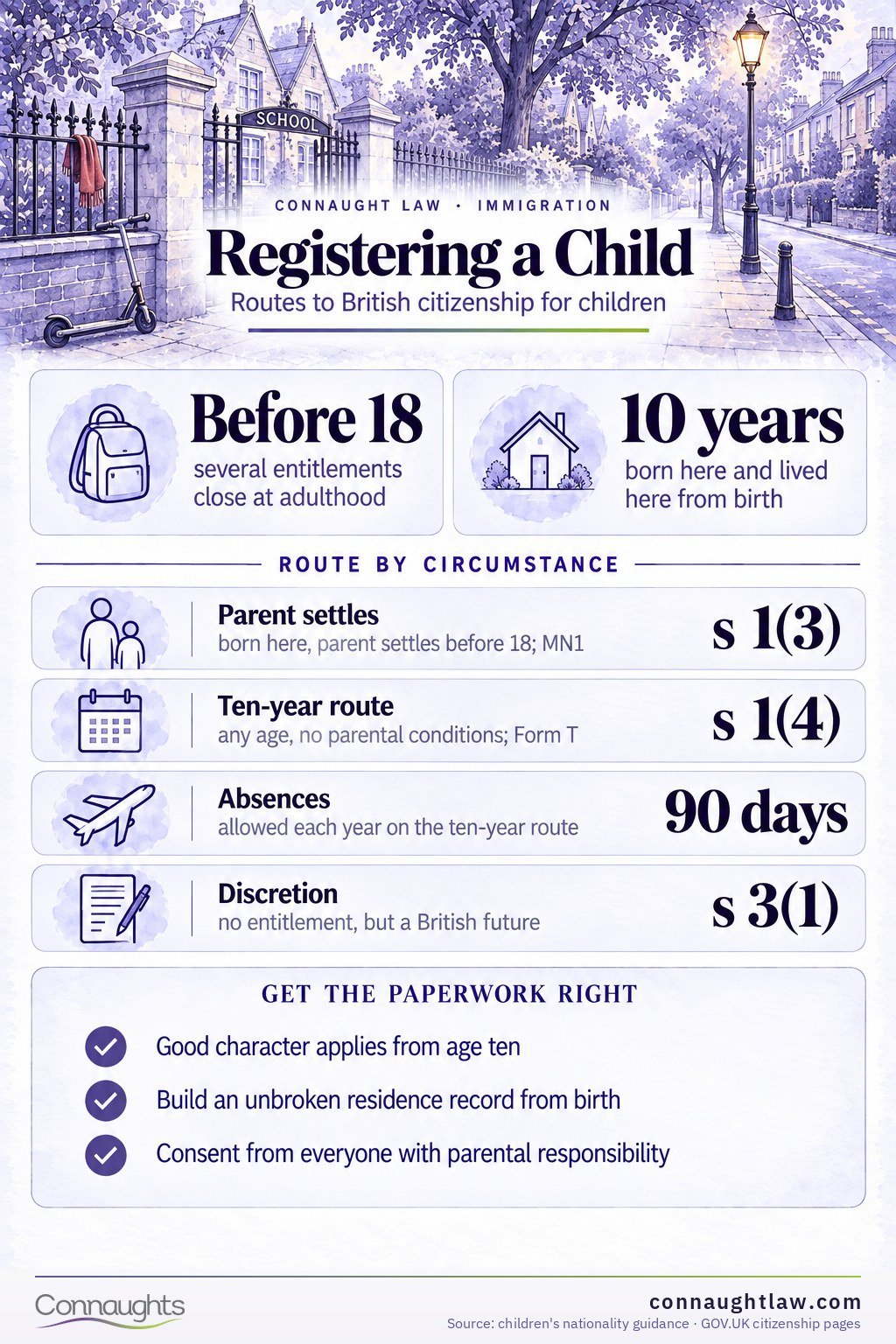
- Born in the UK, parent becomes settled or British before the child is 18: section 1(3) entitlement, Form MN1.
- Born in the UK, first ten years lived here: the section 1(4) ten-year entitlement — any age, no parental conditions.
- Born abroad to a parent British by descent: the descent registration provisions, residence-conditioned.
- No entitlement but a British future: section 3(1) discretion, MN1, decided on the child's connections and best interests.
- Unmarried-father and historical injustice cases: the corrective routes in our section 50(9A) guide.
EU Settlement Scheme Implications
For EUSS families the pivot is the settled status date: children born here after it are British automatically; children born before it register under section 1(3) once it arrives. Pre-Brexit births turn on whether the EU parent was "settled" under the old free movement rules at the time — contested territory the courts have now largely closed — so EUSS households should have each child's position diagnosed rather than assumed, with our European nationals team doing exactly that.
The 10-Year Rule
Residence Requirements
The birth-plus-ten-years entitlement — 90 days' absence allowed per year, no parental conditions, no upper age limit — is covered in full in our ten-year route guide, and runs on Form T rather than MN1.
Evidence for Long Residence
Ten-year applications live or die on the year-by-year record: passports, GP registration, nursery and school letters building an unbroken residence chain from birth. Start the evidence file before the tenth birthday, not after.
Applying
Forms and Procedures
MN1 carries the entitlement and discretion routes, filed online with the child's biometrics, at £1,000 since the April 2026 fee cut — waivable on affordability grounds and free for children in local authority care, per our child citizenship fees guide. Decisions run inside the six-month citizenship standard, and certificates for over-13s follow any ceremony requirements at 18.
Good Character From Ten
Children aged ten or over at application face the good character requirement — usually a formality, occasionally not, and always a disclosure exercise. Pending youth justice matters are a reason to time the application, not to hide them.
Evidence
Documents for Every Application
All routes start from the same core: the child's full birth certificate, the parents' status evidence dated against the birth or the registration trigger, passports, and consent from those with parental responsibility. Entitlement routes add the trigger document — the parent's ILR grant, EUSS settled status or naturalisation certificate — with dates the caseworker can reconcile.
Residence Evidence
Where residence is the qualifying fact, corroborate it institutionally: health records from birth, nursery and school enrolment, and the family's address history. The informal record — clubs, photographs, faith communities — fills gaps but cannot replace the institutional spine.
Legal Developments
The Courts on Automatic Citizenship
The Roehrig litigation resolved the largest recent question — whether children born to EU citizen workers before the EUSS era were born British — against automatic citizenship in most cases: exercising free movement rights did not itself make a parent "settled". Families who assumed a pre-Brexit birth conferred citizenship should verify rather than apply for passports on assumption; registration routes usually repair what the case law closed.
Policy Direction
Fees and Waivers
Children's citizenship policy has moved consistently toward access — the PRCBC-driven fee waiver, the April 2026 fee cut to £1,000, care-leaver exemptions — even as adult citizenship tightens around character and entry history. The children's nationality guidance and gov.uk citizenship pages carry the current state, and our citizenship team sequences multi-child families so every entitlement is caught at its cheapest moment.
Frequently askedQuestions about child registration
Is a child born in the UK automatically British?
Only if a parent was British or settled at the birth — including EUSS settled status. Otherwise the child registers later: by entitlement when a parent settles, through the ten-year birth route, or by discretion.
My child was born before I got settled status — what now?
Register under section 1(3): the entitlement arises the day you settle and lasts until the child turns 18. File MN1 with your settlement evidence and the birth certificate — it is an entitlement, not a discretion.
How much does child registration cost in 2026?
£1,000 following the April 2026 fee cut, with an affordability waiver for families who cannot pay and no fee at all for children looked after by a local authority. A £130 ceremony fee applies only if the applicant turns 18 before decision.
What is section 3(1) discretionary registration?
The catch-all for children with no entitlement but a genuinely British future — decided on residence, family circumstances and best interests. Strong applications document the child's UK-centred life and the family's direction of travel.
Did children of EU parents born before Brexit get citizenship automatically?
Mostly not — the Roehrig litigation confirmed that exercising free movement did not make a parent "settled" for automatic citizenship. Check each child's position; registration under section 1(3) or 1(4) usually provides the repair.
Should we register or wait for the child to naturalise as an adult?
Register — child registration is cheaper (£1,000, waivable), avoids the adult good character bands and the residence tests, and several entitlements expire at 18. Waiting converts an entitlement into an application that can be refused.
Send us each child's birth date and your status history. We'll diagnose automatic citizenship, entitlements and discretion across the family — before any deadline at 18 closes a door.
Get Expert Advice