
A child born in the UK who lives here for their first ten years earns a statutory entitlement to British citizenship — whatever their parents' status was, then or since. The registration runs on Form T — £1,000 under 18, £1,540 at 18 or over — turns on the 90-day-per-year absence rule, and the entitlement never expires: adults who qualified as children can still register today. This guide covers section 1(4), the absence arithmetic, good character for children, and the application end to end.
On This Page

Ten Birthdays to an Entitlement
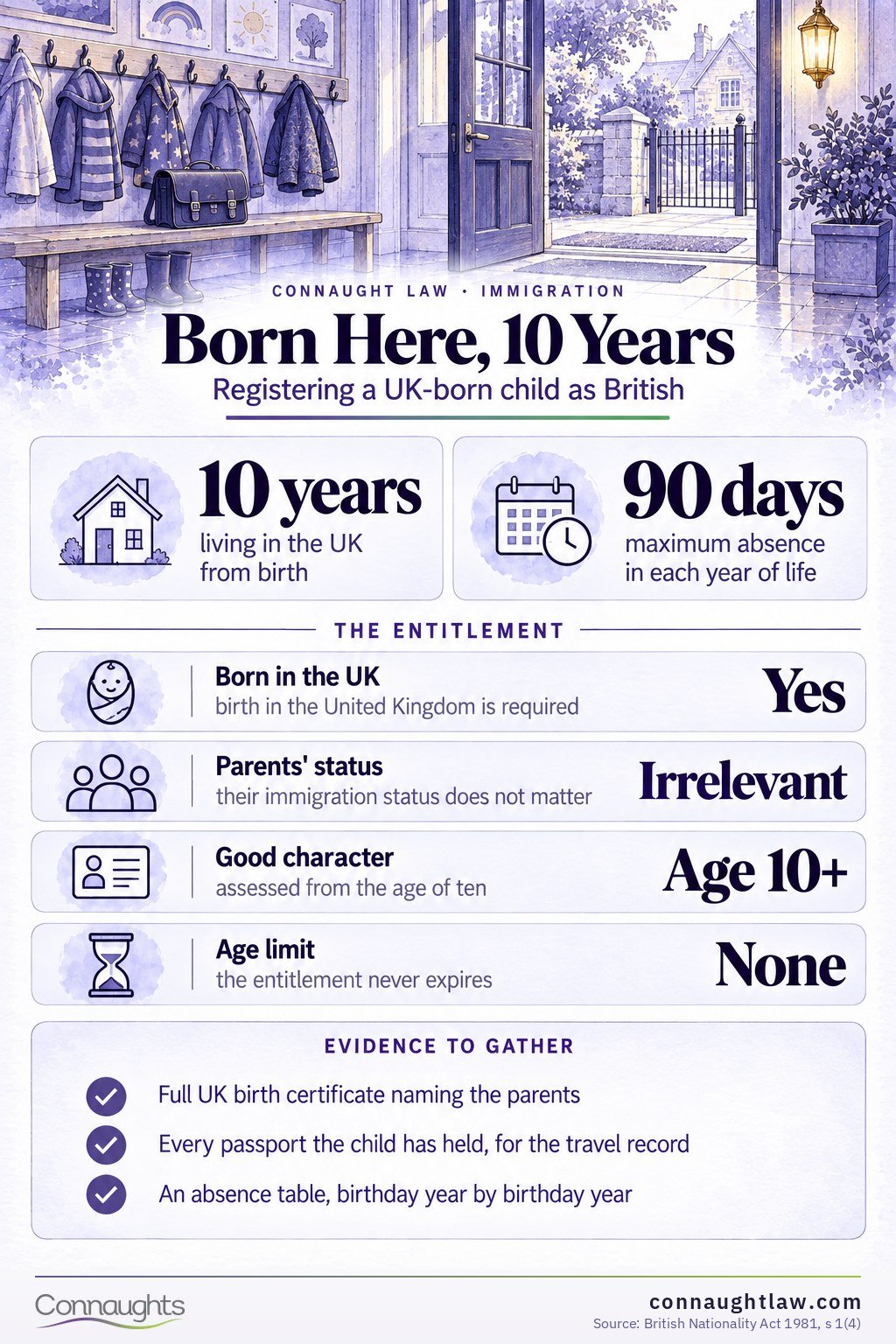
A child born in the United Kingdom who lives here for the first decade of life acquires a statutory entitlement to citizenship, whatever the parents' immigration status. Registration confirms that right rather than weighing it. What most cases turn on is the absence limit of 90 days in each birthday year, and, from age ten, the good character requirement. The entitlement itself never expires: adults who qualified as children can still register.
Eligibility
What Section 1(4) Gives
Section 1(4) Requirements
Section 1(4) of the British Nationality Act 1981 gives three conditions and no discretion once they are met: born in the UK, aged ten or over, and resident here for the first ten years of life within the absence limits. Parental status is irrelevant — the provision exists precisely for children whose parents were not settled at the birth — and the right is an entitlement: the Home Office registers qualifying applicants; it does not weigh them.
The provision's best-kept secret is its missing age limit. The entitlement crystallises at ten and survives indefinitely — a twenty-five-year-old who spent their first decade here can register now, at the adult registration fee with the ceremony for over-18s, on exactly the same statutory footing.
The 90-Day Rule
The residence condition allows up to 90 days' absence in each of the first ten years of life — counted year by birthday-year, not averaged. A single year at 100 days breaks the strict entitlement even if the other nine were spotless; the guidance then allows discretion, normally exercised where total absences stay modest or compelling circumstances explain the excess, per the children's nationality guidance. Families reconstructing a decade of travel should build the year-by-year table before filing — the caseworker will.
Good Character
What It Means for Children
Applicants aged ten or over face the good character requirement — the reason this application's timing sometimes matters more than families expect. For most children it is a formality; for teenagers with cautions, referral orders or pending matters it is not, and the same disclosure discipline applies as for adults: declare everything, contextualise honestly, and take advice before filing rather than after refusal. The full framework sits in our good character guide.
Applying
Form T, Not MN1
Ten-year-route registrations use Form T — MN1 serves the other child registration routes, mapped in our child registration guide — applied for online with biometrics enrolled for the child. Adults registering on the same entitlement use the adult registration process. Choosing the right form matters: fees differ and refunds for wrong-route applications are not the Home Office's habit.
Essential Documents
- Full UK birth certificate naming the parents.
- The child's passports — all of them — establishing the travel record.
- Year-by-year residence corroboration: GP and health visitor records, nursery and school letters.
- A completed absence table, birthday year by birthday year, with evidence for any year near 90.
- Referee declarations meeting the form's requirements.
Fees and Timing
Fee Structure
The child registration fee is £1,000 — cut from £1,214 in the April 2026 fees round. An applicant of 18 or over pays the adult registration fee of £1,540 instead, plus the £130 ceremony fee, which is charged only where the applicant turns 18 before the decision, and the affordability fee waiver available for families who cannot pay, as our child citizenship fees guide details. Children looked after by a local authority pay nothing.
Processing Times
Registration decisions run to the citizenship caseload's six-month standard, usually faster for clean entitlement cases — the absence table's completeness being the main variable. Certificates issue after any ceremony requirement, and the child's British passport application follows separately. Families whose child misses the ten-year entitlement narrowly should look at the 7-year private life route, and the gov.uk application pages carry the forms.
Frequently askedQuestions about the ten-year route
How does a child born in the UK get citizenship after 10 years?
By registration under section 1(4): born here, aged ten or over, and resident for the first ten years with no more than 90 days' absence in any of those years. It is an entitlement — parental immigration status is irrelevant.
What if we exceeded 90 days in one year?
The strict entitlement fails but discretion exists — normally exercised where the overall record is modest or the excess had compelling reasons. Build the year-by-year table, evidence the reason, and argue the discretion expressly.
Is there an age limit for the 10-year registration?
No — the entitlement earned by age ten never expires. Adults who spent their first decade in the UK can register today, at the adult registration fee, with the citizenship ceremony required from 18.
Which form is used — MN1 or Form T?
Form T for the ten-year route; MN1 serves the other child registration routes such as a parent becoming settled. The fee on either is £1,000 following the April 2026 reduction while the applicant is under 18; at 18 or over the adult registration fee of £1,540 applies.
Does the child need good character for this route?
From age ten, yes — cautions, convictions and pending matters are assessed and must be declared. For most children it is a formality; for teenagers with a record it deserves advice before the fee is paid.
Do the parents' immigration problems affect the application?
No — section 1(4) looks only at the child's birth, residence and character. Children of overstayers and visitors qualify identically, which is the provision's whole purpose.
Send us the passports and the school history. We'll build the year-by-year absence table, pick the right form, and file the entitlement the statute already gave them.
Get Expert Advice