
Seven continuous years in the UK gives a child a route to status that does not depend on their parents' immigration history — and for UK-born children it can now mean indefinite leave directly. The test that decides these cases is not the seven years, which is arithmetic, but whether it would be reasonable to expect the child to leave. This guide covers the current rules, the UK-born and non-UK-born tracks, the FLR(FP) process, fees, timelines and evidence.
On This Page

Seven Years That Change a Child's Status
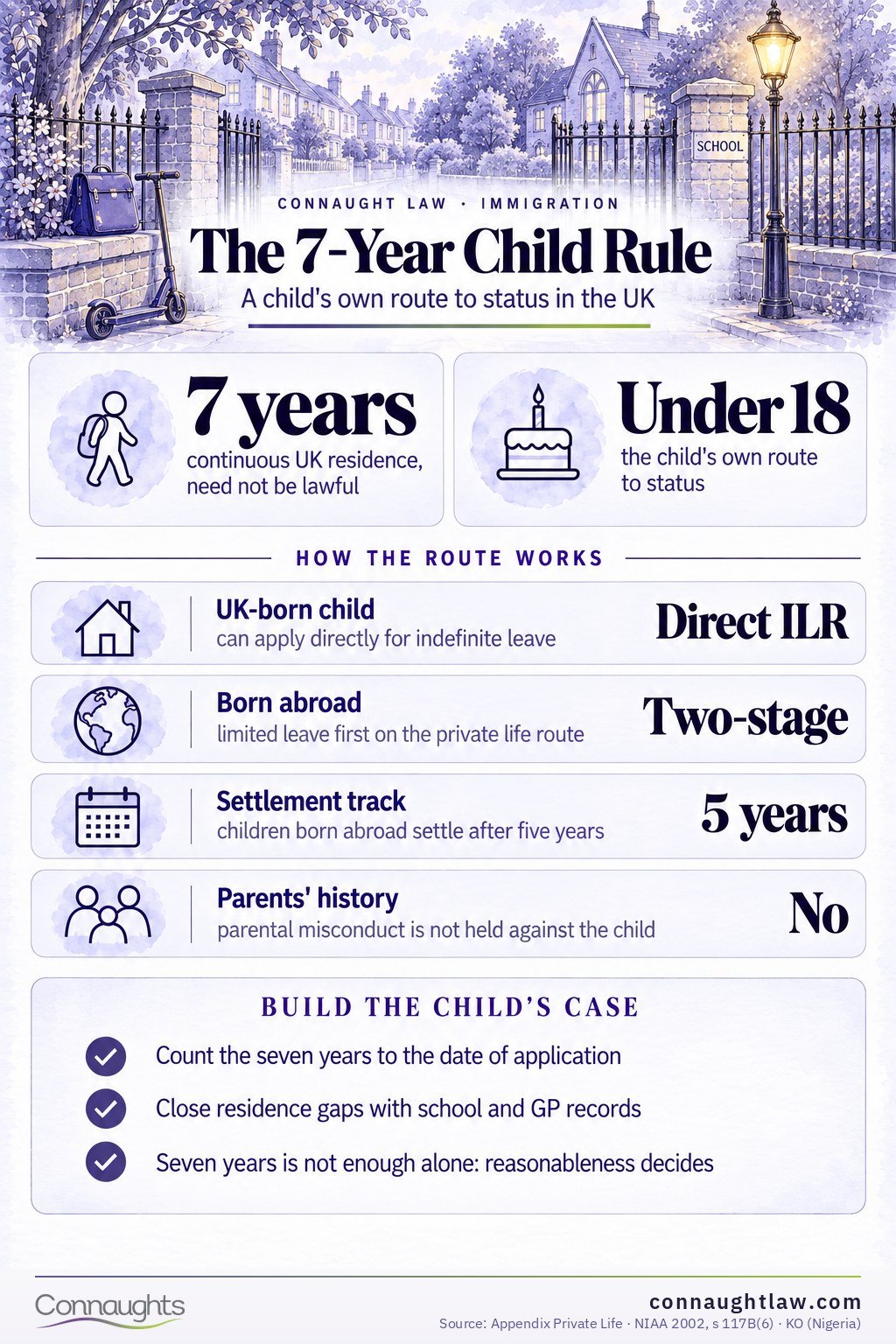
A child under 18 with seven continuous years of UK residence has a route to status in their own right, and the years need not have been lawful. What decides the case is not the arithmetic but whether it would be reasonable to expect the child to leave — a real-world question about schooling, language, health and roots, in which the parents' immigration history is not weighed against the child.
How the Rule Works
Core Legal Requirements
The rule lives in Appendix Private Life and section 117B(6) of the 2002 Act: a child under 18, seven continuous years of UK residence counted to the application date, and a finding that it would not be reasonable to expect the child to leave. The seven years need not be lawful — that is the route's point, and why it anchors so many families' regularisation strategies — but the reasonableness assessment is where every contested case is actually decided.
Rule Changes and Enhanced Pathways
Five-Year Settlement Tracks
What the Changes Do
The private life framework's reforms replaced the old ten-year treadmill for children: qualifying children now progress on five-year tracks to settlement, and the 2025 guidance updates consolidated the caseworking around the child's own position rather than the parents' conduct. The direction of policy has been consistent — children who qualify are moved to security faster, while their parents' status is resolved by reference to the child's.
Case Law Developments
The reasonableness test's modern shape comes from the courts: the Supreme Court's KO (Nigeria) line establishes that the question is the child's, assessed in the real world the child would face, with parental misconduct not held against them. Tribunal decisions since have concentrated on what "real world" means for British-educated children facing countries they have never lived in — length of residence, schooling stage, language, health and social ties all weigh, and a child at GCSE stage after a decade in UK schools is the paradigm case the rule protects.
Born in the UK or Not
UK-Born Children: Direct ILR
A child born in the UK who has lived here seven continuous years can apply directly for indefinite leave — no intermediate grants, no five-year wait — where the reasonableness and suitability requirements are met. It is the fastest settlement route in the children's rules, and families who qualify frequently do not know it exists.
Non-UK-Born Children: The Two-Stage Track
Children born abroad who accrue their seven years here apply first for limited leave on the private life route, then settle after five years on the track. The staging matters for planning: fees recur at each grant, and the child's route interacts with any siblings' and parents' applications — mapped across the family in our child ILR guide, with the citizenship endpoint in our ten-year child citizenship guide.
Fees and Costs
What Families Actually Pay
Cost of an Application
| Item | Amount | Notes |
|---|---|---|
| Limited leave application (FLR route) | £1,407 | Per applicant, in-country |
| Immigration health surcharge | £1,035 per year | Child rate £776 applies to under-18s |
| Direct ILR (UK-born, 7 years) | £3,226 | No IHS on settlement |
| Fee waiver | £0 | Where the fee is unaffordable — evidence-heavy but real |
Processing Times
What Influences Speed
Private life applications run months rather than weeks — the human rights caseload has no short published standard, and fee waiver applications add their own stage before the substantive clock starts. Complete evidence of the seven years and the child's integration is the main accelerant; requests for missing school records are the main brake.
Success Patterns
No official success rate is published for the route. The observable pattern from decided cases: applications for settled, school-age children with long residence and clean evidence succeed as the rule intends, while refusals concentrate where the seven years is arguable on the dates or the family's evidence leaves the child's integration to inference.
Evidence
Critical Documentation
Evidence by Category
- Birth certificate and, for UK-born children, the full birth registration.
- Residence chain: NHS records, health visitor and GP registration from arrival or birth.
- School records — enrolment, attendance, reports — the backbone of both residence and integration.
- Integration evidence: clubs, faith communities, friendships, achievements.
- Country evidence for the reasonableness test: what the child would actually face elsewhere.
The Reasonableness Test
The assessment asks a forward-looking question about the child's real alternatives: language, schooling continuity, health needs, family in the destination country, and the depth of UK roots seven-plus years have grown. It is child-centred by law — decision-makers weigh the child's best interests as a primary consideration under section 55 — and applications should be built the same way: the child's life documented first, the parents' circumstances explained second.
Applying
Which Form and What It Asks
Limited leave applications use the FLR(FP) online process; direct ILR for qualifying UK-born children uses the settlement route's forms. Both collect the residence history, the family's composition and the private life evidence, followed by biometrics — with the child's application often filed alongside parents' applications whose outcome depends on it. Sequencing the family correctly is half the strategy.
Common Mistakes
The recurring failures: counting the seven years to the wrong date, gaps in the residence chain the school records could have closed, treating the reasonableness test as automatic once seven years is shown, and fee waiver applications unsupported by real financial evidence. Each is preventable at preparation; a young adult who misses the child route altogether may still have the early ILR concession to fall back on.
Frequently askedQuestions about the 7-year child rule
What is the 7 year child route?
A private life route for children under 18 with seven continuous years' UK residence, where it would not be reasonable to expect them to leave. The residence need not have been lawful — the child's own position, not the parents' history, drives the assessment.
Can a child born in the UK get ILR directly?
Yes — a UK-born child with seven continuous years here can apply straight for indefinite leave at £3,226, skipping the limited-leave stages, where reasonableness and suitability are met.
How long does a 7 year child route application take?
Months rather than weeks — private life casework has no short published standard, and fee waiver stages extend it further. Complete school and health records from the start are the best acceleration available.
What does "not reasonable to leave" actually mean?
A real-world test of the child's alternatives: schooling stage, language, health, UK roots against actual conditions in the destination country. Parental immigration misconduct is not weighed against the child.
Do the parents get status too?
Usually — where a qualifying child cannot reasonably leave, a parent with genuine parental responsibility ordinarily qualifies on the parent route, which is why the child's application is sequenced first and built strongest.
Is there a fee waiver for child applications?
Yes — where the fee is unaffordable, a waiver application covers the fee and surcharge for limited-leave routes. It needs genuine financial evidence and adds processing time, but it keeps the route open to the families who most need it.
Send us the dates, the school history and the family's status picture. We'll confirm eligibility, sequence the family's applications and build the child's case the way decision-makers assess it.
Get Expert Advice