
Moving home means running a sale and a purchase at the same time, usually inside a chain of other people doing the same thing — which is why it is the transaction type where most things can go wrong. The craft is synchronisation: one solicitor running both files, exchange happening along the whole chain in one afternoon, and completion money cascading from the bottom of the chain to the top. This guide covers the process, the chain mechanics, the stamp duty — including the buying-before-selling surcharge — and the costs of doing both at once.
On This Page

Selling and Buying at Once: The Chain Transaction
A home mover is simultaneously a seller answering enquiries and a buyer raising them, with the sale proceeds funding the purchase deposit and both completions needing to land on the same day. Industry fall-through monitoring put collapses at just under 30% of transactions in 2024 — and home movers sit in the middle of most of them, because a chain fails at its weakest link, not its most careful one.
The sale and the purchase share a timetable, a deposit and a completion date, so splitting them between two firms adds a coordination seam exactly where the transaction is most fragile. One solicitor running both files can warrant the timing to both sides of you — and spot the day the two timetables start drifting apart.
The Process When You Are on Both Sides
Six Stages, Run Twice
- Instruction: identity checks once, both files opened together.
- Investigation: your buyer investigates your title while you investigate your seller's — and searches are ordered on the purchase.
- Enquiries: answered on the sale, raised on the purchase, with the same person watching both.
- Pre-exchange: contract reports both ways, deposit arrangements agreed, dates negotiated along the chain.
- Exchange: simultaneous across every linked transaction.
- Completion: funds cascade up the chain; you move once, on one day.
Searches on the Purchase
The purchase needs the standard bundle — local authority, drainage and water, environmental, plus area-specific extras — typically £250–£600 all in, with results your lender treats as current for around six months. Order them at instruction: in a chain, search turnaround is dead time everyone else waits on.
Chains: How They Work and How They Fail
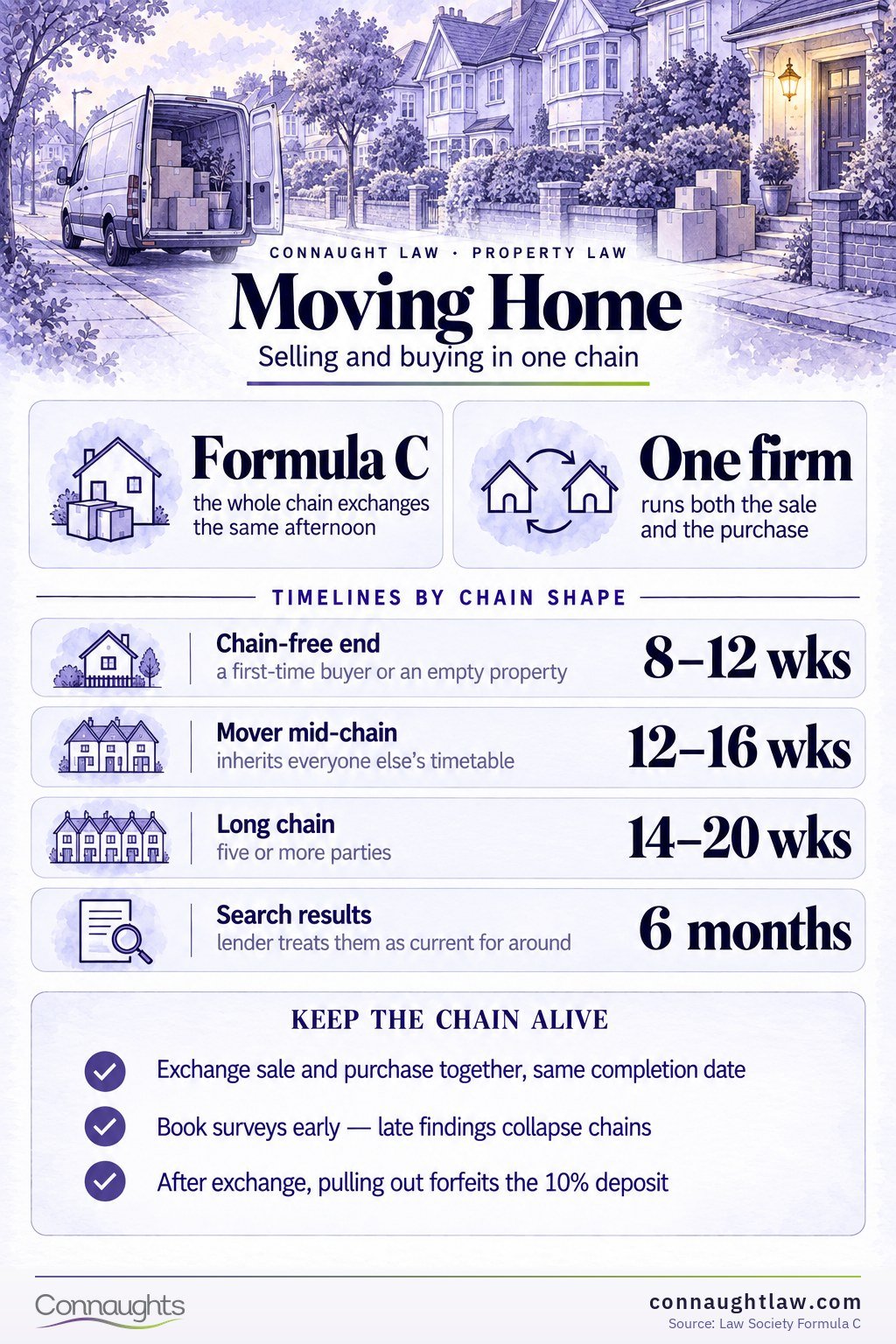
Chains exchange by telephone under the Law Society's Formula C: starting at the bottom, each solicitor obtains a release from the one above, allowing every contract in the chain to be exchanged the same afternoon, so nobody is bound to sell without being bound to buy. That is the machinery behind the phrase "the chain exchanged today" — a synchronised sequence of calls, not a meeting.
Where You Sit in the Chain
Position sets your risk. A chain-free bottom (a first-time buyer) or a chain-free top (an empty property) moves in eight to twelve weeks; a home mover in the middle inherits everyone's timetable and realistically runs twelve to sixteen; long chains of five or more parties stretch further and multiply the failure points. You cannot choose your chain, but you can know its shape before committing to dates — ask the agents to map it on day one.
Keeping the Chain Alive
- Speed at your own link: documents returned in days, enquiries answered the week they arrive.
- A mapped chain, so pressure lands on the genuinely slow link instead of the nearest one.
- Surveys booked early — findings renegotiate prices; late findings collapse chains.
- Realistic dates agreed once, not optimistic dates renegotiated monthly.
- A plan B discussed early where the chain looks fragile — break the chain with a sale-first-then-rent, or bridge, with eyes open on cost.
Stamp Duty for Home Movers
The Bands — and the Surcharge Trap
Home Mover SDLT Bands
| Price Band | Rate |
|---|---|
| Up to £125,000 | 0% |
| £125,001 – £250,000 | 2% |
| £250,001 – £925,000 | 5% |
| £925,001 – £1.5 million | 10% |
| Above £1.5 million | 12% |
Complete the purchase while still owning your old home and the 5% additional-dwelling surcharge applies to the whole price — £10,000 becomes £30,000 on a £400,000 purchase. But it is a deposit, not a sentence: sell your previous main home within three years and the surcharge comes back in full on a refund claim. Movers who must buy first should budget the cash flow, not mourn the money.
Costs and Timelines, Both Transactions In
The Combined Bill
- Legal fees on the sale and the purchase — the purchase side higher, leasehold higher again; see our fees page for our own pricing.
- Searches on the purchase: £250–£600.
- Land Registry fee, scaled to the purchase price.
- Bank transfer fees on both redemption and purchase funds.
- Leasehold extras where either property is a flat: management packs on the sale, notice fees on the purchase.
- Combined legal costs commonly land in the £2,400–£2,900 range before SDLT — the tax and the removals, not the lawyers, dominate the true cost of moving.
Realistic Timelines by Chain Shape
Two-party transactions run eight to twelve weeks; a standard chain twelve to sixteen; long chains fourteen to twenty. The variable you control is your own link's speed — the variable you cannot control is the slowest other link, which is why agreeing dates before the chain is mapped is the commonest self-inflicted wound in moving.
Exchange and Completion in Sync
Your sale contract and purchase contract must exchange simultaneously with matching completion dates — exchanging one without the other leaves you legally bound to sell with nowhere to go, or bound to buy a house you cannot fund. The deposit usually travels: your buyer's 10% is used, with consent along the chain, as your deposit upwards, with any shortfall topped up in cash. A gap of a week or two between exchange and completion remains the sane choice; same-day exchange and completion is possible but converts moving day into a single point of failure.
Completion Day Logistics
Completion money flows upwards: the bottom buyer's funds complete the first purchase, releasing that seller's funds to complete the next, and so on to the top. Everyone above the bottom is waiting on someone else's bank transfer, which is why solicitors want mortgage advances a day early, why completions target early afternoon, and why the top of a long chain gets its keys at 4pm. Build the day around the cascade and it is boring — which is the goal.
Questions about moving home
How long does conveyancing take when selling and buying together?
Twelve to sixteen weeks in a standard chain, eight to twelve where either end is chain-free, and up to twenty in long chains. Your own responsiveness sets the floor; the slowest link in the chain sets the ceiling.
How do solicitors exchange contracts in a chain?
By telephone under the Law Society's Formula C: releases are obtained up the chain and every contract exchanges the same afternoon, so no one is bound to sell without being bound to buy. The whole chain either exchanges together or not at all.
What stamp duty does a home mover pay?
Standard rates on the purchase — nothing to £125,000, then 2%, 5%, 10% and 12% through the bands — so a £400,000 purchase pays £10,000. Buy before selling your old home and a 5% surcharge applies on top, refundable if you sell within three years.
Does my buyer's deposit fund my purchase deposit?
Usually yes — the 10% is passed up the chain with each seller's consent, with any shortfall topped up in cash where you are buying at a higher price. Your solicitor agrees this at exchange; it is standard chain practice, not a favour.
What happens if the chain collapses?
Before exchange, anyone can walk away and losses lie where they fall — survey and legal fees included. After exchange, withdrawal forfeits the 10% deposit and invites damages claims, which is why exchange only happens when every link is genuinely ready.
Should I use the same solicitor for the sale and purchase?
Yes. One firm running both files keeps the timetables locked together, reuses your identity checks, moves the deposit up the chain cleanly and usually costs less than two firms duplicating the coordination.
Tell us both addresses, the chain as you understand it and your ideal dates. We will run the two files as one transaction and tell you early if the chain's timetable and yours are drifting apart.
Get Expert Advice