Remortgage Conveyancing UK 2026: Complete Legal Process Guide

Remortgage conveyancing is the legal work that moves your mortgage from one lender to another - checking title, redeeming the old loan, registering the new charge - and in 2026 it decides whether you actually capture the saving that made you switch. With the Bank of England base rate held at 3.75% in June 2026 but average standard variable rates still at 7.34%, a borrower drifting onto SVR pays thousands a year more than one who completes on time. This guide explains when legal work is required, each step of the process, realistic costs and timescales, and how lender panel rules shape who can act for you.

Understanding Remortgage Conveyancing UK 2026

A remortgage is legally a new secured loan: the incoming lender will not advance funds until a solicitor confirms the property is good security, existing charges will be discharged, and its new charge will register with first priority at HM Land Registry. That is why switching lenders always involves conveyancing, while staying put usually does not. The work is lighter than a purchase - no seller, no contract chain - but the failure modes are the same: missed dates, defective titles and unprepared paperwork.

The 2026 market keeps the stakes visible. Current market data shows average two-year fixed rates around 5.13% against an average SVR of 7.34% - a gap that on a £200,000 repayment mortgage costs well over £300 a month if a deal expires with no replacement completed. Rate context moves, but the structural lesson does not: the legal work belongs on the critical path, started when the new deal is chosen rather than when the old one has already died.

Checking Remortgage Rates and Key Dates

Rates themselves need checking on the day, not remembering from headlines. The Bank of England's bank rate page shows the current official rate and decision dates, while comparison trackers such as Uswitch's daily mortgage rate monitor publish live averages across lenders. What matters for conveyancing is not predicting the next move but knowing your own dates: current deal expiry, offer validity, and any early repayment charge window that shapes when completion should land.

Remortgage Conveyancing Uk Process Timeline Infographic — Six Steps From Id And Aml Checks To Completion When Switching Lender

When You Need a Remortgage Conveyancing Solicitor

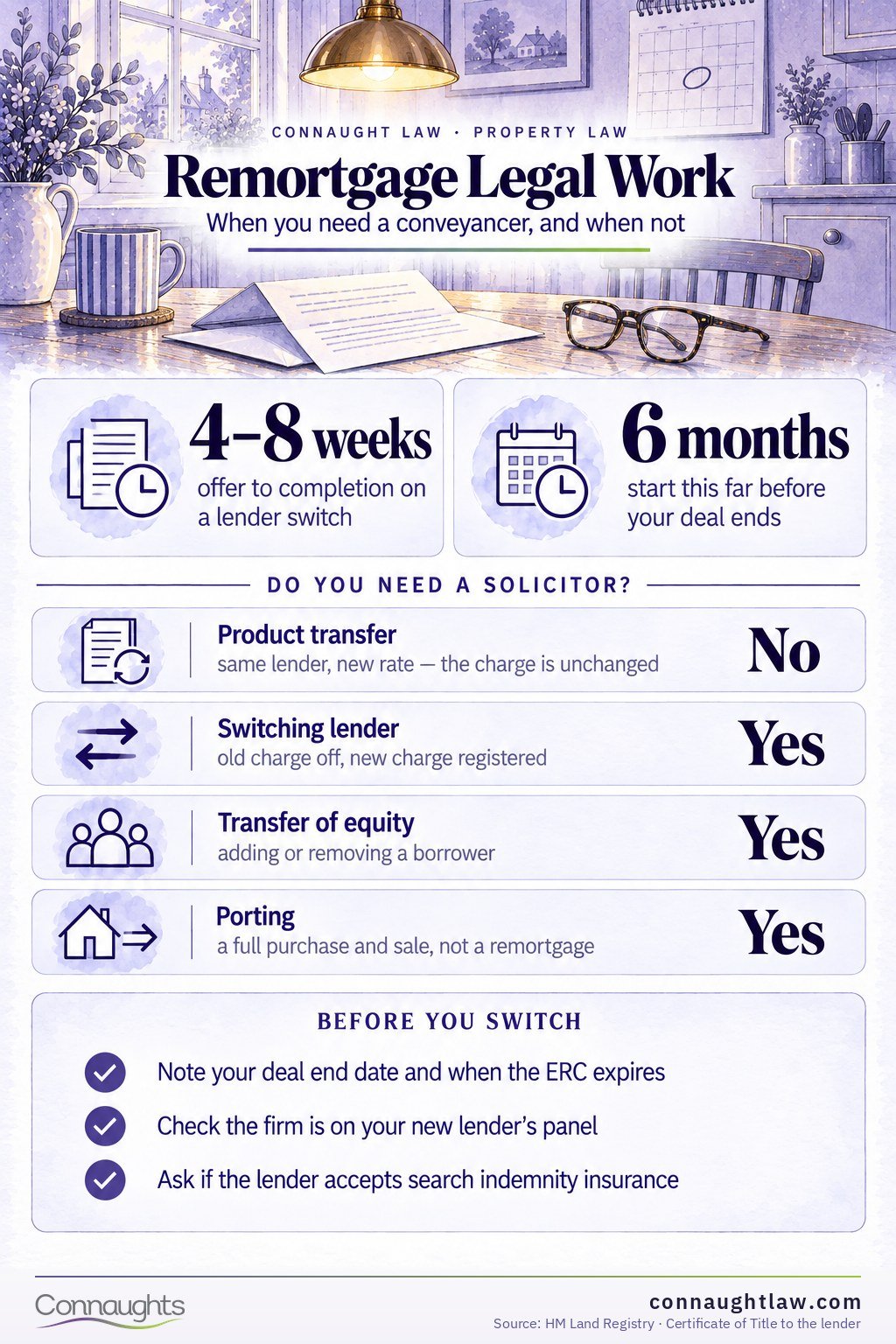
The dividing line is whether the lender changes. A product transfer - a new rate with your existing lender on the same borrowing - involves no legal work and completes in days. A true remortgage to a different lender always requires conveyancing, because the old charge must be redeemed and a new one registered. Between the poles sit further advances with your current lender, which usually need no solicitor, and unencumbered owners mortgaging a property for the first time, which is treated as a remortgage for legal purposes.

Several situations add a second transaction to the same file. Adding or removing a name - after marriage, separation or a buyout - is a transfer of equity completed alongside the remortgage, often with a declaration of trust recording the new shares.

Borrowing against a let property, switching a home onto a buy-to-let basis, or raising capital for a further purchase each brings its own lender conditions and, for lets, tenancy and licensing checks. Family money reducing the balance at remortgage attracts the same documentation rules as gifted deposits on purchase.

Product Transfers, Porting and Consent to Let

Two near-neighbours are worth separating from the remortgage proper. Porting moves an existing mortgage product to a new property - that is purchase-and-sale conveyancing with a lender consent layered on, not a remortgage. Consent to let keeps the existing residential mortgage while permitting tenants temporarily; it involves no conveyancing but does involve conditions, fees and usually a rate loading, and letting without consent breaches the mortgage. Where letting is the long-term plan, a formal switch to a buy-to-let product - with legal work - is the durable answer.

Separation buyouts show all the moving parts at once: one party keeps the home, the other is removed from title and mortgage, and the balance is often increased to fund the payment between them. The remortgage cannot complete until the new lender is satisfied the remaining borrower affords the loan alone, and where a court order or financial settlement specifies the terms, the conveyancing must match it precisely. Sequencing legal, mortgage and family-law advice together prevents the common stall in which each professional waits on the others.

Probate and inherited properties follow a similar coordination rule: where a property passing through an estate is being mortgaged by the beneficiary, the assent or transfer must register before or alongside the new charge, and lenders differ on how much of that sequencing they will accept in one application. Flagging the history at the outset lets the solicitor design the order of registrations once, rather than unpicking a rejected application later.

The Remortgage Conveyancing Process Step by Step

The file opens with identity and source-of-funds checks, then title review: the solicitor examines the registered title for restrictions, second charges, notices and anything the new lender's instructions flag. Instead of full local searches, remortgage lenders commonly accept search indemnity insurance - one reason remortgage legal work runs faster and cheaper than purchase conveyancing - though some lenders and some titles still demand fresh searches.

Leasehold Remortgage Requirements

Leasehold properties carry extra steps: checking the lease meets the lender's minimum term and terms, obtaining management information, and serving notice of charge on the landlord or agent after completion, with their fees payable. Meanwhile the solicitor requests a redemption statement from the outgoing lender, reports to you on the mortgage offer's conditions, and has you sign the new mortgage deed.

On completion day the new advance redeems the old loan to the penny, any surplus is released to you, and the solicitor lodges the discharge and the new charge for registration at HM Land Registry.

Behind the visible steps sits the lender's instruction set - standard requirements covering title, insurance, occupiers and priority. Expect the solicitor to confirm buildings insurance meeting the lender's minimum cover from completion, obtain consent or occupier waivers from adults living at the property who are not borrowers, and carry out final bankruptcy and priority searches that freeze the register while the new charge is lodged. Free government-backed guidance on the borrower's side of the process is available from MoneyHelper, which pairs usefully with legal advice on the property side.

Redemption Statements Rule the Timetable: the single most common remortgage delay is waiting for the outgoing lender's redemption figure - and penalties for miscalculated shortfalls sit with the borrower. Instruct early, authorise your solicitor to request figures immediately, and re-request if completion slips past the statement's validity date.

Remortgage Conveyancing Costs

Most remortgages price in one of three ways. "Free legals" deals bundle a lender-appointed panel firm at no fee to you - efficient for straightforward cases, but the firm acts on the lender's instructions, handles enormous volumes, and will not advise on anything beyond the remortgage itself. Cashback deals pay a fixed sum toward legal costs and let you instruct your own solicitor. Paying your own fixed fee buys dedicated representation - the sensible route where a transfer of equity, trust deed, lease issue or tight deadline is involved.

Beyond the professional fee sit modest disbursements: search insurance or searches, Land Registry office copies, bankruptcy and priority searches, the registration fee itself - scaled to the loan and cheaper for electronic applications - and, for leaseholds, the landlord's notice fees. Ask any firm for a written all-in quote distinguishing fee from disbursements, and treat quotes that bury leasehold extras as a warning sign.

Complexity, not postcode, drives cost: unregistered titles, second charges, expired planning or building-regulation issues surfacing on review, and Help to Buy equity loans - which must be redeemed or re-approved through the scheme administrator at remortgage - all add stages a quote should anticipate once disclosed. Cost comparisons should also weigh speed: a cheaper file that misses your rate deadline is the most expensive option on the market.

Remortgage Timeline: How Long the Process Takes

A clean freehold remortgage typically completes within a few weeks of the mortgage offer; leasehold files, managed properties and transfers of equity run longer, driven by third parties - managing agents' information packs, landlords' consents and outgoing lenders' statements. Mortgage offers themselves generally remain valid for around six months, which sets the planning window: pick the new deal three to six months before your current rate expires, and instruct the legal work at application, not at offer.

Cost of Drifting onto SVR: at mid-2026 averages - 7.34% SVR against low-fives fixed rates - each month on the reversion rate costs a typical £200,000 borrower several hundred pounds. Diarise the expiry, build the legal file early, and the deadline becomes routine rather than expensive. Where a deal has already lapsed, complete the replacement quickly rather than perfectly - every SVR month spent optimising is itself a cost.

Completion dates on remortgages are flexible in a way purchases are not: there is no chain, so the solicitor can complete the day the redemption figure, offer conditions and registration requirements all line up. The discipline is in sequencing - deed signed and witnessed early, direct debits and insurance requirements satisfied, and buffer left for the outgoing lender's processing rather than assuming same-day everything.

Early Repayment Charges and Completion Timing

Early repayment charges deserve their own line on the timeline. Completing a new deal before the old one's ERC period ends can trigger a percentage charge on the whole balance - sometimes thousands - while waiting a few weeks lets it expire; conversely, some borrowers deliberately pay an ERC to escape a high rate early. The solicitor's redemption statement is where the ERC becomes a hard number, and completion dates should be chosen with that figure in front of you, not discovered in it.

Second charges complicate redemption arithmetic in a different way. A secured loan behind the first mortgage must either be repaid at completion or agree to postpone its priority to the new first lender - and postponement is the second lender's decision, on its timescale and fee. Discovering a forgotten secured loan mid-transaction is a genuine timetable event, so disclose every borrowing secured on the property at instruction, including old ones you believe were settled.

Lender Panel Requirements and Choosing a Solicitor

Lenders only accept legal work from firms on their conveyancing panel, managed directly or through panel networks, so the first question for any solicitor is simply whether they are on your new lender's panel. Most established residential firms sit on the major panels; where a firm is not, the choice is a different firm, a different lender, or separate representation with two firms involved - workable but slower and costlier, and worth avoiding on a deadline.

Verification is quick and worth doing before instruction: confirm the firm's SRA or CLC registration, confirm panel membership for the specific lender named on your offer, and confirm who will actually run the file. On the lender side, remortgage instructions arrive through panel management platforms, and a firm that handles them daily will quote turnaround times from experience rather than hope - a better predictor of hitting your deadline than any headline fee.

Borrowers control more of the timetable than they think. Return identity documents and the signed deed promptly, complete the lender's direct debit and insurance requirements early, chase your existing lender for the redemption statement if authorised, and respond to occupier-consent requests the week they arrive. Files rarely stall on law; they stall on a signature sitting in a drawer while a rate deadline approaches.

After completion, close the loop. The old lender's discharge and the new charge can take time to appear on the register while HM Land Registry processes the application, so diarise a check that the title ultimately shows exactly one charge - the new one - and keep the completion statement, redemption statement and registration confirmation with your property papers. Those three documents answer most future questions, from the next remortgage's requisitions to a buyer's enquiries when you eventually sell.

Free Legals vs Your Own Solicitor

Choosing between a free-legals panel firm and your own solicitor is really a complexity decision. Straightforward single-name freehold switches suit volume operations. Anything layered - equity transfers on separation, trust arrangements between unequal contributors, lease defects surfacing on title review, interest-only conditions of the kind covered in our guide to interest-only mortgage legal considerations, or hard rate deadlines - argues for dedicated representation through our residential property team, where the remortgage is handled alongside the documents that protect the ownership behind it.

Capital-raising remortgages add a purpose layer: lenders ask what the extra borrowing funds, and their instructions may require the solicitor to confirm or even disburse it - paying off specified debts directly in consolidation cases, or holding funds to an undertaking where a home improvement or onward purchase is the stated purpose. Answer the purpose questions accurately at application, because a mismatch surfacing at completion is a condition failure, and condition failures at the eleventh hour are how rate deadlines die.

Frequently Asked Questions

Do I need a solicitor to remortgage?

Yes, if you are switching lenders: the new lender requires a solicitor or licensed conveyancer to check title, redeem the existing mortgage and register its charge. You do not need one for a product transfer with your current lender, and usually not for a further advance from the same lender.

What is the difference between a remortgage and a product transfer?

A product transfer keeps your existing lender and simply changes the rate or term - no legal work, days to complete. A remortgage moves the loan to a new lender, which requires full conveyancing. Product transfers are simpler; remortgages open the whole market and allow borrowing or ownership changes.

How long does remortgage conveyancing take?

A straightforward freehold case typically completes within a few weeks of the mortgage offer; leasehold properties, transfers of equity and consent-to-let situations take longer because third parties control key documents. Starting the legal work when you apply - not when the offer arrives - is the reliable way to hit a rate deadline.

What does "free legals" actually mean?

The lender appoints and pays a panel firm to do the legal work. It genuinely costs nothing, but the firm works to the lender's instructions at volume: it will not advise on trust deeds, transfers of equity or title problems beyond the remortgage, and service levels reflect caseload. Cashback alternatives let you fund your own solicitor instead.

Why does a leasehold remortgage cost more?

The solicitor must review the lease against the lender's requirements, obtain management information, and serve notice of the new charge on the landlord after completion - and landlords and agents charge fees for packs and notices. Lease defects found at this stage, such as short terms, may need fixing before the lender will lend.

Can I remove or add someone to the mortgage when I remortgage?

Yes - a transfer of equity is commonly completed simultaneously, subject to the new lender's affordability checks on those remaining. Expect additional legal work, possible stamp duty where mortgage debt is assumed, and a declaration of trust where the new ownership shares are unequal.

Are searches required for a remortgage?

Usually not in full: most lenders accept no-search indemnity insurance for remortgages, which is faster and cheaper than fresh local searches. Some lenders, high-value cases or unusual titles still require full searches, and your solicitor will confirm the requirement from the lender's instructions at the outset.

What happens on remortgage completion day?

The new lender releases the advance to your solicitor, who redeems the old mortgage against a current redemption statement, accounts to you for any surplus, and then registers the discharge and the new charge at HM Land Registry. You start the new deal immediately; the register updates after completion.

Expert Remortgage Conveyancing Support
Deadline-Driven Remortgages

Files opened at application, redemption figures chased early and completions sequenced so rate deadlines are met, not mourned

Equity Transfers and Trusts

Name changes, buyouts and declarations of trust completed alongside the remortgage with the tax and lender consents handled

Leasehold and Complex Titles

Lease reviews against lender requirements, management packs, notices and title fixes that keep offers alive

A remortgage saves money if it completes on time and on the right foundations — for conveyancing that treats your rate deadline as the client, contact our residential property team at Connaught Law.

Contact Our Property Team

Disclaimer:

The information in this blog is for general information purposes only and does not purport to be comprehensive or to provide legal advice. Whilst every effort is made to ensure the information and law is current as of the date of publication it should be stressed that, due to the passage of time, this does not necessarily reflect the present legal position. Connaught Law and authors accept no responsibility for loss that may arise from accessing or reliance on information contained in this blog. For formal advice on the current law please don't hesitate to contact Connaught Law. Legal advice is only provided pursuant to a written agreement, identified as such, and signed by the client and by or on behalf of Connaught Law.