
A gifted deposit — family money given, not lent, towards a property purchase — now sits behind a majority of first purchases. Lenders take the money gladly, but on conditions: the right donor, a gift letter that says the right things, and a paper trail that survives the money-laundering checks. Get any of those wrong and the mortgage is declined at the worst possible moment. This guide covers the lender rules, the common rejection triggers and their fixes, the tax position, and how the giver protects the money.
On This Page

Family Money in a Purchase: What Makes a Gift Work
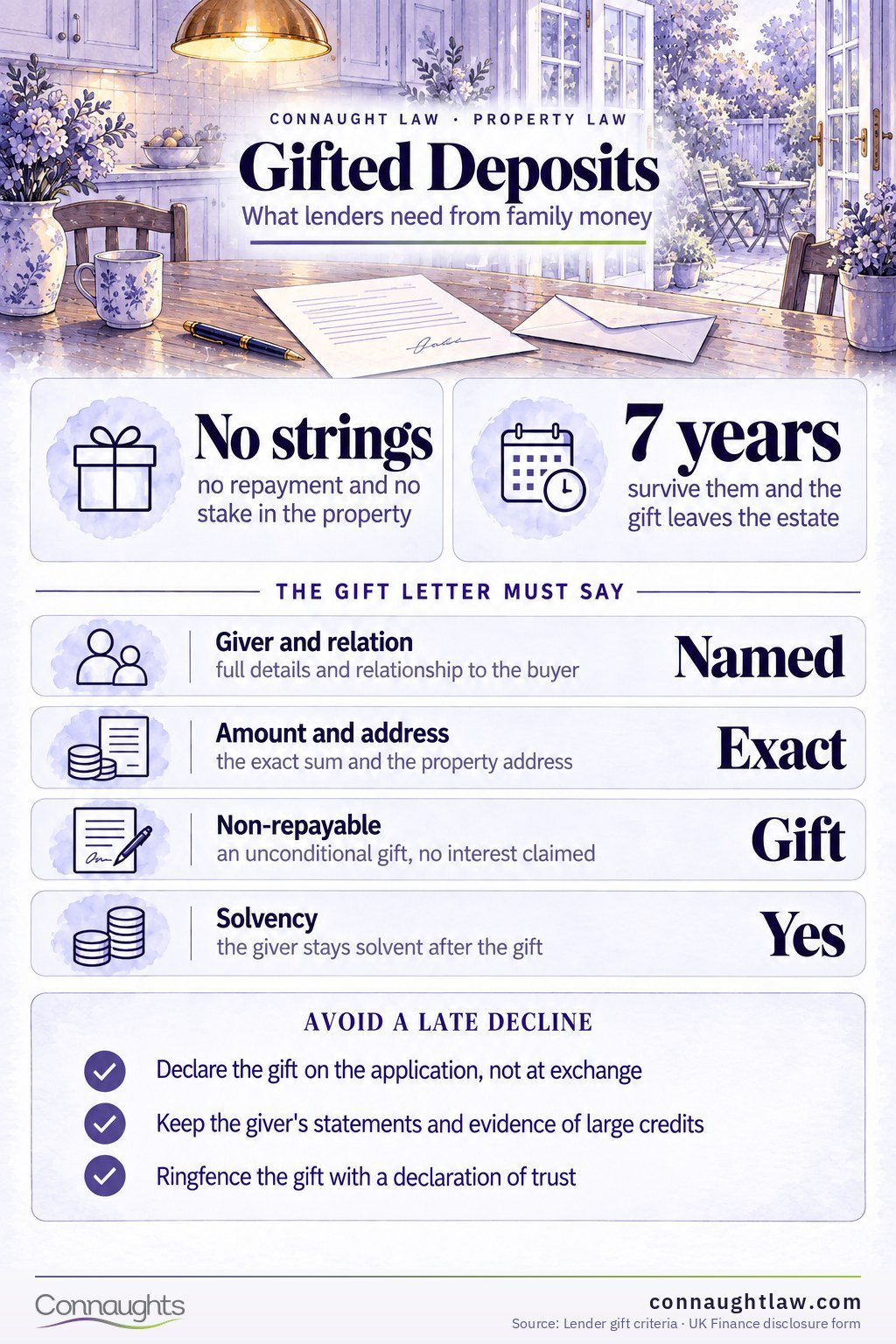
The word doing the work is "gift". A true gift carries no repayment obligation and no stake in the property — that is what the lender is underwriting, what the letter certifies, and what the anti-money-laundering checks verify. Everything that goes wrong with gifted deposits traces back to one of those three elements failing: a donor the lender will not accept, a gift that is secretly a loan, or money whose origin cannot be shown.
Savills research published in June 2026 found 53% of first-time buyers relied on family gifts, loans or inheritance in 2025, with £8.3 billion paid in gifts and loans and total family support around £11 billion. This is the mainstream route onto the ladder — which is exactly why lenders have built detailed rules around it.
What Lenders Require Before Accepting a Gift
Most lenders accept gifts from close family — parents, step-parents, grandparents, siblings — while policies diverge on aunts, uncles, cousins, friends and employers. Some cap the gifted proportion of the deposit; some require the giver to take independent legal advice on larger gifts; and almost all refuse gifts from anyone with an interest in the transaction itself. The single best move is disclosure at application stage: a gift declared on day one is routine, while the same gift surfacing at exchange looks like concealment.
Documents the Underwriter Wants
- The signed gift letter, in the lender's required form where it has one.
- Identity and address evidence for the giver.
- The giver's bank statements showing the funds and how they accumulated.
- Source evidence for any large recent credits — a property sale, inheritance grant or investment redemption.
- Confirmation the money travels from the giver's own account, not through third parties.
Family Gifts, Builder Incentives and Vendor "Gifts"
Developer contributions and cashback are permitted within disclosed limits and must appear on the UK Finance disclosure form; a vendor "gift" is treated as a price reduction, not hidden assistance. The bright line is honesty with the lender: a gift letter declaring "no repayment" while the family privately treats the money as a loan is mortgage fraud, not paperwork pragmatism.
Why Gifted Deposit Mortgages Get Rejected
Declines cluster around a handful of triggers, and almost all of them are fixable — usually by changing lender or structure rather than abandoning the purchase.
One: a donor outside the lender's accepted relationships — a friend, cousin or employer where the criteria say close family. Two: a "gift" with repayment strings or an expected stake, which underwriters read as an undisclosed loan or interest. Three: source-of-funds failure — cash savings with no trail, crypto without exchange records, money routed through third-party accounts. Four: late disclosure, after an application built on "own savings". Five: an overseas gift without verifiable bank evidence and transfer records.
The fixes follow the causes. A donor problem is usually a criteria problem — another lender accepts wider relationships, which is broker work, not luck. A strings-attached problem is a structure problem: document it honestly as a loan with the lender's knowledge, or move to a joint borrower structure. A source problem needs the trail rebuilt — statements, sale completions, exchange records — before reapplying. And every disclosure problem is solved by doing it earlier: the application form, not the solicitor's file, is where the gift first appears.
The Gift Letter and the Money-Laundering Checks
- The giver's full details and relationship to the buyer.
- The exact amount and the property address.
- That the money is an unconditional, non-repayable gift.
- That the giver claims no interest in the property and will not live there (or discloses it if they will).
- That the giver remains solvent after making the gift.
- Signature and date — witnessed where the lender requires it.
Alongside the letter, the solicitor's anti-money-laundering duty applies to the giver as if they were a client: several months of bank statements and evidence explaining any large credits. Gifts can also be unwound if the giver becomes bankrupt within the statutory clawback period — one more reason the solvency confirmation is not boilerplate.
Overseas Gifts: The Enhanced Checks
Money arriving from abroad passes the same tests with more friction: foreign bank evidence, certified translations where documents are not in English, and the currency-transfer records connecting the overseas account to the UK completion funds. Start assembling that file when the offer is made, not when the lender asks — international document-gathering is the classic cause of a lost completion date.
Inheritance Tax: The Seven-Year Rule
A gifted deposit is a potentially exempt transfer: survive seven years and it leaves the giver's estate entirely. Death within seven years brings it back into account against the frozen £325,000 nil-rate band, with taper relief reducing the tax — not the value — where death falls between years three and seven. There is no tax at the moment of gifting, and nothing for the buyer to pay.
Exemptions That Shrink the Exposure
Each tax year carries a £3,000 annual exemption (plus one year's unused carry-forward), £250 small gifts per recipient, and £5,000 for a wedding gift from a parent. Larger regular gifts made from genuine surplus income, properly evidenced, are exempt without limit — the most under-used relief in family planning. A couple gifting together can layer these, and a short letter recording which exemptions were used saves an executor real difficulty later.
Protecting the Gift: Declarations of Trust
Where the buyer purchases with a partner, the standard protection is buying as tenants in common with a declaration of trust placing the gifted sum in the child's share. Unmarried couples need this most — there are no automatic cohabitation rights to fall back on. The alternatives are a formal secured loan (with the lender's consent) or keeping the parent off the money as a gift but on the mortgage as a supporting borrower.
Joint Borrower, Sole Proprietor
JBSP structures put a parent's income behind the mortgage without putting their name on the title. Done properly it preserves the child's first-time buyer relief and avoids the additional-dwelling surcharge, because the parent never owns the property. The price is real: the parent is jointly and severally liable for the whole mortgage, and lenders require them to take independent legal advice before signing — advice worth taking seriously rather than treating as a formality.
Stamp Duty: Where Gift Structures Go Wrong
- The gift itself is SDLT-neutral — money changing hands within a family attracts no stamp duty.
- First-time buyer relief: nothing to £300,000, 5% on the slice to £500,000, no relief above — and every joint buyer must qualify.
- The classic error: putting a home-owning parent on the title "for security". That triggers the 5% additional-dwelling surcharge on the whole price and destroys the relief.
- The same protection is available without the damage — declaration of trust or JBSP, per the sections above.
Questions about gifted deposits
Why would a gifted deposit mortgage be rejected?
Five usual reasons: a donor outside the lender's accepted relationships, a gift with repayment strings, funds whose source cannot be evidenced, disclosure arriving late in the application, or an overseas gift without a verifiable trail. Each has a fix — often just a different lender or an honest restructure.
Who can gift money for a house deposit?
Close family — parents, step-parents, grandparents, siblings — with almost every lender. Friends, cousins and employers are accepted by some lenders and refused by others, so donor identity should drive lender choice. Anyone with an interest in the transaction itself is refused everywhere.
What must a gifted deposit letter include?
The giver's details and relationship, the exact amount and property address, confirmation the money is an unconditional non-repayable gift with no interest in the property claimed, a solvency statement, and a signature. Many lenders have their own form — use it where one exists.
Is there tax to pay on a gifted deposit?
Nothing when the gift is made. The only exposure is inheritance tax if the giver dies within seven years and their estate exceeds the £325,000 nil-rate band, with taper relief from year three. Annual exemptions and the surplus-income relief can shelter part or all of it.
Can my parents protect the money if my partner and I split up?
Yes — buy as tenants in common with a declaration of trust ringfencing the gifted sum in your share, or structure the money as a formal documented loan with the lender's consent. Doing nothing leaves the gift exposed to a straight half-share split.
Should a parent go on the title to protect their gift?
Almost never. A home-owning parent on the title triggers the 5% additional-dwelling surcharge on the entire price and destroys first-time buyer relief. A declaration of trust or a joint borrower, sole proprietor mortgage achieves the protection without the tax damage.
Tell us who is giving, how much, and where the money has been sitting. We will tell you what the lender will ask for, how to structure the protection, and anything about the trail that needs fixing before it costs you the mortgage.
Get Expert Advice