
When separated parents live in different countries — or one wants to — children's arrangements gain an international layer: consent for travel, permission for relocation, and the Hague Convention machinery when a child is taken without agreement. Two instruments do most of the work, the 1980 and 1996 Hague Conventions. This guide covers holidays abroad, permanent relocation, abduction, and which country's courts decide.
On This Page
Children's Arrangements Across Borders
International families are now ordinary families, but the law still treats a national border as a serious line to cross with a child. Consent or a court order is needed to take a child abroad, relocation cases are decided on welfare with real rigour, and removal without consent is both a civil wrong the Hague Convention reverses and, in many cases, a criminal offence under the Child Abduction Act 1984.
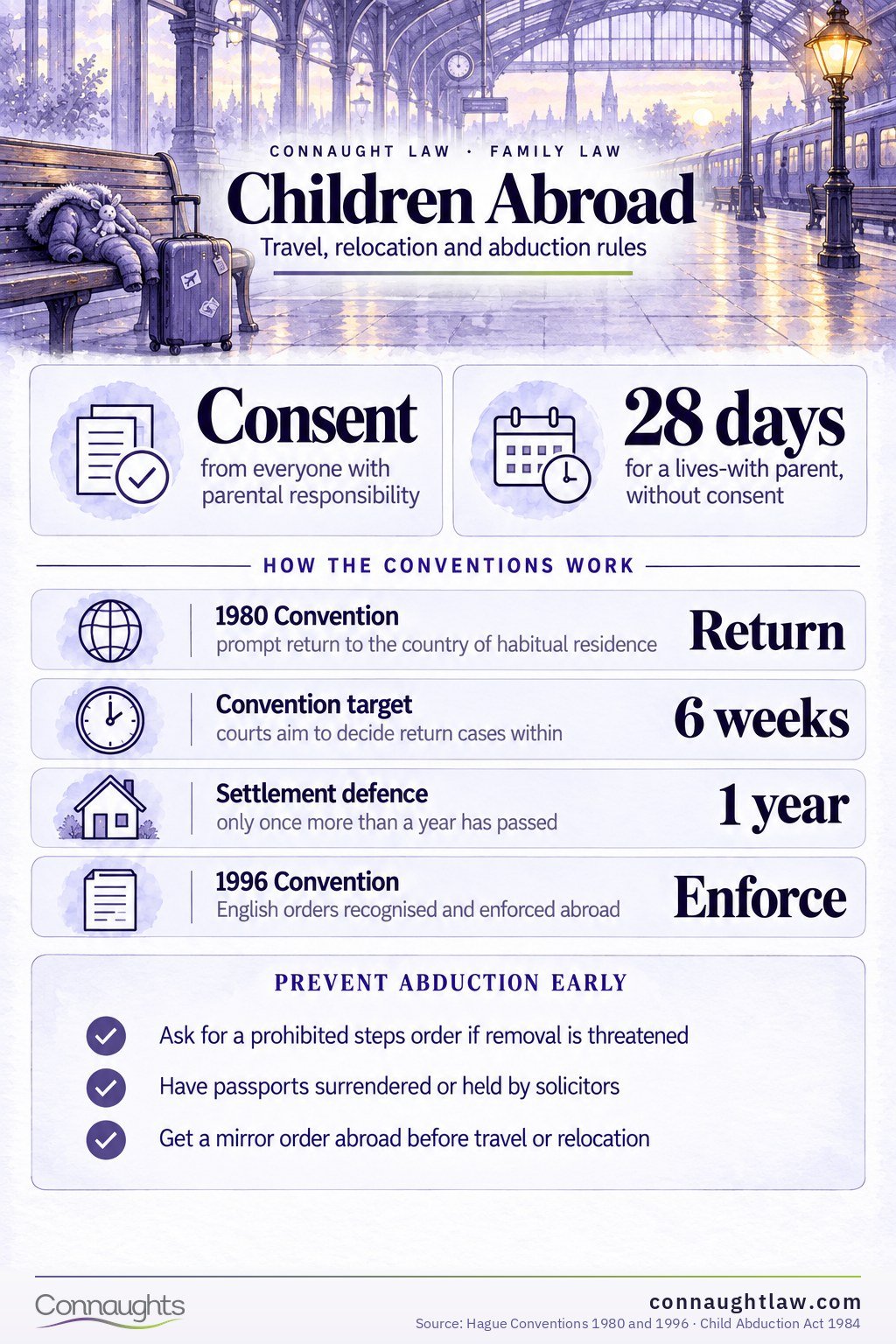
Taking a child out of England and Wales needs the consent of everyone with parental responsibility or the court's permission — for a holiday as much as a move. The exception: a parent with a "lives with" order may travel abroad for up to 28 days without consent unless an order says otherwise.
Holidays and Temporary Travel
For a trip abroad you need consent from everyone with parental responsibility, or the court's leave — with the 28-day exception for a lives-with parent. Unreasonable refusals can be overridden by a specific issue order, and a court weighing a holiday application looks at the destination, the plans, and any real risk of non-return.
Consent Letters and Border Checks
Carry a signed, dated consent letter from the other parent with their contact details, plus evidence of your relationship to the child — birth certificate, divorce order where surnames differ. Border officers in the UK and abroad do ask, particularly a lone parent with a different surname, and a letter turns an interrogation into a formality.
Relocating Abroad With a Child
Moving a child abroad permanently without consent or a court order is abduction, however good the motive. Contested relocation is decided on the child's welfare — the realism of the relocation plan, the effect on the child's relationship with the left-behind parent and how it will be preserved, the motives on both sides, and the impact of refusal on the applicant. The same framework, at lower intensity, governs moves within the UK.
How Relocation Applications Are Decided
The child's welfare is the only principle; everything else is analysis. The older guidance in Payne v Payne — the applicant's genuine motives, the realism of the plan, the impact of refusal — survives as a checklist of factors inside a holistic welfare evaluation, not as a presumption for or against the moving parent. In practice courts weigh three things hardest: whether the relocation plan is fully built or aspirational; whether the proposals for preserving the other parent's relationship are genuine, funded and enforceable in the destination country; and what each outcome actually does to this child's life.
Applications succeed on detail: a confirmed school place, housing, income, family support at the destination, costed travel plans for contact and a schedule the left-behind parent can hold the applicant to — ideally backed by a mirror order abroad. They fail on thin plans, on motives that read as escape from the other parent, and on contact proposals that would not survive the first missed flight.
Abduction and the 1980 Hague Convention
When a child is wrongfully removed to, or retained in, another Convention country, the 1980 Hague Convention requires their prompt return to the country of habitual residence, so that the courts there can decide the substantive dispute. Applications go through the central authority — in England and Wales, ICACU — and Convention cases are heard fast, by design. Defences are narrow: grave risk of harm, a settled older child's objections, consent or acquiescence. Under the Child Abduction Act 1984, taking a child out of the UK without the required consents is also a criminal offence.
The Narrow Defences, and Why the Clock Rules Everything
Return is near-automatic unless a defence succeeds, and the defences are deliberately narrow: a grave risk that return would expose the child to physical or psychological harm; the objections of a child old and mature enough to be heard; consent or acquiescence by the left-behind parent; and, where more than a year has passed before the application, the child's settlement in the new country. That last defence is the reason speed is not just tactical but structural — Convention courts aim to decide cases within six weeks, and every month of delay strengthens a settlement argument. A left-behind parent who hesitates loses options; one who applies immediately rarely does.
Preventing Abduction Before It Happens
Prevention beats every remedy in this field. If the warning signs are there — threats to leave, ties wound down, documents gathered, tickets hinted at — the tools are immediate: an urgent prohibited steps order forbidding removal, an order for passports to be surrendered or held by solicitors, and in true emergencies a port alert flagging the child at UK borders — with police action available where departure is imminent. None of these requires waiting for something to happen: courts hear genuine removal-risk applications urgently, without notice where necessary, and would far rather restrain a threatened abduction than reverse a completed one.
Which Country's Courts Decide
Jurisdiction normally follows the child's habitual residence — the country where the child's life is in fact centred — a concept our habitual residence guide unpacks. The 1996 Hague Convention then carries orders across borders: an English child arrangements order can be recognised and enforced in other contracting states, and foreign orders likewise here. That machinery is why getting the right order in the right country first matters so much in international custody disputes after divorce: the parent who establishes the correct forum early usually keeps it, and the arrangements made there travel.
Mirror Orders: Belt and Braces Across Borders
Where a child will spend real time in another country — extended holidays, a permitted relocation, a parent resident abroad — a mirror order replicates the English order in the other country's courts before travel, so that local judges enforce their own order rather than construing a foreign one. Courts granting relocation or foreign-holiday permission in higher-risk cases routinely make the mirror order a condition: it converts promises about contact into something the left-behind parent can enforce where the child actually is.
When the Other Country Is Not a Hague State
Outside the Convention network there is no return machinery to invoke: recovering a child from a non-Hague country means proceedings under that country's own law, in its own courts, sometimes assisted by diplomatic channels — slow, uncertain and expensive. That reality inverts the strategy. For travel to non-Hague destinations, prevention carries all the weight: security for return built into the court's permission, passports and undertakings, orders obtained in the destination country before departure, and honest risk assessment about whether the trip should happen at all. Specialist advice in both countries before consent is given is not caution; it is the whole protection.
Making International Arrangements Work
- Write foreign travel into the order or parenting plan: notice, itineraries, consent letters
- Keep passports held as agreed, with any court conditions recorded
- Build video contact and school-holiday blocks into arrangements across time zones
- In risk cases, use prohibited steps orders, port alerts and passport orders before travel, not after
- Take advice in both countries before agreeing any relocation package
Specialist charity Reunite supports families through abduction and contact cases, and our child living arrangements guide covers the domestic framework the international rules sit on.
Frequently askedQuestions about children and international borders
Can I take my child abroad on holiday without the other parent's consent?
Only if a child arrangements order names you as the parent the child lives with, and then only for up to 28 days unless an order says otherwise. Otherwise you need consent from everyone with parental responsibility or the court's permission — without it the trip is child abduction.
What should a travel consent letter include?
The other parent's signed, dated consent naming the trip's dates and destination, their contact details, and ideally a copy of their identification. Carry the child's birth certificate and any order showing your connection where surnames differ. Border officials can and do ask for it.
How do I relocate abroad with my child lawfully?
With the other parent's consent recorded in writing, or the court's permission after a relocation application. Courts decide on welfare and expect a fully-built plan — schooling, housing, income and detailed proposals for preserving the child's relationship with the other parent.
What happens if my child is taken abroad without my consent?
Act immediately: the 1980 Hague Convention requires the child's prompt return from Convention countries, with applications made through the central authority. Wrongful removal is also a criminal offence. Speed matters — delay can strengthen defences based on the child settling.
Which country decides custody after an international divorce?
Normally the courts of the child's habitual residence — the country where the child's life is genuinely based — whatever the parents' nationalities or where the divorce ran. A parent cannot switch the forum by wrongfully moving the child; abduction does not change a child's legal home.
What is a mirror order?
An order of a foreign court replicating the English child arrangements order, obtained before the child travels or relocates, so the destination country's own courts enforce it directly. Courts often require one as a condition of relocation or foreign-holiday permission in higher-risk cases.
Does an English child arrangements order work abroad?
In 1996 Hague Convention countries, yes — the order can be recognised and enforced there, and foreign orders can be enforced here. Outside the Convention network enforcement depends on local law, which is why advice in both countries before travel or relocation is essential.
Tell us the countries involved, the orders in place and the timeline. International cases reward speed — we will tell you today which application protects your child.
Get Expert Advice