Child Living Arrangements UK: Complete Legal Guide 2026

Child living arrangements UK law decides where children live and how much time they spend with each parent after separation. Most families agree arrangements privately, but where they cannot, the family court can make a child arrangements order under the Children Act 1989. The rules are changing significantly in 2026: Child Focused Courts are rolling out nationally, the statutory presumption of parental involvement is being repealed through the Courts and Tribunals Bill, and court fees rise from 13 July 2026. This guide explains how living arrangements are decided, what weight children’s own views carry at different ages, and the routes that keep families out of court altogether.

Understanding Child Living Arrangements UK

When parents separate, the law does not automatically favour either of them. Child living arrangements UK decisions start from a single principle in section 1 of the Children Act 1989: the child’s welfare is the court’s paramount consideration. Everything else - parental preferences, convenience, even formal agreements between adults - gives way to what serves the individual child best.

In practice, only a minority of separating families ever see a courtroom. Parents who can agree arrangements between themselves need no order at all, and the court will not make one unless doing so is better for the child than making no order. Court becomes necessary when communication has broken down, when safety is in question, or when one parent plans a move that the other cannot accept.

2026 is reshaping how contested cases are handled. Child Focused Courts - the model piloted as Pathfinder courts - are expanding across England and Wales with £17 million of funding, resolving pilot cases around 7.5 months faster than the traditional process. At the same time, Parliament is removing the statutory presumption of parental involvement following the Ministry of Justice’s October 2025 review.

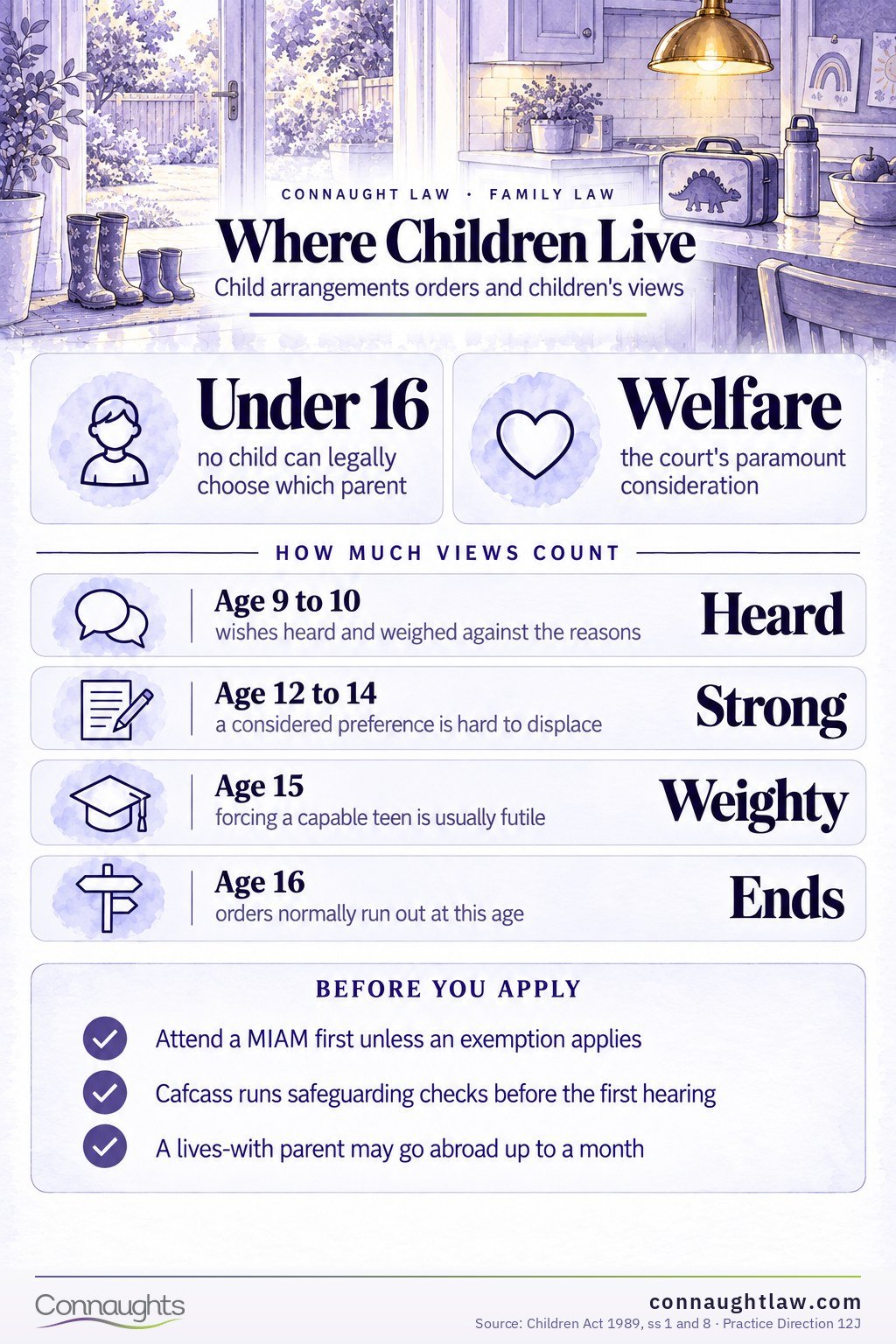
Child Living Arrangements Uk Infographic — The Lives-With And Spends-Time-With Sides Of A Child Arrangements Order, Judged On The Child Welfare

What Are Child Arrangements Orders - Complete Definition

A child arrangements order is made under section 8 of the Children Act 1989, as amended by the Children and Families Act 2014. Since 22 April 2014 it has replaced the older residence and contact orders, though many people still search using those terms - and the older language of “custody” and “access” disappeared from the law back in 1989.

Child Living Arrangements UK: “Lives With” vs “Spends Time With”

The order regulates two things: with whom a child lives, and with whom the child spends time or otherwise has contact. A “lives with” order can name one parent, or both under a shared arrangement - which does not have to mean an equal split of nights. A “spends time with” order sets out visits, overnight stays, telephone or video contact, and holiday arrangements.

The distinction carries practical consequences. A parent named in a “lives with” order may take the child abroad for up to 28 days without the other parent’s consent; anyone else needs agreement or the court’s permission. Orders normally run until the child turns 16, and courts only extend arrangements to 18 in exceptional circumstances under section 9(6).

Parents, step-parents with parental responsibility, guardians and anyone the child has lived with for three years can apply as of right. Others - including grandparents - usually need the court’s permission first, a hurdle explained in our guide to grandparents’ rights after divorce and separation.

Child arrangements orders sit alongside two companion orders made under the same section. A specific issue order resolves a single disputed question - which school, whether a child is vaccinated, a change of surname - while a prohibited steps order prevents a parent taking a particular step without the court’s consent. Courts can also make interim arrangements at the first hearing so children have stability while a case proceeds.

Living arrangements sit alongside parental responsibility - the legal authority over major decisions in a child’s life. Mothers acquire it automatically, as do fathers married to the mother or named on the birth certificate after 1 December 2003. Crucially, parental responsibility and time are separate: a parent who sees a child every other weekend keeps an equal say in schooling, medical treatment and religion.

Day-to-day decisions - meals, bedtimes, homework - belong to whichever parent the child is with at the time. Major decisions require consultation between everyone holding parental responsibility, whatever the living pattern. Disagreements over a single issue, such as a school move, are resolved through specific issue or prohibited steps orders rather than by changing living arrangements.

How the 2026 Presumption Repeal Affects Child Living Arrangements UK

Since 2014, section 1(2A) of the Children Act has required courts to presume that involvement of each parent furthers the child’s welfare, unless the contrary is shown. The Ministry of Justice’s review, published in October 2025, found the presumption could pull decisions away from individual welfare analysis - particularly in cases involving domestic abuse.

The government announced on 7 March 2026 that the presumption will be repealed through the Courts and Tribunals Bill, which had its second reading on 10 March 2026. Until the repeal takes effect the presumption remains in force. The change will not create any starting point against either parent - it simply returns every case to an undiluted welfare assessment.

What Changes in 2026: Child Focused Courts are rolling out nationally from March 2026, backed by £17 million. The presumption of parental involvement is being repealed through the Courts and Tribunals Bill. The C100 application fee rises to £270 from 13 July 2026, and the £500 family mediation voucher remains funded for 2026-27.

Children’s Views: Age-Specific Considerations

No statute sets an age at which a child chooses where to live. The welfare checklist directs the court to consider the child’s ascertainable wishes and feelings “in the light of the child’s age and understanding” - so weight builds gradually with maturity rather than switching on at a birthday.

What Age Can a Child Choose Their Living Arrangements in the UK?

As a working guide: below about 10, views are noted but rarely decisive; from around 10 to 12, they carry genuine weight; from 12 to 14, a mature child’s consistent preference will often shape the outcome; and by 14 to 16, courts recognise that orders imposed against a teenager’s settled wishes seldom work in practice. From 16, arrangements orders normally cannot be made at all, absent exceptional circumstances.

Understanding matters as much as age. Courts examine whether a preference is the child’s own, whether it reflects coaching or loyalty conflict, and whether the child grasps the consequences - the same capacity-focused reasoning that underpins Gillick competence in medical law. A thoughtful 11-year-old may be heard more loudly than a wavering 15-year-old.

Wishes are a factor, never a veto. A court can depart from even a teenager’s clearly expressed preference where the wider welfare analysis points the other way - for example, where a child’s stated choice is driven by fewer rules at one home, or by pressure from a parent. Judges explain such departures carefully, because arrangements that a child actively resists rarely survive contact with reality.

Children’s views usually reach the judge through Cafcass, whose officers speak with the child and report under section 7. In complex cases the child may be separately represented through a guardian. Child Focused Courts strengthen this voice further: children are kept informed about decisions affecting them, and judges increasingly write directly to children explaining what has been decided and why.

Application Requirements and Court Process

Before applying, most parents must attend a Mediation Information and Assessment Meeting. Exemptions apply where there is evidence of domestic abuse, urgency, or child protection involvement. The application itself is made on form C100 to the family court, with a fee of £270 from 13 July 2026 - up from £263 - and help with fees available for those on low incomes.

After gatekeeping, Cafcass carries out safeguarding checks with the police and local authority and writes to the court before the first hearing. The traditional track then runs through a First Hearing Dispute Resolution Appointment, any fact-finding or section 7 report the court directs, a Dispute Resolution Appointment, and - if agreement still cannot be reached - a final hearing.

Where domestic abuse is alleged, Practice Direction 12J governs how the court manages the case, and a separate fact-finding hearing may be listed to determine disputed allegations before any welfare decision is made.

Costs extend beyond the court fee. Legal aid for child arrangements cases remains available only with evidence of domestic abuse or child protection concerns, so many parents act in person, instruct solicitors for discrete stages, or use a McKenzie friend for support at hearings. Early advice on the realistic range of outcomes frequently pays for itself by shortening proceedings.

Child Focused Courts: Faster Living Arrangements Decisions

In Child Focused Court areas the process is front-loaded: Cafcass prepares a fuller child impact report before the first hearing, agencies share information earlier, and a review hearing checks that arrangements are actually working. The model already operates in ten of the 43 court areas - including all of Wales, Birmingham, Dorset and West Yorkshire - with national expansion announced on 17 March 2026. Pilot cases resolved roughly 7.5 months faster, and backlogs halved in trial areas.

Arrangements Following Divorce and Separation

Divorce itself decides nothing about children. Since the no-fault reforms of April 2022, the divorce application contains no children element at all - living arrangements are agreed separately or dealt with under the Children Act if disputed. Unmarried parents use exactly the same framework.

Successful patterns vary with children’s ages, school locations and parents’ work. Common structures include alternating weekends with a midweek visit, week-on week-off shared care for older children, and term-time with one parent balanced by extended holiday time where distance rules out frequent contact. Predictability tends to matter more to children than the precise arithmetic of nights.

Writing the agreement down as a parenting plan prevents most future disputes - covering handovers, schooling, holidays, new partners and how changes will be discussed. Our guide to parenting plans for separated parents covers what to include, and Cafcass’s free Planning Together for Children course helps parents reduce conflict around arrangements.

Living arrangements also drive financial obligations: the number of nights a child spends with each parent directly affects child maintenance calculations, though maintenance and contact remain legally independent - one can never be withheld because of the other.

Arrangements also need room for the wider family. Time with grandparents and extended relatives is usually built into each parent’s own time rather than ordered separately, and the arrival of new partners is a common flashpoint best handled by agreed ground rules - introductions after relationships become established, and no disparagement of either parent in front of the children.

Welfare Principle and Best Interests Assessment

Every contested decision runs through the section 1(3) welfare checklist. The court weighs the child’s wishes and feelings; physical, emotional and educational needs; the likely effect of any change in circumstances; age, sex, background and relevant characteristics; any harm suffered or at risk of being suffered; how capable each parent is of meeting the child’s needs; and the full range of the court’s powers.

Certain factors recur in living-arrangement cases. Stability - the status quo - carries real weight, because courts are cautious about disrupting settled routines that are working. Keeping siblings together is strongly preferred. School continuity, the practicality of travel, and each parent’s willingness to support the child’s relationship with the other parent all feed the assessment.

Allegations of harm change the analysis entirely. Where abuse is proved or admitted, the court must consider its impact on the child and the victim parent before ordering any involvement, and can order supported or supervised contact, or in serious cases no direct contact at all. The 2026 presumption repeal reinforces that safety is assessed first, not presumed away.

Orders are not necessarily the end of the court’s involvement. A family assistance order can direct Cafcass to support a family for up to twelve months, activity directions can require attendance at a parenting programme, and in Child Focused Court areas a built-in review hearing checks whether the arrangements are actually working for the child before the case closes.

Mediation and Alternative Resolution Methods

Court is the last resort, not the default. Family mediation resolves the majority of cases that reach it, typically within two to four sessions, at a fraction of litigation cost. The government’s £500 mediation voucher - confirmed as funded for 2026-27 - covers cases involving children and is not means-tested. Accredited mediators can be found through the Family Mediation Council.

Child-inclusive mediation deserves particular mention: a trained mediator meets the child separately, with both parents’ agreement, and feeds the child’s perspective back into the parents’ negotiation. For children aged ten and over this is increasingly the expected practice, and it often unlocks agreement precisely because both parents hear the same message about what their child actually wants.

Other routes suit different families. Solicitor-led negotiation produces a documented agreement while keeping advisers involved; collaborative law commits both parents and their lawyers to settle without court; and family arbitration under the IFLA children scheme delivers a binding decision privately and quickly. Agreed arrangements can be made enforceable as a consent order where certainty matters.

Support beyond lawyers helps too: the single-parent charity Gingerbread provides practical guidance on contact arrangements, and separated-parent programmes reduce the conflict that damages children most. Where an order already exists and is being ignored, enforcement through form C79 is covered in our guide to breaching family court orders.

Frequently Asked Questions

At what age can a child decide where to live in the UK?

There is no fixed legal age. Courts must consider a child’s wishes in light of age and understanding, so weight grows with maturity - significant from around 12, and often decisive by 14-16. From 16, child arrangements orders normally cannot be made at all, so a teenager’s settled choice is rarely disturbed in practice.

What is the difference between custody and child arrangements orders?

“Custody” and “access” were replaced in 1989, and “residence” and “contact” orders were merged into the single child arrangements order in April 2014. The modern order says with whom a child lives and with whom they spend time - the legal effect covers everything the older orders did.

Do we need a court order if we agree arrangements between ourselves?

No. The no-order principle means courts only make orders where doing so is better for the child than not. Most separated parents rely on a written parenting plan. An order becomes worthwhile where you want enforceability, or where one parent has repeatedly broken agreed arrangements.

How much does a child arrangements order cost in 2026?

The court fee for a C100 application is £270 from 13 July 2026, with fee remission available on low incomes. Mediation typically costs far less than contested proceedings, helped by the £500 voucher scheme, while fully contested cases with solicitors and hearings cost substantially more.

Is there a legal presumption that children live with their mother?

No, and there never has been. The law is gender-neutral: the child’s welfare is paramount. The separate statutory presumption of parental involvement - that each parent’s involvement benefits the child - is itself being repealed through the Courts and Tribunals Bill in 2026, returning every case to a pure welfare assessment.

How long does a child arrangements case take in 2026?

Fully contested cases commonly take many months, and complex cases longer. Child Focused Courts are changing this: pilot areas resolved cases around 7.5 months faster and halved their backlogs, and the model is now expanding nationally with £17 million of funding announced in March 2026.

Can a parent move away with the children after separation?

A parent named in a “lives with” order may take the child abroad for up to 28 days without consent; permanent removal from the UK requires agreement from everyone with parental responsibility or the court’s permission. Moves within the UK can also be restrained where they would gut the other parent’s relationship with the child.

What happens if the other parent does not return the children?

If a child arrangements order exists, you can apply on form C79 for enforcement - courts can order unpaid work, compensation and, exceptionally, committal. Without an order, an urgent application may be needed. Keep records of every incident, and take advice quickly where there is any risk of removal abroad.

Expert Legal Support
Child Arrangements Specialists

Clear advice on living arrangements, children’s views and the 2026 court reforms.

Agreement First

Mediation-aware strategy that keeps families out of court wherever possible.

Strong Court Advocacy

Determined representation where safety or a child’s stability demands it.

For advice on child living arrangements tailored to your family, contact the family law team at Connaught Law for a confidential consultation.

Contact Our Family Team

Disclaimer:

The information in this blog is for general information purposes only and does not purport to be comprehensive or to provide legal advice. Whilst every effort is made to ensure the information and law is current as of the date of publication it should be stressed that, due to the passage of time, this does not necessarily reflect the present legal position. Connaught Law and authors accept no responsibility for loss that may arise from accessing or reliance on information contained in this blog. For formal advice on the current law please don't hesitate to contact Connaught Law. Legal advice is only provided pursuant to a written agreement, identified as such, and signed by the client and by or on behalf of Connaught Law.