
Grandparents have no automatic legal right to see their grandchildren in England and Wales — but the law gives them a route. When divorce, separation or a family rift cuts contact, a grandparent can seek a child arrangements order, usually after mediation and with the court's permission to apply. This guide explains the two-stage process, how courts weigh grandparent applications, special guardianship for grandparents raising grandchildren, and the practical steps when contact is denied.
On This Page

No Automatic Right — but a Real Route to Contact
The bond between grandparents and grandchildren is one the courts genuinely value; what the law withholds is an automatic entitlement to it. When contact stops — after divorce, a bereavement, or a falling-out with a parent — the path runs through negotiation, then mediation, then a court application that most grandparents with an established relationship are permitted to make and many win.
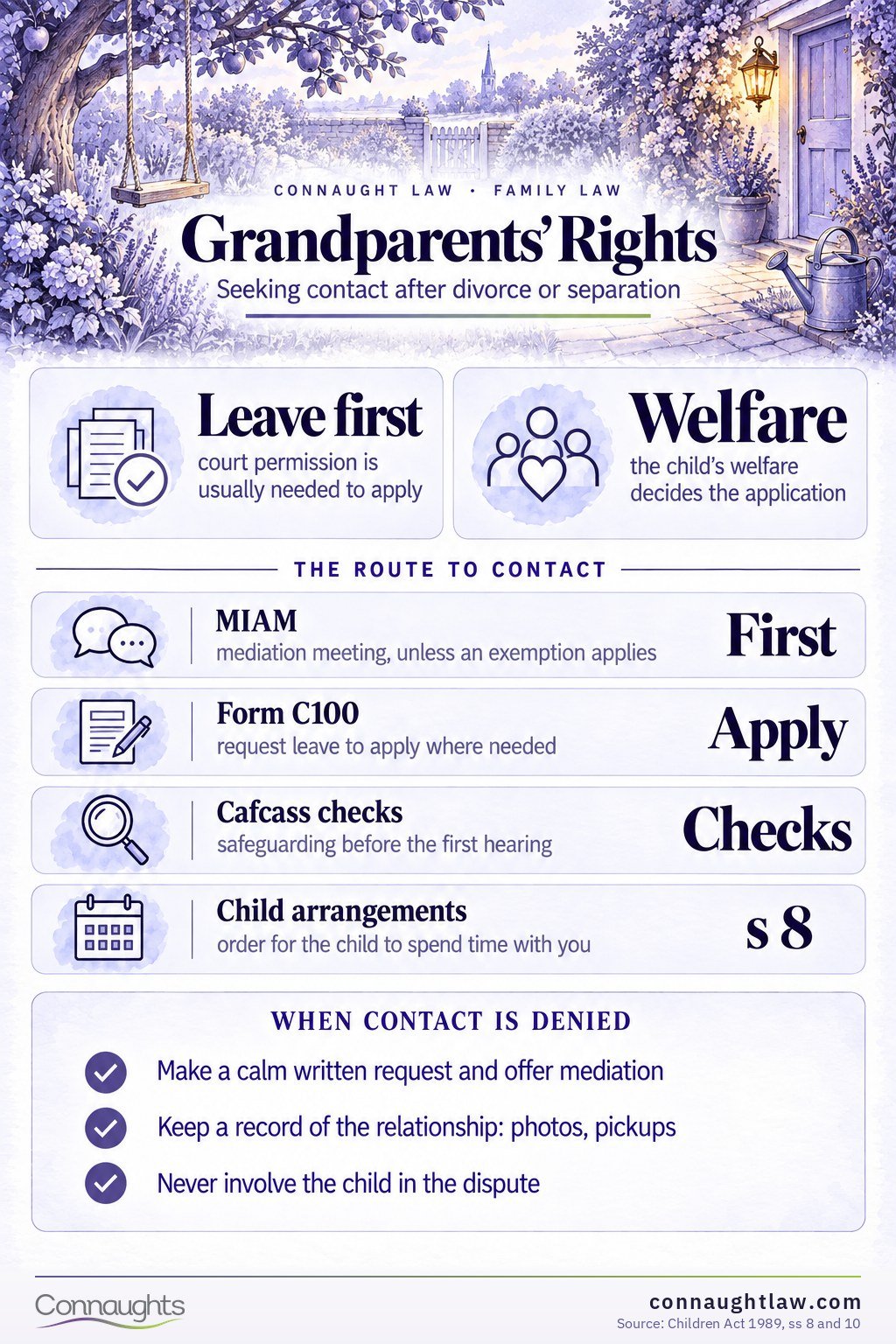
A grandparent usually needs the court's permission (leave) to apply, granted by reference to their connection to the child and the application's prospects. With leave, the application is judged on the child's welfare like any other. Established, positive relationships that the child benefits from are protected far more often than not.
The Legal Framework
The machinery lives in the Children Act 1989: a child arrangements order under section 8 can provide for a child to spend time with a grandparent, and section 10 sets who may apply as of right and who needs leave. Grandparents generally fall in the leave category — except where the child has lived with them for defined periods, when they can apply directly.
No Automatic Rights, No Parental Responsibility
Grandparents do not hold parental responsibility for a grandchild, so they cannot make decisions about schooling, medical care or residence, and parents can lawfully refuse contact without a court order in place. That legal reality cuts both ways: it is why negotiation and mediation matter, and why the court route exists for relationships worth protecting.
Child Arrangements Orders for Grandparents
The substantive application asks the court to order time between child and grandparent — from visits and overnights in strong cases to indirect contact by video, calls or letters where rebuilding is needed. Orders are shaped to the relationship as it actually stands: courts restore and protect established bonds; they rarely construct from scratch a relationship the child never had.
Mediation Before Court
Before applying, a grandparent must attend a mediation information and assessment meeting (MIAM) unless an exemption such as domestic abuse applies — and since the April 2024 procedure reforms, courts expect genuine engagement with non-court resolution and can take an unreasonable refusal into account, including in costs. Mediation through a Family Mediation Council mediator resolves many family rifts without proceedings, and the £500 family mediation voucher applies to child-arrangement cases. A mediated agreement can later be made binding as a consent order.
The Court Application, Step by Step
- Attend a MIAM, unless an exemption applies
- Apply on form C100, requesting leave where needed — the fee is £270 from 13 July 2026
- Leave is decided on your connection to the child, the application's merit and any disruption risk
- Cafcass safeguarding checks precede the first hearing
- The substantive application is decided on the child's welfare, most cases settling before final hearing
How Courts Weigh a Grandparent's Application
The welfare checklist governs: the child's wishes and feelings by age, their needs, any risk of harm, and the effect of making or refusing the order. The court also confronts the friction question honestly — where parental hostility is intense, it asks whether contact's benefits outweigh the conflict's costs to the child, and structures orders (neutral handovers, indirect contact first) to keep the child out of the crossfire.
Cafcass in Grandparent Cases
Cafcass runs safeguarding checks on all parties and, where ordered, prepares a welfare report covering the child's relationship with the grandparent and the family dynamics. A child's warm, unprompted account of a grandparent is powerful evidence — another reason never to coach, which officers reliably detect.
Raising a Grandchild: Special Guardianship and Kinship Care
Where grandparents step in to raise a grandchild — through parental illness, addiction or death — different orders carry the arrangement. A "lives with" child arrangements order gives day-to-day authority; a special guardianship order goes further, granting enhanced parental responsibility exercisable above the parents', while preserving the legal parent-child relationship short of adoption. Support for kinship carers, including the charity Kinship, and local authority special guardianship support services can help with the practical and financial load.
Practical Steps When Contact Is Denied
Start soft and document as you go: a calm written request, an offer of mediation, and a record of the relationship — photographs, school pickups, holidays, childcare provided. If proceedings become necessary, that record is your evidence base. What loses cases is escalation: turning up uninvited, involving the child in the dispute, or litigating the parents' conduct rather than the child's interests. Our guide to child living arrangements explains the wider framework your application sits in.
The Courts' Settled Approach
The reported cases hold a consistent line: leave is readily granted to grandparents with a genuine, established connection; substantive outcomes track the strength and quality of the relationship; and even entrenched parental opposition does not defeat contact where the child's welfare supports it — though the order's shape will manage the conflict. The law reform debate about automatic grandparents' rights resurfaces periodically in Parliament; until any change, the two-stage route above is the law.
Frequently askedQuestions about grandparents and contact
Do grandparents have legal rights to see their grandchildren?
Not automatically, in England and Wales. But grandparents can apply for a child arrangements order — usually with the court's permission first — and courts regularly order contact where an established relationship benefits the child. Mediation is required before most applications.
Why do grandparents need the court's permission to apply?
Section 10 of the Children Act 1989 filters non-parent applications to protect children from unmeritorious litigation. Leave is decided on your connection to the child and the application's prospects — for grandparents with a real relationship it is granted far more often than refused.
Can a parent legally stop grandparents seeing a grandchild?
Yes, unless a court order provides otherwise — without parental responsibility a grandparent has no enforceable entitlement. The remedy is the mediation-then-court route; a court order, once made, binds the parents and can be enforced like any child arrangements order.
How much does a grandparents' contact application cost?
The C100 court fee is £270 (from 13 July 2026), with Help with Fees available on low income. Mediation first is usually far cheaper, supported by the £500 voucher scheme for child-arrangement cases, and many disputes settle there without any court fee at all.
What is a special guardianship order for grandparents?
An order appointing a grandparent as the child's special guardian, with parental responsibility exercisable above the parents' — used where grandchildren live with grandparents long-term. It preserves the parent-child legal bond, unlike adoption, and carries local authority support duties.
Will the court order contact if the parents strongly object?
It can and does, where the child's welfare supports it — but the court weighs the conflict's impact on the child and may start with indirect or short contact, building up. Keeping your application child-focused rather than parent-critical materially improves the outcome.
Tell us how the relationship stood before the rift and what has been tried since. We will tell you whether leave would be granted and the gentlest route back to contact.
Get Expert Advice