
If your relationship has broken down because of domestic abuse and your immigration status depended on that relationship, you may be able to apply for indefinite leave to remain in your own right. The rules sit in Appendix Victim of Domestic Abuse (Appendix VDA), which replaced the earlier domestic violence settlement rules on 31 January 2024. This guide explains who qualifies, how the MVDAC concession differs, the evidence, the fee, and what to do if you are refused.
On This Page

Settlement in Your Own Right, Not the Abuser's
UK immigration law recognises that a person whose right to stay depended on a relationship should not be forced to choose between an abusive partner and their immigration status. The domestic abuse settlement route — long known as the DVILR rules and applied for on form SET(DV) — lets eligible victims apply for indefinite leave to remain in their own name, under Appendix VDA of the Immigration Rules.
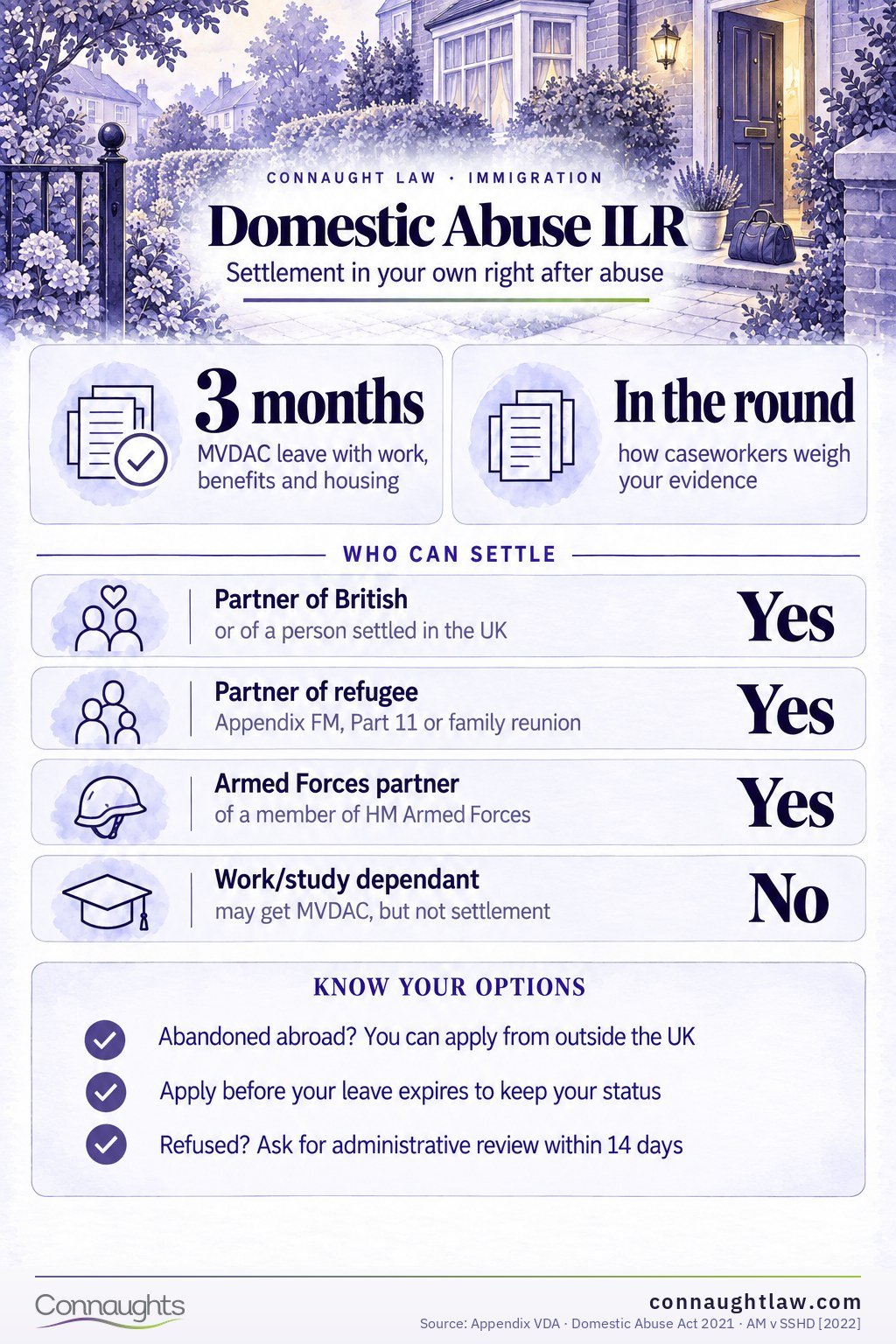
You can apply for indefinite leave to remain as a victim of domestic abuse if you are, or were last granted leave as, the partner of a British citizen, a settled person, a refugee, or certain armed forces members. Partners on work or student routes do not qualify for this settlement route, though some can access the MVDAC concession for short-term support.
Who Qualifies Under Appendix VDA
Appendix VDA settlement is not open to every migrant whose relationship has ended in abuse. It is limited to people whose immigration route was one that leads to settlement in its own right. You may qualify if you currently hold, or were last granted, permission as one of the following.
- Partner, under Appendix FM, of a British citizen or a person settled in the UK
- Spouse, civil partner or durable partner under Appendix EU with pre-settled status
- Partner of a refugee under Appendix FM, Part 11 or Family Reunion
- Partner of a member of HM Armed Forces under Appendix Armed Forces or Part 7
- A person granted leave under the Migrant Victims of Domestic Abuse Concession
Routes That Do Not Lead to Settlement
This is a common and important misunderstanding: a dependant of a Skilled Worker, Global Talent, Student or Graduate visa holder cannot use this route to indefinite leave to remain, even where domestic abuse is clearly established. The reason is that these routes do not themselves lead to settlement through the partner relationship, so there is no settled expectation for the domestic abuse rules to protect. Where a person is not eligible for settlement, other immigration options may still exist, and specialist advice is important before making any application.
The MVDAC Concession Versus Settlement
The Migrant Victims of Domestic Abuse Concession is a separate and wider scheme, and confusing it with the settlement route is the most frequent source of error. The concession grants three months of temporary permission to stay, with access to work, benefits and housing assistance, so that a victim can leave an abusive home, access support and prepare their case without being destitute.
The concession is broader than settlement. Some people can obtain MVDAC who cannot then apply for indefinite leave to remain — including some partners on work and student routes. Being granted the concession does not guarantee eligibility for settlement: the two schemes have different qualifying categories, and the settlement application is decided on its own rules.
In practice, many victims apply for MVDAC first to stabilise their situation, then apply for settlement only if they fall within one of the eligible partner categories above. For those who do not, MVDAC still provides vital short-term protection and access to benefits and housing support while other options are explored.
Transnational Marriage Abandonment and Applying From Abroad
One genuine expansion of protection concerns transnational marriage abandonment, where an abuser deliberately strands a visa-dependent partner overseas, often without money or documents, to prevent their return to the UK. Following the High Court's ruling in AM v SSHD [2022] EWHC 2591 (Admin), this is recognised as a distinct form of domestic abuse, and victims can apply for settlement from outside the UK rather than having to return first.
The court found that excluding abandoned victims created unjustifiable discrimination contrary to Article 14 of the European Convention on Human Rights. For out-of-country applicants the evidence standard is lower than for in-country cases — a reasonable degree of likelihood that the account is true, rather than the balance of probabilities — reflecting how difficult it is to gather evidence when stranded abroad.
What Counts as Domestic Abuse and the Evidence You Need
The Domestic Abuse Act 2021 defines domestic abuse broadly, well beyond physical violence. Appendix VDA reflects that definition, so the abuse that ended your relationship can take several forms.
- Physical abuse — violence, assault or threats of physical harm
- Psychological and emotional abuse — intimidation, degradation and manipulation
- Sexual abuse — non-consensual activity, coercion and reproductive control
- Economic abuse — controlling money, preventing access to funds, debt coercion
- Coercive control — a pattern of behaviour designed to isolate and dominate
- Immigration-related abuse — threatening deportation, withholding a passport, or lying about someone's immigration rights
How the Home Office Weighs Your Evidence
Caseworkers assess evidence "in the round" — looking at everything together rather than demanding one particular document. This flexible approach recognises that many victims never reported the abuse or accessed formal support. Stronger evidence includes criminal convictions, cautions, court orders such as a non-molestation order, MARAC referrals and letters from professional support services. Police reports without charges, medical records and personal statements carry weight as part of a wider picture. Combining several types of evidence into a clear account of the abuse and the relationship breakdown gives the strongest application.
Applying: the SET(DV) Form, Fee and Processing Time
In-country settlement applications are made on the SET(DV) form through the online portal, followed by a biometrics appointment. The current application fee is £3,226 per person, set by the 8 April 2026 fees uplift. There is no Immigration Health Surcharge on a settlement application. Fee waivers are available where you cannot afford the fee — for example if you would otherwise be homeless, unable to afford essentials, or where paying would harm a child's wellbeing — which matters because economic abuse so often accompanies other forms of domestic abuse. Legal aid can also cover immigration advice for domestic abuse victims who pass the evidence gateway and means test.
Plan for the wait. There is no priority or super-priority service for domestic abuse settlement applications, and decisions commonly take around six months. If your existing leave is due to expire, applying in time preserves your status under section 3C of the Immigration Act 1971 while the Home Office decides.
If Your Application Is Refused
A refusal is not necessarily the end of the road. Because this is a settlement application rather than a human rights claim, there is no full right of appeal to the tribunal; instead the main challenge route is administrative review, which must usually be requested within 14 days of the decision. Administrative review looks for a caseworker error in applying the rules rather than re-arguing the merits.
Where administrative review is not appropriate, a fresh application with stronger evidence is often the better course, and judicial review may be available in limited circumstances where the decision was unlawful. If the refusal also engages your human rights — for example where removal would separate you from a child in the UK — a separate human rights claim can carry a right of appeal. Because the deadlines are short and the strategy depends on the exact refusal reasons, it is worth taking specialist advice quickly after any refusal.
Frequently askedQuestions about settlement, the concession and evidence
Can I get settlement as a domestic abuse victim if I am on a Skilled Worker dependant visa?
No. The Appendix VDA settlement route is limited to partners of British citizens, settled persons, refugees and certain armed forces members, because those routes lead to settlement in their own right. Work and student route dependants may still access the MVDAC concession for short-term status. Other options should be explored with an adviser.
What is the difference between MVDAC and the settlement route?
MVDAC grants three months of permission with access to work, benefits and housing so you can leave safely and prepare your case. Settlement under Appendix VDA is permanent status. MVDAC is broader — some people who get the concession cannot go on to qualify for settlement, so the two must not be treated as the same thing.
What is transnational marriage abandonment and can I apply from outside the UK?
It is where an abuser deliberately strands a visa-dependent partner overseas to stop them returning to the UK. Following AM v SSHD [2022], this is recognised as domestic abuse and victims can apply for settlement from outside the UK, with a lower evidence standard than in-country applicants because gathering evidence from abroad is harder.
What evidence do I need for a domestic abuse settlement application?
The Home Office assesses evidence "in the round," so no single document is required. Strong evidence includes criminal convictions, cautions, court orders, MARAC referrals and professional support letters. Police reports without charges, medical records and personal statements also count. Several types combined into a clear account work best.
How much does the SET(DV) application cost and how long does it take?
The fee is £3,226 per person, with no Immigration Health Surcharge, and fee waivers are available where you cannot afford it. Decisions commonly take around six months, and there is no priority service for these applications. If your current leave is close to expiring, applying before it ends preserves your status.
Can my children be included in the application?
Yes. Children can be included where they are dependants of the victim, and the Domestic Abuse Act 2021 treats children who experience the effects of abuse in the household as victims in their own right. Requirements differ by age, so check how the rules apply to each child before applying.
What can I do if my application is refused?
You can usually request administrative review within 14 days, which looks for a caseworker error rather than re-arguing the merits. A fresh application with stronger evidence is often the better route, and judicial review may be possible in limited circumstances. Because deadlines are short, seek specialist advice quickly.
Tell us what leave you hold, who your application depended on and what has happened. We will tell you which route fits and what evidence it needs, in your own time.
Get Expert Advice