
Applying for a UK sponsor licence means proving to the Home Office that your business is genuine, that the roles you want to fill qualify, and that your HR systems can carry the duties that come with sponsorship. Most applications are decided in under eight weeks — £750 buys a ten-working-day decision — and the licence fee is £611 or £1,682 depending on your size. This guide walks through the whole process.
On This Page

What Getting a Licence Involves
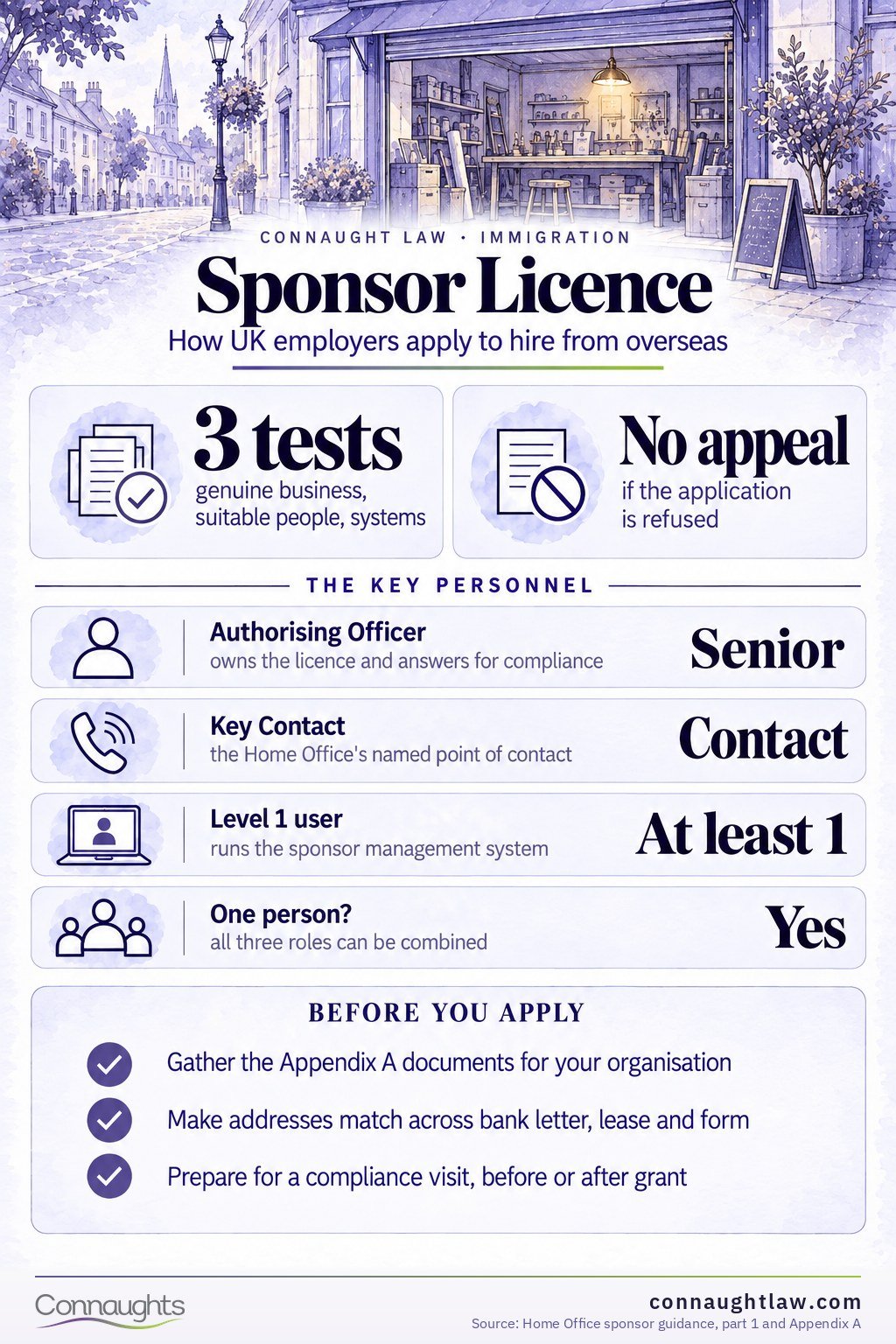
A sponsor licence is permission from the Home Office to employ workers from outside the UK on the sponsored work routes. The application is made online, supported by specified documents, and judged on three things: whether your organisation is genuine and trading, whether the people you appoint to run the licence are suitable, and whether your systems can meet the duties sponsorship imposes.
Most sponsor licence applications are decided in under eight weeks. A £750 priority service, limited to a small daily allocation, brings that down to ten working days. The application fee under the table in force from 8 April 2026 is £611 for small or charitable sponsors and £1,682 for medium or large ones.
The official starting point is the gov.uk employer sponsorship guide; the definitive rulebook is part 1 of the sponsor guidance. What follows translates both into the order you will actually meet them.
The Application Process Step by Step
Applications fail on preparation far more often than on submission. The process rewards employers who resolve eligibility questions before the form is opened, not after the Home Office raises them.
- Which routes you need — Worker, Temporary Worker or both — and whether the roles you plan to fill meet the skill and salary rules on those routes.
- Who will act as Authorising Officer, Key Contact and Level 1 user, and whether they pass the suitability checks.
- Whether your sponsor-size classification is small or medium/large under the Companies Act test, since it fixes your fees.
- Whether your HR records could answer a Home Office question about any employee today, not after a tidy-up.
Stage 1 — Planning and Eligibility
Confirm the organisation is eligible: genuinely operating in the UK, with no unspent relevant convictions among key staff and no recent licence revocation in the business's history. Match each intended hire to a route and an occupation code, and check the role clears the salary floor for that code. Errors at this stage surface months later as refusals.
Stage 2 — Documents and Evidence
Appendix A of the sponsor guidance — last updated 8 April 2026 — lists the specified documents by organisation type. Most private businesses must send a defined minimum set within the deadline given at submission, covering registration, trading and financial standing. The evidence must be internally consistent: the address on the bank letter, the lease and the application form all get compared.
Stage 3 — Submission and Decision
The application is submitted online, the fee paid, and the submission sheet signed by the Authorising Officer. The Home Office may decide on the papers, ask follow-up questions, or visit before granting. Once licensed you receive an A-rating, access to the sponsor management system, and an annual Certificate of Sponsorship allocation to request against.
How Long Applications Take
The published service standard is the figure that matters: most applications are dealt with in less than eight weeks, per the gov.uk guidance checked on 1 August 2026. The £750 pre-licence priority service produces a decision within ten working days, but slots are capped daily and go first come, first served — it is a genuine lottery at busy times.
The eight-week standard is not a guarantee. Where the Home Office wants a pre-licence compliance visit, the decision waits for the visit and its write-up. Employers with a start date in mind should apply well ahead of need and treat the priority service as insurance rather than a plan.
You cannot assign a Certificate of Sponsorship until the licence is granted, so recruitment timelines should run from decision, not submission. If a candidate is already in the UK on another route, their permission may allow the process to overlap — advice pays for itself here.
Licence Types and What Each Covers
The licence comes in two families, and you can apply for one or both. The choice follows the length and nature of the roles, not preference — each route carries its own certificate type, fee and rules.
Worker Licence Routes
The Worker licence covers long-term skilled employment: Skilled Worker, Health and Care Worker, the Global Business Mobility routes for transfers within a group, Minister of Religion and International Sportsperson. Most Skilled Worker roles must now sit at degree level (RQF6) and meet the general salary threshold of £41,700, and the care route has been closed to new overseas recruitment since 22 July 2025 — a route-by-route check, including the shortage and salary list discounts, comes before any application.
Temporary Worker Routes
The Temporary Worker licence covers time-limited work — creative, charity, religious, seasonal and government-authorised exchange schemes among them — with its own £55 certificate and shorter permissions. Our guide to the specialised sponsorship routes maps each option and what it can and cannot be used for.
Who Qualifies to Apply
There is no minimum size, turnover or trading history for most routes — a genuine one-person company can hold a licence. What the Home Office tests is legitimacy, suitability and capability, and it tests them with documents and, increasingly, with visits.
Business Legitimacy Evidence
You must show the organisation lawfully operates in the UK: registration, premises, banking and activity consistent with the roles you want to sponsor. A software company sponsoring a chef invites questions; so does an application whose stated headcount does not match its PAYE records. The genuine-vacancy assessment reaches the licence stage as well as the visa stage.
HR Systems and Key Personnel
- The Authorising Officer owns the licence and answers for compliance — a senior, UK-based employee, not an external adviser by default.
- The Key Contact is the Home Office's named point of contact for the application and after.
- At least one Level 1 user runs the sponsor management system day to day; all three roles can be combined in one suitable person.
- Everyone appointed is checked — immigration history, convictions and past involvement in failed or revoked licences all count.
Alongside the people, you need systems: right to work checking that would survive scrutiny — our right to work checks guide covers the current regime — plus attendance monitoring, contact-detail records and reporting discipline.
What the Application Costs
Home Office Fees at a Glance
The figures below are from the fee table in force from 8 April 2026, checked on the day of writing. The full cost picture — the Immigration Skills Charge, the recovery prohibitions and a five-year worked example — lives in our sponsor licence fees guide.
Licence Fees by Organisation Size
| Fee | Small or charitable sponsor | Medium or large sponsor |
|---|---|---|
| Worker licence application | £611 | £1,682 |
| Temporary Worker licence application | £611 | £611 |
| Certificate of Sponsorship — Worker | £525 | £525 |
| Certificate of Sponsorship — Temporary Worker | £55 | £55 |
| Priority service (optional, limited slots) | £750 | £750 |
Home Office fees usually change each April, and guides quoting 2025 rates are already wrong. Check the current fee table on the day you budget, and check your size classification with equal care — the small-sponsor test (two of: turnover £15 million or less, assets £7.5 million or less, 50 or fewer employees) drives every later charge.
Professional Costs Beside the Fees
Legal fees are the variable in the budget, and they scale with complexity: a clean single-entity application is a different job from a group structure with TUPE history and a refused application behind it. We scope and quote per instruction through our business immigration team rather than publishing headline rates that would mislead in both directions.
Compliance Visits Around the Application
What Officers Check
The Home Office can visit before granting a licence and at any point after, announced or unannounced. Officers compare the application to the premises in front of them: do the key personnel know their duties, do the HR files hold what Appendix D requires, do the sponsored roles exist as described. A pre-licence visit that goes badly does not produce advice — it produces a refusal.
How to Prepare
Preparation is rehearsal, not decoration: brief the Authorising Officer and Level 1 users on the questions officers actually ask, pull a sample worker file and test it against the record-keeping duties, and fix the gaps before the doorbell. We run mock audits against the current sponsor guidance and attend visits where clients want representation on the day.
Who Holds a Licence Today
The Register in Numbers
The public register of licensed sponsors now lists well over 100,000 organisations, and it grows every quarter — yet sponsors remain a small minority of UK employers. The Home Office publishes quarterly application and outcome figures in its sponsorship transparency data; the practical lesson in every release is the same: most refusals trace to preparation, and most grants to applications that answered the questions before they were asked.
How We Support Applications
We act for employers across the licence's whole life — first application, restructuring, compliance and enforcement — so applications are prepared by the team that also sees what goes wrong afterwards.
Planning the Right Application
Before any form is completed we test eligibility, route choice, sponsor size and key personnel suitability, and set a realistic timeline against your hiring need. Where a problem exists — thin trading history, a past refusal, a group structure that blurs the employing entity — the strategy is built around it, not discovered by the caseworker.
What the Service Covers
Support by Application Type
| Application type | What the work involves |
|---|---|
| Standard Worker licence | Eligibility check, document set, key personnel setup, submission and Home Office liaison |
| Temporary Worker licence | Route selection, sector-specific evidence and the compliance framework the route demands |
| Combined Worker and Temporary Worker | Multi-route strategy so allocations, fees and duties line up across both licence families |
| Complex or group structures | Entity analysis, enhanced documentation and pre-licence visit preparation |
Preparation Through Submission
We assemble and check the Appendix A documents, draft the supporting narrative where the form cannot carry the context, manage the online submission and handle caseworker correspondence until the decision. Clients see each stage before it goes in.
Complex Structures and Groups
Multinationals, franchises, care groups and businesses mid-transaction need the employing entity, the licence holder and the workforce mapped precisely — a licence in the wrong group company is a compliance failure waiting to be found. We structure these applications so the licence sits where the employment sits.
Priority Changes After Licensing
Once licensed, some changes — allocation increases, adding routes, key personnel replacements — can be expedited through the Home Office's post-licence priority arrangements, where eligibility and daily availability allow; current availability and pricing are listed on gov.uk. We advise when paying for speed is worth it and when the standard queue serves just as well.
After the Licence Arrives
Approval starts the duties. We set up the sponsor management system, train the Level 1 users, support the first certificate assignments and keep clients aligned with guidance changes — the obligations, and how enforcement against them has sharpened, are covered in our sponsor compliance analysis.
Why Employers Instruct Us
Experience Across Licence Types
The firm acts on Worker and Temporary Worker licences across sectors and structures, from first-time single-entity applicants to groups consolidating licences after acquisitions. Because we also defend suspensions and revocations, applications are built to the standard that survives a visit, not just the standard that wins a grant.
A Relationship Past Approval
Sponsorship is a standing legal status, not a transaction. Clients keep the same team for reporting questions, guidance changes, audits and emergencies — which is exactly when knowing the client's history stops being a nicety and starts being the advice.
Frequently askedQuestions about sponsor licence applications
How long does a sponsor licence application take?
Most applications are decided in under eight weeks. The £750 priority service, capped at a small daily allocation, brings this down to ten working days. A pre-licence compliance visit extends the wait, so build the application timeline back from your intended start date.
What does a sponsor licence application cost in 2026?
£611 for small or charitable sponsors and £1,682 for medium or large ones under the fee table in force from 8 April 2026, plus £525 per Worker Certificate of Sponsorship once licensed. The Immigration Skills Charge and other per-worker costs are set out in our fees guide.
What documents are required?
Appendix A of the sponsor guidance sets the specified documents by organisation type — registration, trading and financial evidence — submitted by the deadline given when you apply. Public bodies and listed companies need less; newer private businesses need more. Consistency across every document matters as much as completeness.
Can a small business get a sponsor licence?
Yes. There is no minimum headcount or turnover for most routes, and small sponsors pay reduced fees — £611 to apply and the lower Immigration Skills Charge rate. What matters is genuine trading, a genuine vacancy at the required skill level, and HR systems that can carry the duties.
What happens if the application is refused?
There is no right of appeal. Depending on the refusal reason, a cooling-off period usually applies before you can reapply, and a fresh application must fix what failed. The consequences and the routes back are covered in our sponsor licence refusal and revocation guide.
Should we apply for a Worker or Temporary Worker licence?
Worker licences suit long-term skilled hires with settlement prospects; Temporary Worker licences cover defined short-term work at a £55 certificate fee. Many organisations hold both. The choice follows the roles — their length, skill level and route rules — not the fee difference.
When can we assign a certificate of sponsorship?
Only after the licence is granted and your Level 1 user has sponsor management system access. Worker certificates cost £525 each; how defined and undefined certificates work, and how to plan an allocation, is explained in our Certificate of Sponsorship guide.
Tell us what your business does, how long it has traded in the UK and which roles you need to sponsor. We'll tell you which licence to apply for and what the application has to evidence.
Get Expert Advice