
A possession order does not put keys in your hand — enforcement does, and enforcement runs on its own clock. The order itself does not expire, but after six years a warrant needs the court's permission under CPR 83.2, and the warrant, once issued, lives for twelve months. This guide covers the whole chain: what the order actually is, when the clock starts, the N325 warrant application and its £152 fee, suspended orders and breach, the six-year permission hurdle, and how the money judgment runs alongside.
On This Page

Enforcing a Possession Order: The Clock, the Warrant, the Bailiff
Winning the possession hearing is the middle of the process, not the end. If the tenant does not leave by the date on the order, the landlord cannot act on it personally — enforcement belongs to the court, through a warrant executed by county court bailiffs or, with permission, a High Court writ. Each stage has its own time rules, and misunderstanding them is how landlords turn a won case into a stale one.
The court makes the order; the order states a leaving date; if the date passes with the tenant in place, the landlord requests a warrant; the bailiff appoints an eviction date and executes it. Only that last step transfers possession — and only the bailiff may perform it. Everything in this guide is about keeping each link alive.
The Framework: Orders, Warrants and Writs
What a Possession Order Is — and Is Not
A court order requiring an occupier to give up possession of property by a stated date. Outright orders set a single date — usually 14 days, up to six weeks for exceptional hardship. Suspended and postponed orders let the occupier stay on conditions. The order is not an eviction, and it is not by itself a CCJ — though a money judgment for arrears often accompanies it.
Enforcement instruments differ by court. The county court issues a warrant of possession executed by its bailiffs; the High Court issues a writ of possession executed by enforcement officers, normally after transfer with the court's permission. Interim possession orders are a separate, faster regime against trespassers only — they play no part in tenant evictions.
Calculating the Enforcement Window
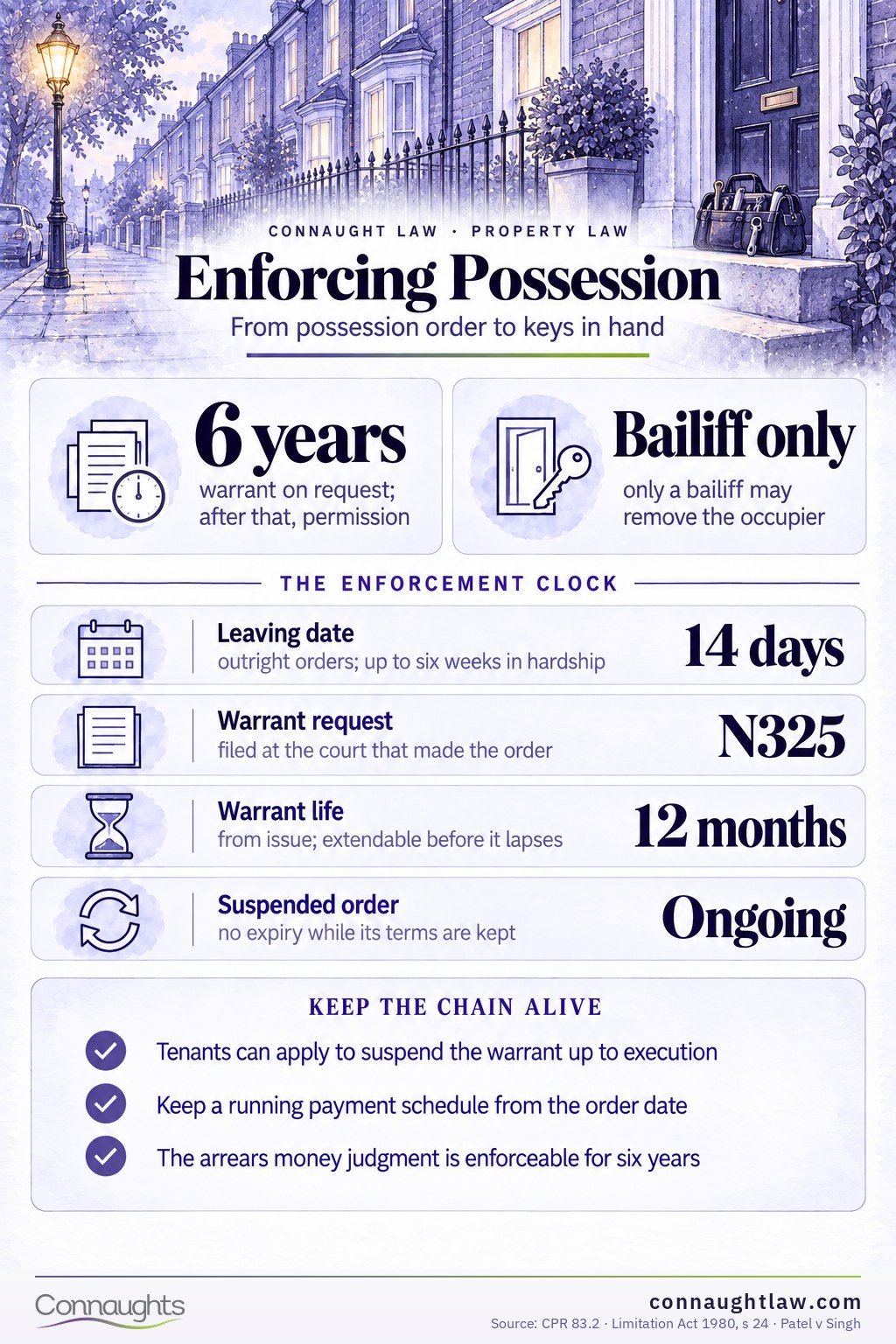
Two clocks matter, and they are commonly confused. The six-year clock runs from the date the order became enforceable and governs whether a warrant can be requested without permission. The twelve-month clock starts when a warrant is issued and governs how long that warrant stays live before it lapses or needs extending. A landlord can be inside one and outside the other; the analysis has to check both.
Does a Possession Order Expire?
Not in the way people expect. The order itself does not lapse on an anniversary — the Court of Appeal confirmed in National Westminster Bank Plc v Powney [1991] Ch 339 that enforcing by warrant is not an "action upon a judgment" caught by the Limitation Act's six-year bar. What changes at six years is procedure: CPR 83.2 requires the court's permission before a warrant can issue, and that permission is far from automatic.
- Within six years of the order: request the warrant as of right.
- Beyond six years: permission required under CPR 83.2(3)(a), granted only on a proper explanation for the delay.
- The warrant itself is valid for twelve months from issue and can be extended on application before it lapses.
- Suspended orders complicate the start date — the enforcement clock is tied to breach, not just the order's date.
Timing Strategy for Landlords
The practical rule: enforce while the order is fresh. Delay invites three problems — the permission threshold at year six, evidential decay around breaches of suspended orders, and changed circumstances that give the occupier material for a stay application. A landlord holding an unenforced order as leverage should diarise it like a limitation date, because functionally that is what it is.
When the Clock Starts
For an outright order, time runs from the date possession was ordered to be given up. For a suspended order, the position turns on the breach that makes enforcement available — which is why the breach date, not the order date, dominates the calculation, and why records of exactly when payments stopped carry real weight years later.
Warrants: Form N325, Fees and the Bailiff Queue
- Form N325 — the request for a warrant of possession of land, filed at the court that made the order.
- Fee: £152 on the EX50 schedule current from 13 July 2026.
- For a suspended order: confirmation of the breach relied on, with the arrears schedule brought up to date.
- The bailiff then fixes the eviction appointment and gives the occupier notice of it — the wait varies by court and is measured in weeks.
Practical Points at the Door
The bailiff's appointment is the tenant's last procedural moment: an application to suspend the warrant can be made right up to execution, and arrears cases with a plausible payment offer sometimes win a stay even at that stage. Landlords should attend or be represented with a locksmith booked, an up-to-date arrears figure, and instructions on belongings left behind. High Court transfer for writ enforcement — faster, dearer, permission required, with notice rules of its own — earns its cost mainly where the bailiff queue is long and the property loss is expensive.
After Six Years: Permission Under CPR 83.2
Applications to enforce old orders meet a court asking one question: why now? The leading authority, Patel v Singh [2002] EWCA Civ 1938, sets the tone — permission is the exception, not the default, and the applicant must explain the whole period of delay, not just the latest chapter.
Grounds That Persuade a Court
Explanations that succeed involve circumstances genuinely outside the applicant's control: enforcement stayed by agreement or insolvency, litigation over the same subject matter, or the occupier's own conduct concealing the position. Explanations that fail are choices — waiting, forbearance without terms, or simply not getting round to it. A landlord who deliberately sat on an order is unlikely to revive it.
Suspended Orders: Validity, Breach and Enforcement
A suspended possession order survives for as long as its terms are kept — there is no automatic expiry while the tenant pays current rent plus the instalment. On breach, the landlord's route to a warrant does not require a fresh hearing: the request certifies the breach, and enforcement follows unless the tenant applies to stay it. That machinery is what gives suspended orders their discipline, and it is also why tenants under one should treat the instalment as untouchable.
Monitoring and Proving Breach
- A running schedule of payments against the order's terms, kept from the order date.
- Bank statements corroborating each missed or short payment.
- Correspondence showing the tenant was told of the breach — not required, but persuasive on any stay application.
- Dates: the first breach and its continuation, because the enforcement clock hangs off them.
Possession Orders and CCJs: Related but Different
A possession order is not itself a CCJ. The money judgment for arrears that usually rides with it is — registrable, credit-file-visible, and enforceable for six years under section 24 of the Limitation Act 1980 through attachment of earnings, charging orders or bailiffs. Losing the property race does not lose the money claim, and vice versa.
Running Both Recoveries Together
The efficient sequence is usually possession first, money second: once the property is back and re-let, the arrears judgment can be enforced against a former tenant whose address and employment are known from the tenancy file. Enforcing the money aggressively before the eviction, by contrast, can fund the tenant's stay application with evidence of hardship. Strategy, not sentiment, should pick the order of operations.
Where Enforcement Sits After the Renters' Rights Act
The 2026 reforms rewrote how possession orders are obtained — every claim now proves a section 8 ground, as our five-step eviction guide sets out — but the enforcement machinery on the far side of the order is untouched: same warrants, same fees, same bailiffs. The pressure point is capacity. On the Ministry of Justice's Q3 2025 figures the median claim-to-repossession time was 27.9 weeks where bailiff enforcement was needed, and the reformed system funnels every possession through that same pipe.
Looking Ahead
Two developments deserve watching. The PRS database will make registration a precondition of possession orders as rollout reaches each region — a landlord planning enforcement in 2027 should be registered before issuing, per our database guide. And court digitisation of the possession process continues, which should shorten the administrative gaps between order, warrant and appointment even if bailiff capacity stays tight.
Frequently askedQuestions about enforcing possession orders
How long is a possession order valid for?
The order does not expire, but its enforceability changes: within six years a warrant issues on request; after six years CPR 83.2 requires the court's permission, granted only for delay genuinely explained. A warrant, once issued, is valid for twelve months and can be extended.
Does a suspended possession order expire?
Not while its terms are kept — it continues indefinitely as the tenancy's framework. On breach, the landlord can request a warrant certifying the default without a new hearing. The six-year enforcement question is then measured against the breach that made enforcement available.
What happens after I get a possession order?
If the tenant leaves by the order date, nothing more is needed. If not, file Form N325 with the £152 fee for a warrant of possession; the bailiff fixes an eviction appointment and executes it. Only the bailiff can remove the occupier — self-help is a criminal offence.
Is a possession order a CCJ?
No. Possession is an order about the property. The arrears money judgment that often accompanies it is the CCJ — registrable, visible to lenders, and enforceable for six years through the usual debt routes. The two are enforced separately.
Can a tenant stop the eviction after the warrant is issued?
They can apply to suspend the warrant at any point up to execution. Arrears cases with a realistic payment proposal are the classic candidates. The application does not pause the appointment automatically — it must be issued and heard, which is why tenants should move immediately.
Should I use the High Court instead of county court bailiffs?
Sometimes. Writ enforcement is usually faster but needs the court's permission, proper notice, and higher fees that are not always recoverable. It earns its cost where the bailiff wait is long and every week of lost possession is expensive.
Tell us the order's date and type, any suspension terms and what has been paid since. We will tell you whether the warrant issues on request or needs permission, and the fastest lawful route to the keys.
Get Expert Advice