
The final divorce order ends the marriage — it does not end the financial claims between you. Those survive indefinitely unless a court dismisses them in a financial order, which is why couples who "agreed everything amicably" can face claims years later. This guide covers the orders courts can make under the Matrimonial Causes Act, consent orders and clean breaks, the application process, and what happens when an order is breached.
On This Page

The order that actually ends a marriage's money
A financial order is the court-approved settlement that divides assets and, crucially, dismisses future claims between former spouses. Without one, claims stay open indefinitely — however amicable the separation and whatever you agreed informally. Agreed terms become binding through a consent order (£62 court fee from 13 July 2026); contested cases are issued on Form A (£321).
The stakes are not theoretical. In Wyatt v Vince [2015] UKSC 14, the Supreme Court allowed a financial claim to proceed nearly two decades after the divorce, because no order had ever dismissed it — and the case ultimately settled for a six-figure sum. Later windfalls, lottery wins included, have grounded substantial claims on the same logic. The financial order is the only door that closes.
Section 23 Matrimonial Causes Act 1973: The Framework
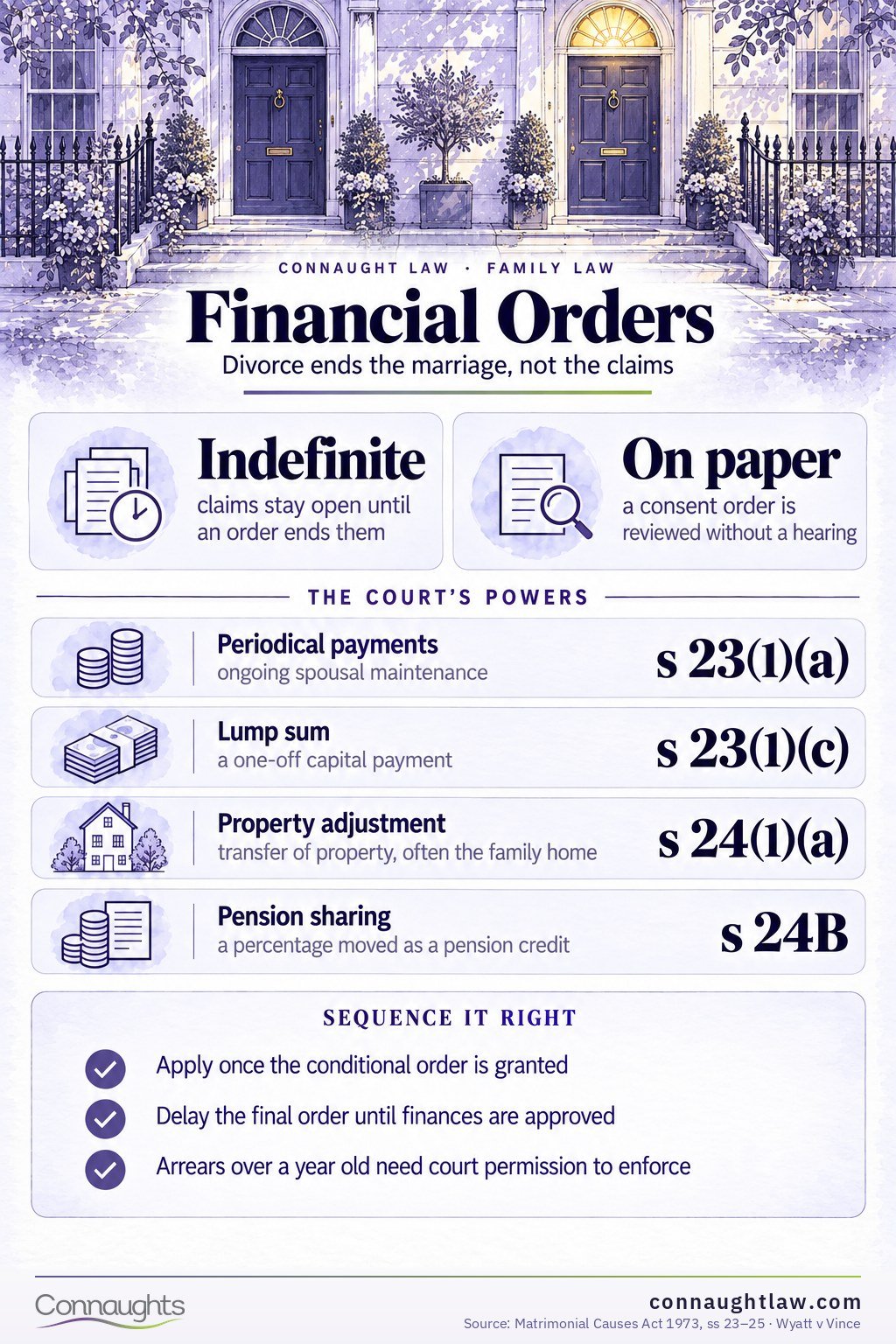
The court's financial powers on divorce come principally from sections 23 and 24 of the Matrimonial Causes Act 1973, exercised through the section 25 factors — needs, resources, contributions, duration, standard of living — with first consideration to minor children's welfare. The same powers stand behind every consent order: the judge approves your agreement only after checking it against the statute.
Court Powers Under the Act
| Order | Legal Basis | What It Does |
|---|---|---|
| Periodical payments | Section 23(1)(a) | Ongoing spousal maintenance from one former spouse to the other |
| Lump sum | Section 23(1)(c) | A one-off capital payment, including maintenance buyouts |
| Property adjustment | Section 24(1)(a) | Transfer of property — most often the family home |
| Pension sharing | Section 24B | A percentage of pension rights transferred as a pension credit |
Consent Orders: Agreed Financial Settlements
A consent order records the settlement you have already reached — through direct negotiation, mediation or solicitors — and converts it into a binding court order. The judge reviews it on paper against section 25; nobody attends a hearing in the normal case. It is the cheapest legal product in the divorce, and the one whose absence causes the most expensive problems.
When a Consent Order Is the Right Route
- You have agreed the division — even a simple one — and want it final and enforceable.
- Assets include a pension share or property transfer: only an order moves them properly.
- There is nothing to divide, but you want future claims dismissed — the clean break case.
- Maintenance is being paid and both sides want its terms fixed and variable only through the court.
Clean Break Orders
A clean break order dismisses every future financial claim between former spouses — capital, income, pensions and claims against each other's estates — either immediately or after a defined maintenance term. The statute actively prefers it where fairness allows. What a clean break covers, how to apply and what it costs is set out in full in our clean break order guide; the point that belongs here is simpler: even couples with no assets at all need one, because it is the dismissal of claims, not the division of wealth, that protects the future.
Applying for a Financial Order
Step-by-Step: Agreement to Binding Order
- Reach agreement — negotiation, mediation or solicitor-led.
- Exchange financial disclosure, usually through Form E or its summary equivalent.
- Have the consent order professionally drafted — precision here is what enforcement relies on later.
- Complete the D81 statement of information for the court.
- Submit with the £62 fee (from 13 July 2026) — possible once the conditional order is granted.
- Court review on paper; the judge can query terms that look unfair.
- The approved order becomes binding — and the final divorce order can safely follow.
Where agreement fails, contested proceedings are issued on Form A (£321) and the court's timetable takes over — disclosure, a first appointment, a financial dispute resolution hearing, and trial only for the minority that settle nowhere earlier. GOV.UK's consent order guidance covers the mechanics of the agreed route.
Enforcement and Breach Consequences
An order is only as good as its enforcement, and the machinery is real: attachment of earnings, charging orders, third-party debt orders, bailiff enforcement and — for contempt in the clearest cases — committal proceedings. Courts distinguish genuine inability to pay from wilful refusal, and arrears more than twelve months old need the court's permission to enforce, so move promptly rather than accumulating grievances. Precision in the original drafting decides how cleanly any of this works.
Future Claim Protection: Why It Matters
- Wyatt v Vince: a claim permitted nearly twenty years after the divorce, settled for a six-figure sum — no order had ever closed it.
- Reported cases have seen lottery winnings and business success years after separation grounding substantial claims.
- Remarrying without having applied for financial remedy can extinguish your own claims while leaving you exposed to your ex's.
- Inheritance received after an "amicable" divorce with no order remains claimable — indefinitely.
The pattern in every cautionary tale is identical: an informal agreement, years of silence, then changed fortunes and an open door. The financial obligations that survive divorce end only when a court dismisses them — which, for most couples, costs a £62 fee and a properly drafted order.
Frequently askedQuestions about consent orders, clean breaks and enforcement
What is the difference between a consent order and a clean break order?
A consent order is any agreed settlement approved by the court — it may include ongoing maintenance. A clean break is the variety that severs all financial ties, dismissing every future claim except child maintenance. Both bind only once a judge approves them.
Do I need a financial order if we agree on everything?
Yes — precisely because you agree. An informal agreement is unenforceable and dismisses nothing: either of you can claim later, whatever was promised. Court approval converts the agreement into a binding order and closes the claims permanently, for a £62 fee.
Can financial orders be changed after approval?
Periodical payments can be varied on material change. Lump sum and property orders generally cannot — they are final once implemented, as are pension shares. That finality is the product you are buying, so test the terms properly before approval, not after.
When should I apply for a financial order in the divorce process?
Prepare during the 20-week reflection period, submit once the conditional order is granted, and delay the final divorce order until the financial order is approved — sequencing that protects pension shares, home rights and survivor benefits.
What happens if my ex-spouse breaches the financial order?
Enforcement machinery exists: attachment of earnings, charging orders, third-party debt orders, bailiffs, and committal for contempt in clear cases. Act promptly — arrears over a year old need the court's permission — and courts separate genuine inability from wilful refusal.
Tell us when the divorce completed, what was agreed informally and what each of you has now. We will tell you what is still exposed and how quickly it can be closed.
Get Expert Advice