
A nikah performed in England and Wales creates a marriage that is fully valid in Islam — and, on its own, invisible to English law. The couple are legally unmarried, whatever the ceremony meant and however long the marriage lasts. This guide explains the recognition rules, how to put a nikah on a legal footing, what Akhter v Khan decided, how overseas Islamic marriages are treated, and the reform now under consultation.
On This Page
One ceremony, two legal worlds
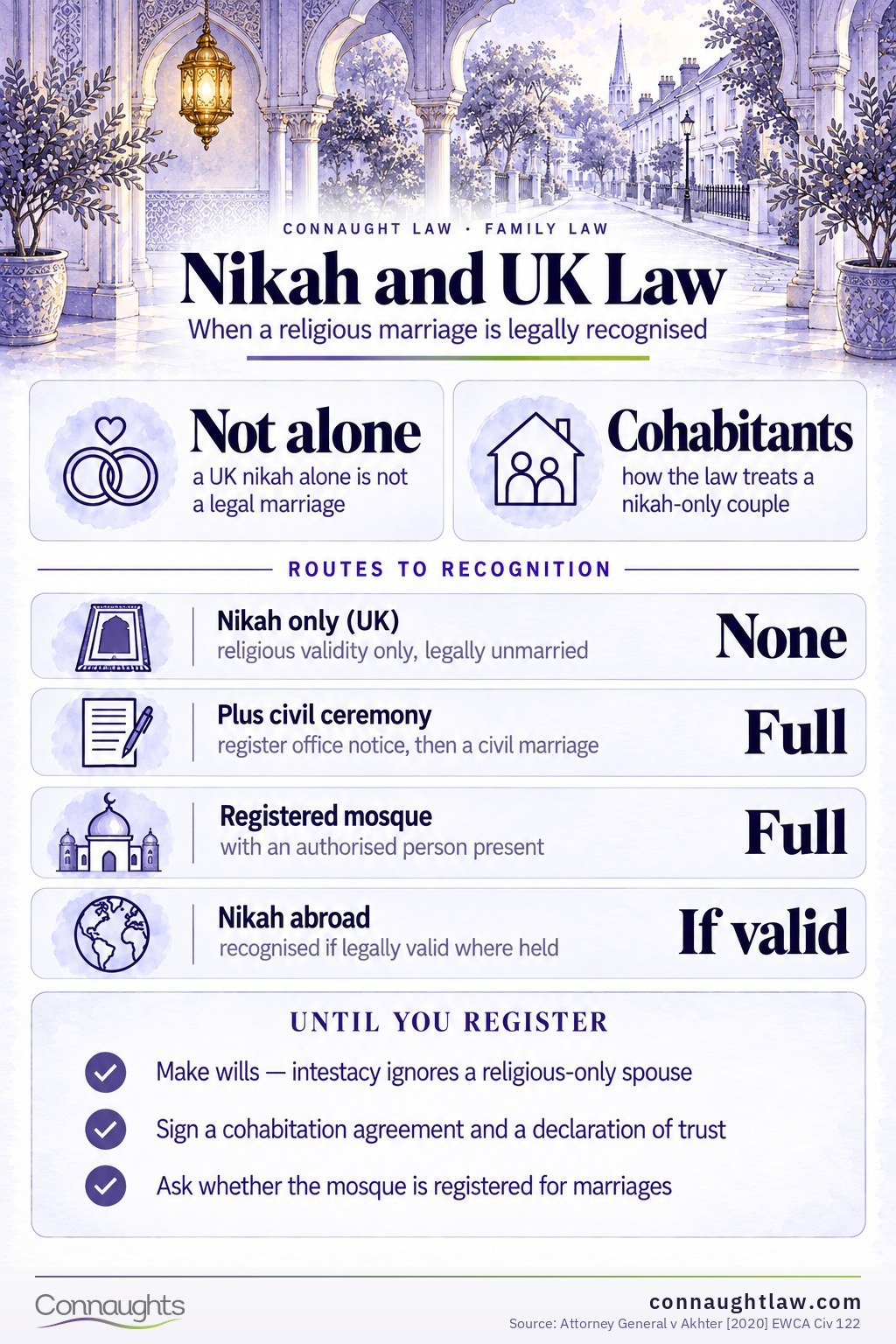
In England and Wales a nikah by itself creates no legally recognised marriage: the couple are treated as unmarried, with none of the financial protections marriage carries. Add a civil ceremony, marry at a mosque registered for marriages, or marry validly abroad, and the marriage is fully recognised.
The scale of the gap is what makes it serious. Survey evidence gathered in the House of Commons Library's briefing on Islamic marriage suggests a majority of British Muslim couples married by nikah have never civilly registered — most discovering what that means only at separation or bereavement, when the law offers a cohabitant's remedies rather than a spouse's. The gap is entirely closable in advance, and this guide is about closing it.
Is Nikah Recognised in UK Law?
The "Non-Qualifying Ceremony" Classification
English law now calls a domestic nikah without civil formalities a "non-qualifying ceremony" — the older label was "non-marriage", and both mean the same hard thing. The participants cannot divorce in an English court, because there is legally nothing to dissolve; they cannot claim financial provision through matrimonial law; and they have no automatic inheritance rights on a partner's death, however many years the marriage ran.
Exceptions: When a Nikah Alone Is Recognised
- A nikah performed abroad, where it was legally valid in the country of celebration and both parties had capacity to marry.
- A nikah conducted at a UK mosque registered for marriages, with the civil preliminaries completed — one ceremony then does both jobs.
- Limited armed-forces and consular routes for ceremonies overseas, under their own statutory rules.
How to Register a Nikah in the UK
The Civil Ceremony Route
The standard fix is a civil marriage alongside the nikah — before or after, the order does not matter legally. Both parties give notice at the local register office with identity and status documents, wait out the statutory notice period, then marry in a register office or on approved premises. GOV.UK's marriages guidance carries the current notice requirements and fees; the civil ceremony can be as short and functional as the couple wishes.
Marrying at a Registered Mosque
Some mosques and Islamic centres are registered for the solemnisation of marriages, with an authorised person present. Where yours is, the nikah itself — with civil preliminaries completed — creates the legal marriage, and no separate civil ceremony is needed. Ask the mosque directly whether it holds marriage registration and an authorised person; many do not, and assuming otherwise is precisely how couples end up unregistered without knowing it.
Registration Options Compared
| Option | Legal Recognition | What It Involves |
|---|---|---|
| Nikah only (UK) | None | Religious validity only — the couple remain legally unmarried |
| Nikah plus civil ceremony | Full | Notice at the register office, then a register office or approved-premises marriage |
| Nikah at a registered mosque | Full | Civil preliminaries, then one ceremony with an authorised person present |
| Nikah performed abroad | Recognised if valid there | Valid under local law, with capacity under each party's own law |
Legal Consequences of a Nikah-Only Marriage
Money and Property: Treated as Cohabitants
On separation, a nikah-only couple stand as cohabitants: no maintenance for a former partner, no sharing of pensions, no matrimonial claim over the home. Property follows the legal title and trust law, exactly as for any unmarried couple — which is why, until registration happens, the protections that exist are the cohabitant's toolkit: a cohabitation agreement, a declaration of trust, wills and death-benefit nominations. On death the position is starker still: intestacy gives a surviving religious-only spouse nothing automatically.
Children and Parental Responsibility
Children's own rights are unaffected: a child of a nikah-only marriage has identical inheritance and maintenance rights, and the court's powers over living arrangements and financial provision for children apply in full. One parental point is different and widely misunderstood — the father of a child born outside a legal marriage does not acquire parental responsibility automatically. He has it if named on the birth certificate (for registrations since December 2003), or through a parental responsibility agreement or court order. Check the birth certificate; do not assume.
Akhter v Khan and the Law's Evolution
In Akhter v Khan [2018] EWFC 54, Williams J confronted an 18-year nikah marriage with children, cohabitation and community recognition — and held it a "void marriage" rather than a non-marriage, opening the door to financial provision through nullity. For two years, that looked like the law bending towards protection.
Court of Appeal Reversal and Current Status
The Court of Appeal reversed in Attorney General v Akhter [2020] EWCA Civ 122: the ceremony was a non-qualifying ceremony, nullity was unavailable, and the marriage's duration and social reality could not substitute for the statutory formalities. That remains the law today — which is why registration, not litigation, is the reliable protection.
Human Rights Considerations
Arguments persist that denying all protection to long religious-only marriages sits badly with family-life and non-discrimination rights, and they carried real academic and judicial sympathy in Akhter itself. But the Court of Appeal's answer stands: reform is for Parliament, not interpretation. Parliament, at last, may be moving.
Weddings Law Reform: The July 2026 Consultation
Following the Law Commission's 2022 weddings report, the Ministry of Justice opened its consultation Tying the Knot on 16 July 2026, running to 24 September 2026. It proposes regulating the officiant rather than the building — which would make it far easier for a nikah, wherever held, to create a legally binding marriage. It is a consultation, not law: until legislation commences, register under the current rules and treat reform as a bonus, not a plan.
Overseas Islamic Marriage Recognition in UK Law
Countries Where a Nikah Is the Legal Marriage
English law recognises a foreign marriage that was legally valid where celebrated, provided both parties had capacity to marry. In many Muslim-majority jurisdictions — Pakistan and Bangladesh among the most common for British families — the nikah, properly registered locally, is itself the legal marriage. A couple married that way abroad are married here too: they can divorce in an English court and claim the full range of financial remedies.
Documentation and Proof
The marriage is only as strong as the evidence of it: the original certificate, a certified translation, and any local registration records. Keep them safe and copied — the same documents carry spouse and partner visa applications, probate, and pension claims. Where local registration was skipped or the paperwork is doubtful, take advice before assuming either recognition or its absence.
Practical Guidance for Muslim Couples
Recommended Action Steps
- Register the marriage: civil ceremony or a registered mosque, whichever suits — the legal effect is identical.
- Until then, protect as cohabitants: a cohabitation agreement and a declaration of trust for the home.
- Make wills — intestacy ignores a religious-only spouse entirely.
- Complete pension and life-insurance nominations naming your partner.
- Check the children's birth certificates settle parental responsibility, and take family law advice where anything is unclear.
Community Awareness
The most effective protection is upstream of any law firm: couples asking, before the wedding, whether the mosque is registered and whether civil preliminaries are booked. It is increasingly common for imams to raise exactly that question before conducting a nikah — a habit worth encouraging, because every marriage registered at the start is a dispute that never happens at the end.
Frequently askedQuestions about nikah, registration and legal recognition
Is nikah recognised in UK law as a legal marriage?
Not by itself, if performed in England and Wales without civil formalities — the law treats it as a non-qualifying ceremony and the couple as unmarried. It is recognised where combined with civil registration, performed at a registered mosque, or validly celebrated abroad.
How do we register a nikah in the UK for legal recognition?
Two routes: give notice and have a civil ceremony alongside the nikah, or hold the nikah at a mosque registered for marriages with an authorised person, after the same civil preliminaries. Both produce identical legal recognition — use whichever fits your community and family.
Is an Islamic marriage recognised in the UK if performed overseas?
Yes, where it was legally valid in the country of celebration and both parties had capacity to marry. A nikah properly registered in Pakistan or Bangladesh, for example, is a full legal marriage here — keep the certificate, translation and registration documents safe.
What are the legal consequences of an unregistered Muslim marriage?
You are cohabitants in law: no spousal maintenance, no pension sharing, no matrimonial claim on the home, and nothing automatic under intestacy on death. Claims relating to children survive in full. The cohabitant's toolkit — agreement, trust declaration, wills, nominations — becomes essential.
Can Muslim couples get divorced in UK courts without a civil marriage?
If the nikah was UK-only, no — there is no legal marriage to dissolve, and religious dissolution goes through a Sharia council. If the marriage was validly celebrated abroad, an English court can divorce you and deal with finances in the ordinary way.
What was the impact of Akhter v Khan on Islamic marriage law?
The 2018 decision treated a long nikah-only marriage as void, unlocking financial provision through nullity. The Court of Appeal reversed it in 2020: the ceremony was non-qualifying and no relief flowed. It confirmed that formalities, not duration, decide recognition — and pushed reform to Parliament.
How can we protect ourselves financially without a civil marriage?
Use the cohabitant's tools: a cohabitation agreement recording ownership and contributions, a declaration of trust over the home, wills on both sides, and pension and insurance nominations. They are real protections — and still weaker than marriage, which is why registration remains step one.
Do children from nikah-only marriages have legal rights in the UK?
Yes — a child's inheritance, maintenance and welfare rights do not depend on the parents' marital status. The one difference: an unmarried father has parental responsibility only if named on the birth certificate (registrations since December 2003) or through an agreement or court order.
Tell us where the ceremony took place, whether it was registered anywhere and what is at stake — the home, the children, a visa. We will tell you what the law recognises and the fastest way to protect your position.
Get Expert Advice