
A stateless child born in the UK — most often to Indian parents who never registered the birth at their consulate — holds a registration entitlement to British citizenship after five years' residence. Since 2022, children aged 5 to 17 must also show they could not reasonably acquire another nationality, a change that reversed the case law and reshaped every application. This guide covers the routes, the paragraph 3A test, the Indian-law mechanics and the evidence that wins these cases.
On This Page

Citizenship for Children Born Stateless in the UK
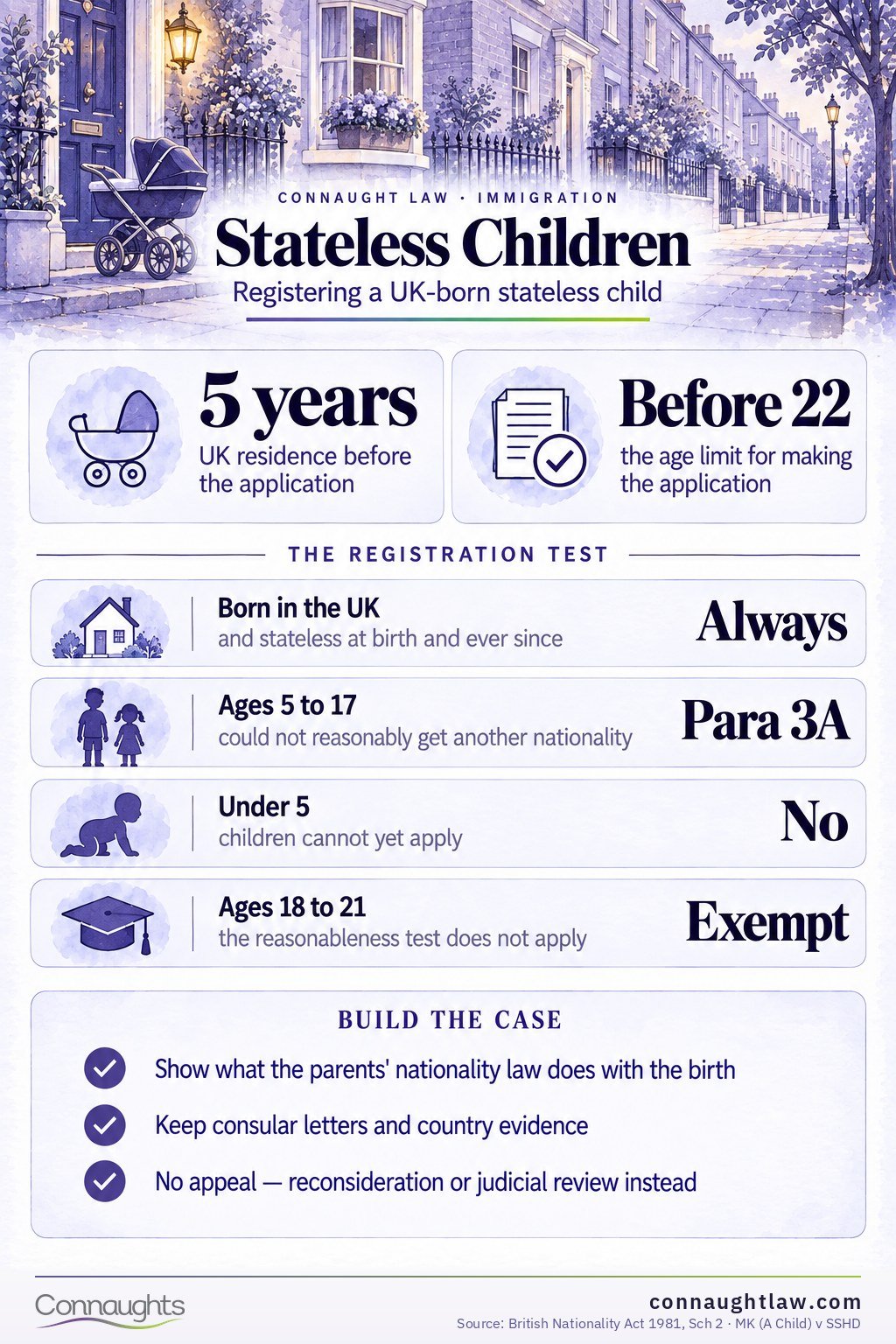
A child born in the UK who has been stateless at birth and ever since may register as a British citizen as of right, not by discretion, after five years' residence and before turning 22. Statelessness must be unbroken: a single day holding any nationality defeats the claim. For applicants aged 5 to 17, paragraph 3A adds the decisive question of whether another nationality, usually the parents' state's, could reasonably have been acquired.
Routes to Citizenship
Registration Under Schedule 2
The entitlement lives in paragraph 3 of Schedule 2 to the British Nationality Act 1981: a person born in the UK who has always been stateless may register as a British citizen — as of right, not discretion — if the residence conditions are met and the application is made before age 22. It sits apart from the ordinary children's routes mapped in our registration guide, and for genuinely stateless children it is usually the strongest claim in the family.
The Five-Year Requirements
- Born in the UK, and stateless at birth and ever since — a single day holding any nationality breaks the claim.
- Five years' residence in the UK immediately before the application, with absences within the permitted allowance.
- Application made before the applicant turns 22.
- For children aged 5 to 17: the Home Office must be satisfied the child could not reasonably have acquired another nationality.
Legal Framework
Definition and International Context
Statelessness carries the 1954 Convention meaning — not considered a national by any state under the operation of its law — assessed against how each candidate country's nationality law actually works, not against the parents' assumptions. The full definition, standard of proof and adult routes are covered in our stateless person guide; for children the question is nearly always what the parents' home state confers automatically at birth abroad.
Where the Rules Stand in 2026
The framework in force runs on two layers: the paragraph 3 entitlement, and paragraph 3A's reasonableness test for 5-to-17-year-olds, inserted by the Nationality and Borders Act 2022. No further statutory change has altered the children's route since — the movement is in the Home Office guidance applying paragraph 3A, which is where refusals are now argued and won.
Appendix Statelessness Changes
The January 2024 Appendix Statelessness rewrote the separate immigration route — five-year leave grants and a stricter admissibility limb for stateless adults — but it did not touch the citizenship entitlement: a child registering under Schedule 2 does not need stateless leave first. Families should treat the two systems as parallel tracks and run the child's registration claim on its own statutory terms.
Applying
Core Eligibility
The application is made on the stateless registration form with evidence covering birth, continuous residence and the statelessness itself, and the fee position — including the waiver for families who cannot afford it — follows the children's fee framework in our fees and waivers guide. Residence is counted backwards from the application date, so absence records need assembling before the form goes in.
Children Aged 5 to 17
Paragraph 3A and Its Impact
For applicants aged 5 to 17, paragraph 3A adds the decisive question: could the child reasonably have acquired another nationality? Where a parent's home state offers registration by descent — India being the paradigm — the Home Office will ask why that registration was not made, and refuse where it considers the route reasonably available. Under-5s cannot apply; over-18s applying before 22 escape the test.
Exceptions and Discretion
Reasonableness is the battleground, and the guidance concedes ground worth taking: a consulate that refuses or obstructs, a parent who cannot safely approach their state's authorities, registration windows that have lapsed through no fault of the child, or legal conditions the family cannot meet. What was reasonably available years ago may not be available now — the test is applied to the child's actual circumstances, not a theoretical family.
Indian Parents
How Indian Law Creates Statelessness
India confers citizenship on a child born abroad by descent only where the birth is registered at an Indian consulate, within the prescribed period and with a declaration that the child holds no other passport. A UK-born child of Indian parents whose birth was never registered therefore acquires no nationality at all — born in a country that does not confer citizenship by birthplace, to parents whose state requires a step they did not take.
Risk by Family Background
The same mechanics reach other nationalities whose laws condition descent on registration, declarations or marital status — and cut the other way for states that confer nationality abroad automatically, whose children are not stateless however few documents they hold. Every case starts with the same exercise: the parents' nationality law, applied to this child's birth, on the facts as they actually stand.
Special Circumstances
Some families cannot be sent to a consulate at all: refugee parents, parents at risk from their own authorities, gender-discriminatory nationality laws that block the mother's line, or states whose registration regimes have closed to the family in practice. In these cases the paragraph 3A argument is not that registration failed but that it was never reasonably available — a distinction the evidence must carry.
Evidence
The application proves a negative, so it is built like one: the child's birth certificate and residence records; the parents' nationality documents; the relevant nationality law and how it operates; and — where paragraph 3A bites — evidence of why another nationality could not reasonably be acquired, from consular correspondence to country evidence on how registration works in practice. Assertions that the child "has no passport" prove nothing; the file must show what the law of the parents' state does with this birth.
Cases That Shaped the Rules
The modern law is a dialogue between court and Parliament. In MK (A Child) v Secretary of State for the Home Department [2017] EWHC 1365 (Admin) the High Court held that a UK-born child of Indian parents was stateless in law even though consular registration had been available — the entitlement looked at what the child held, not what the parents might have obtained. Paragraph 3A was Parliament's answer, restoring the reasonableness question for 5-to-17-year-olds; the PRCBC fees litigation separately forced the waiver regime that keeps the route open to families who cannot pay.
Challenges
Refusals and Reconsideration
Registration refusals carry no statutory appeal: the tools are reconsideration on fresh evidence, complaint where process failed, and judicial review where the reasonableness assessment misapplied the guidance or ignored the family's actual circumstances — the framework our reviews and challenges team runs. Where registration genuinely cannot succeed, the fallback is the child's ordinary immigration position and the stateless leave route, sequenced so no application prejudices the next.
Frequently askedQuestions about stateless children
Is a child born in the UK automatically British?
No — birth in the UK confers citizenship only where a parent is British or settled. A child whose parents' state also confers nothing is stateless, which is exactly the gap the Schedule 2 registration entitlement exists to close.
Can a stateless child born in the UK get British citizenship?
Yes — by registration as of right after five years' residence, applied for before age 22, provided the child has always been stateless and, if aged 5 to 17, could not reasonably have acquired another nationality.
Why are children of Indian parents so often stateless?
India gives citizenship to children born abroad only through consular registration within the prescribed period. If the parents never registered the birth, the child holds no nationality — Indian law confers nothing automatic, and UK law confers nothing by birthplace alone.
What is the paragraph 3A test?
For applicants aged 5 to 17, the Home Office must be satisfied the child could not reasonably have acquired another nationality. It reversed the position in the MK case, and reasonableness — consular obstruction, lapsed windows, family risk — is where these applications are now decided.
Does the five years' residence need to be lawful?
The entitlement counts residence, not status — the five years run immediately before the application, subject to the absence allowance. Take advice on the current guidance before relying on periods without leave, as the assessment of evidence differs case by case.
What if the registration application is refused?
There is no statutory appeal: the routes are reconsideration with better evidence, and judicial review where the reasonableness test was misapplied. Many refusals turn on thin nationality-law evidence and are recoverable with a properly built file.
Bring us the birth certificate and the family's nationality story. We'll analyse what each state's law actually confers, build the paragraph 3A case and file the registration that fits it.
Get Expert Advice