Decree Nisi vs Decree Absolute UK 2026: Complete Legal Guide

Decree nisi and decree absolute no longer exist for new divorces: since 6 April 2022 they are called the conditional order and the final order. The two-stage structure survives - a court first confirms you are entitled to divorce, then ends the marriage six weeks and a day later - but the process around it changed completely under no-fault divorce. This guide translates the old terminology into the new, explains what each order does, the timeline and fees in 2026, and the critical question of when to apply for the final order - because taking it too early can cost you pension rights and settlement leverage.

Decree Nisi vs Decree Absolute: The Modern Position

People still search for decree nisi and decree absolute because decades of divorces used those names - and because documents from older proceedings keep them. If your divorce concluded before April 2022, your decree absolute is and remains your proof of divorce. If you are divorcing now, the same milestones are the conditional order and final order.

The renaming was not cosmetic branding. The Divorce, Dissolution and Separation Act 2020 rebuilt the process the orders sit inside: no fault, no defended petitions, a mandatory reflection period, and plain-English terminology - applicant instead of petitioner, conditional instead of nisi, final instead of absolute.

The Latin explains the old names for anyone decoding correspondence: nisi means “unless” - a decree that would become absolute unless cause was shown otherwise. Nothing ever really turned on the Latin, which is partly why it went; but older court orders, insurance documents and pension files are full of it, and translating accurately matters when those documents are still doing legal work.

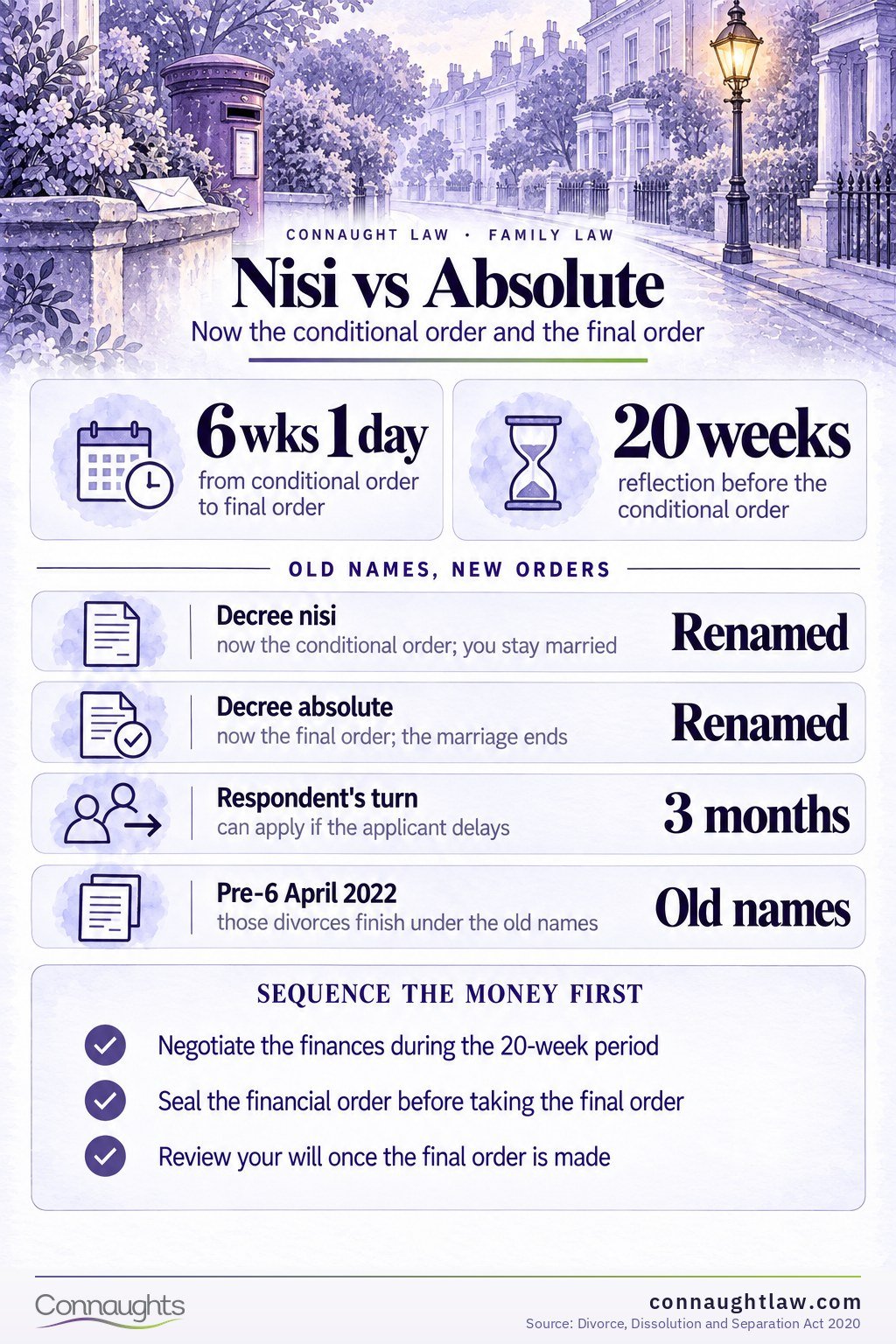
Decree Nisi Versus Decree Absolute Infographic — The Two Stages Of An English Divorce, Now Renamed The Conditional Order And The Final Order Under No-Fault Divorce

The April 2022 UK Divorce Law Changes Explained

Under the old law a petitioner proved one of five facts, the respondent could defend, and the decree nisi hearing had genuine content - a judge deciding whether the ground was made out. Under the 2020 Act, a statement of irretrievable breakdown is conclusive, so the conditional order stage confirms procedure rather than testing blame.

Civil partnerships mirror the structure exactly: dissolution proceeds through a conditional order and final order on the same timetable and fees. Everything on this page about sequencing, remarriage and pensions applies equally to dissolving a civil partnership.

The Act also inserted the 20-week reflection period between issue and conditional order eligibility, allowed joint applications, and preserved the six-weeks-and-a-day gap before the final order. The full modern procedure, costs and strategy are covered in our no-fault divorce guide.

What Is a Decree Nisi - Now Called the Conditional Order?

The conditional order is the court’s confirmation that you are entitled to divorce: the application is in order, service requirements are met, and the statutory waiting period has passed. You apply for it from 20 weeks after the application was issued, and a legal adviser or judge grants it - almost always on the papers, without any hearing.

Joint applicants apply for the conditional order together; if one stops cooperating, the other can switch the application to a sole one and proceed. There is no longer any mechanism for a respondent to resist the conditional order on the merits - challenges are confined to jurisdiction and validity, both rare.

Decree Nisi vs Conditional Order: Is Anything Actually Different?

Substantively little at the milestone itself - both mark the court’s confirmation that the divorce can proceed. What changed is everything around it: no fault to prove, no defended suits, a fixed reflection period, and paperwork designed for litigants in person. The old strategic questions about contesting grounds are gone; the surviving strategy is all about money and timing.

Crucially, you are still married after the conditional order. Neither spouse can remarry, inheritance and pension positions are unchanged, and the marriage continues until the final order. What the conditional order unlocks is jurisdiction that matters enormously: the court can now approve financial consent orders and make financial remedy orders.

Why the Conditional Order Stage Matters for Money

A financial agreement lodged before the conditional order simply waits; once the order is granted, the court can seal the consent order that makes the settlement binding. Well-run divorces are sequenced so the consent order is ready at conditional order stage, approved shortly after, and only then is the final order sought.

Pension sharing orders carry a specific timing rule: they cannot take effect until the final order, and they only take effect 28 days after they are made. Where a pension share is part of the deal, the final order should not be applied for until that 28-day window has run - otherwise a death in the gap can defeat the share entirely.

Death between the orders illustrates why the sequence protects people. If a spouse dies after the conditional order but before the final order, the survivor is a widow or widower - inheriting under the will or intestacy and keeping survivor pensions - rather than a divorced former spouse. Grim arithmetic, but it decides real cases and explains professional caution about racing to the final order.

What Is a Decree Absolute - Now Called the Final Order?

The final order legally ends the marriage - the moment of divorce. You can apply from six weeks and one day after the conditional order; the order is then made quickly and both parties receive it. From that moment you are free to remarry, and your legal status changes across inheritance, pensions and tax.

If the applicant does not apply, the respondent can - but only from three months after the applicant’s earliest date, and the court can consider objections. Delay is sometimes tactical and sometimes protective; either way it should be a decision, not a drift.

The final order document itself matters practically: it is the certificate institutions ask for - remarriage registrars, mortgage lenders, pension administrators, foreign authorities (often with an apostille). Store it with your will and marriage certificate; replacements are obtainable but slow.

What Changes at the Final Order

Wills stay valid but gifts to the former spouse lapse as if they had died; pension survivor benefits for spouses end; home rights registrations expire unless extended; and joint tax treatments cease. Every one of those consequences is why financial orders should normally be secured first - and why solicitors talk so much about sequencing.

Key Differences Between Decree Nisi and Decree Absolute

The distinction is status. Conditional order (decree nisi): still married, cannot remarry, financial orders become possible, pension and inheritance positions preserved. Final order (decree absolute): marriage over, remarriage possible, survivor benefits gone, financial claims survive but a new marriage can bar them - the remarriage trap.

Old-law documents map cleanly: a decree nisi from 2019 has the same legal character as a conditional order today, and a decree absolute is a final order. Certified copies of older decrees are obtained from the court that made them - needed surprisingly often for remarriage abroad, pension administration and probate.

Names are a common follow-on question at both stages: a spouse can revert to a former name at any time by deed poll or, in practice, simply by using the final order and marriage certificate together as evidence with banks and agencies. Nothing in either order changes a name automatically.

Religious formalities can also attach to this stage: for Jewish couples the court can be asked under section 10A of the Matrimonial Causes Act to withhold the final order until a get is given, and Muslim couples frequently complete a separate religious divorce alongside the civil orders. Aligning the two systems avoids being divorced in one and married in the other.

The Divorce Timeline in 2026: From Application to Final Order

The statutory minimum runs about 26 weeks: issue, acknowledgment of service, the 20-week reflection period, conditional order, then six weeks and a day to final order eligibility. Court processing adds time at each stage, so around seven months is the practical floor and many divorces sensibly take about a year while finances are agreed.

The 20-week period runs from issue of the application, not from acknowledgment - a detail worth knowing where service abroad or a slow respondent eats weeks. Delays concentrate at two points: getting valid service accomplished early, and queueing for conditional order processing at busier courts. Neither affects entitlement; both affect calendars.

The court fee is £628 from 13 July 2026, paid once at application - there is no separate fee for the conditional or final order. A financial consent order adds £62; contested financial proceedings are started by Form A at £321. Help with Fees remission applies to low-income applicants.

Timeline at a Glance: Application (£628) → acknowledgment → 20 weeks → conditional order (decree nisi) → consent order approved → 6 weeks + 1 day → final order (decree absolute). Rushing the last step before the consent order is approved is the classic self-inflicted wound.

Financial Settlements and the Timing of the Final Order

Financial claims do not end with the divorce - they survive the final order until a court dismisses them. But two things degrade with premature finality: pension survivor benefits vanish when the marriage ends, and a spouse who remarries before applying for financial orders loses the right to most claims. Both risks are avoided by simple sequencing.

Where the other spouse presses for the final order early - or delay is being used as leverage - the court balances prejudice: it can postpone the final order until financial matters are resolved where ending the marriage first would cause real detriment. Raising the issue early, with evidence of the pension position, is what wins these arguments. The wider settlement framework is explained in our guide to financial orders on divorce.

Interim protection bridges the gap while the marriage continues: home rights registration prevents disposal of the family home, maintenance pending suit can fund living costs, and neither spouse should restructure pensions, nominations or wills unilaterally in the window between orders - courts take a dim view of positional manoeuvring during proceedings.

Common Problems and Solutions

A respondent who ignores the process cannot stop it: deemed service, bailiff service and alternative service deal with silence, as our guide to a spouse who does not respond sets out. An applicant who stalls after the conditional order hands the respondent the three-month application route.

Amendments and corrections are cheap to fix early and expensive late: names misspelled on the application flow through to both orders and then to every institution that relies on them. Check the draft conditional order when it arrives - correcting an error at that stage is an email; correcting a final order is an application.

Lost decree absolutes are replaced with certified copies from the issuing court; divorces concluded abroad are usually recognised without any English order. And couples who obtained a decree nisi years ago but never the absolute remain married - the cure is an application in the original proceedings with an explanation for the delay, scrutinised for financial prejudice but routinely granted.

One more recurring confusion: separation dates and decree dates are different things. Tax windows for transferring assets run from separation, not from either order; entitlement to claim financial remedies runs until dismissed, not until the final order; and time limits for challenging a will or claiming against an estate have their own clocks. Anchor each deadline to the right event.

Where children are involved, neither order says anything about arrangements - parenting and child maintenance run on their own tracks, unaffected by the divorce milestones. Parents surprised by this often delay the divorce needlessly; the better course is to progress arrangements and the divorce in parallel, each on its own timetable.

Overseas recognition raises the last practical point: some countries ask for evidence that a UK divorce is truly final, which means the final order, sometimes legalised with an apostille. A conditional order will not support remarriage anywhere. Couples planning weddings abroad should build the six-week gap - and foreign document processing - into the date.

Practical guidance on the mechanics - forms, fees and the online service - is maintained on gov.uk and by Citizens Advice; strategy about timing and money belongs with a specialist.

Frequently Asked Questions

What is the difference between decree nisi and decree absolute?

The decree nisi (now conditional order) confirms entitlement to divorce but leaves you married; the decree absolute (now final order) legally ends the marriage. Financial consent orders are approved between the two - which is why the gap exists.

Do decree nisi and decree absolute still exist in 2026?

Not for new divorces - since April 2022 they are the conditional order and final order. Decrees from older proceedings remain fully valid: a decree absolute is permanent proof of divorce whatever the current terminology.

How long after decree nisi (conditional order) is the divorce final?

You can apply for the final order six weeks and one day after the conditional order. Most solicitors advise waiting until the financial consent order is approved before applying - the gap is protective, not bureaucratic.

Can I remarry after the conditional order?

No. You remain married until the final order is made. Remarrying is only possible after the final order - and remarrying before making financial claims can bar those claims entirely, so take advice on sequence first.

Why should I delay applying for the final order?

Because ending the marriage first can forfeit pension survivor benefits, end home rights protection, and weaken settlement leverage. The standard sequence is conditional order, then approved consent order, then final order.

What happens if my ex refuses to apply for the final order?

If the applicant does not apply, the respondent can apply three months after the applicant’s earliest eligibility date. The court can hear objections - typically about unresolved finances - before making the order.

How much does the divorce process cost in 2026?

The application fee is £628 from 13 July 2026, covering the whole process including both orders. A financial consent order adds a £62 lodging fee; contested financial proceedings start at £321 (Form A). Fee remission is available on low incomes.

I have a decree nisi from years ago but never got the decree absolute. Am I divorced?

No - the marriage continues until the absolute (final) order. You can apply within the original proceedings with an explanation for the delay. Do this before remarrying or relying on single status for inheritance or immigration purposes.

Expert Legal Support
Sequencing Strategy

Conditional order, consent order and final order timed to protect pensions and leverage.

Stalled Divorces Fixed

Non-responding spouses, old decrees and delayed final orders resolved efficiently.

Fixed-Fee Clarity

Transparent pricing for the divorce process and the financial orders that matter more.

For advice on conditional and final orders - especially before taking the final step - contact the family law team at Connaught Law for a confidential consultation.

Contact Our Family Team

Disclaimer:

The information in this blog is for general information purposes only and does not purport to be comprehensive or to provide legal advice. Whilst every effort is made to ensure the information and law is current as of the date of publication it should be stressed that, due to the passage of time, this does not necessarily reflect the present legal position. Connaught Law and authors accept no responsibility for loss that may arise from accessing or reliance on information contained in this blog. For formal advice on the current law please don't hesitate to contact Connaught Law. Legal advice is only provided pursuant to a written agreement, identified as such, and signed by the client and by or on behalf of Connaught Law.