
When a partner dies during the visa journey, the immigration system does not send the survivor back to the start. The bereaved partner route grants indefinite leave to remain immediately — no probationary years to finish, no financial requirement, no English test. What it asks for instead is proof of the relationship and of the loss. This guide explains who qualifies under Appendix Bereaved Partner, the £3,226 fee and its waiver, and how the application works.
On This Page

Settlement Without the Waiting Years
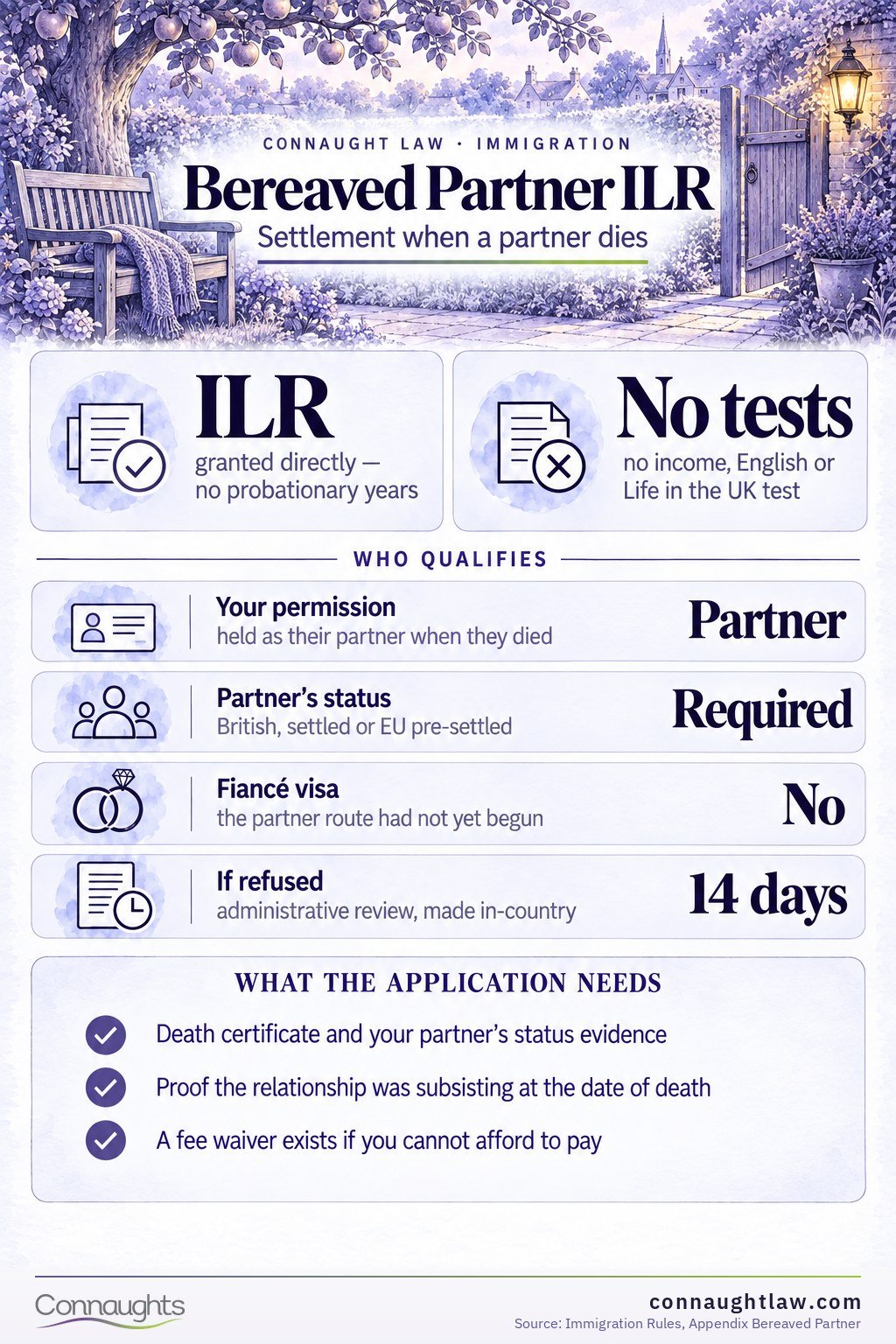
A settlement route under Appendix Bereaved Partner, in force since 31 January 2024, for people whose partner died while they held permission as that partner's spouse, civil partner or unmarried partner. It grants indefinite leave to remain directly: the five-year clock, the £29,000 financial requirement and the English and Life in the UK tests all fall away. The official overview is on gov.uk.
The route reflects a simple principle: a person who was building a life here in a genuine relationship should not lose their future because the relationship ended in bereavement rather than breakdown. The application is short by immigration standards, but it arrives at the hardest possible time — which is exactly why knowing its shape in advance helps.
Who Qualifies
Eligibility turns on two statuses at the date of death: yours and your partner's. You must have held permission as their partner — fiancé and fiancée permission does not count — and your partner must have been British, settled, or an EU citizen with pre-settled status. The relationship must have been genuine and subsisting when they died.
Qualifying Status at the Date of Death
| Your permission when your partner died | Partner's status | Position |
|---|---|---|
| Spouse, civil partner or unmarried partner (Appendix FM) | British citizen or settled | Eligible |
| Partner under Appendix FM | EU citizen with pre-settled status | Eligible |
| Partner under Appendix Armed Forces | Serving or discharged HM Forces member | Eligible — this variant can be used from outside the UK |
| Fiancé, fiancée or proposed civil partner | Any | Not eligible on this route — advice needed on alternatives |
| Dependant of a worker or student | Any | Not eligible — different rules apply |
Evidence of the Relationship and the Loss
What the Application Asks For
- The death certificate, and your partner's passport or status evidence showing they were British, settled or pre-settled.
- The relationship documents — marriage or civil partnership certificate, or the evidence trail of an unmarried partnership.
- Evidence the relationship was subsisting at the date of death: shared address, joint tenancy or mortgage, joint finances, correspondence.
- Your own current and previous permission documents, tying your status to the partner route at the relevant time.
Caseworkers are not auditing the marriage's quality — they are confirming it was real and continuing. Households keep evidence unevenly, especially through illness; where a category is thin, a short explanation with what does exist serves far better than silence.
Fees, Waiver and Process
What It Costs and Who Pays Nothing
The application is made online on the settlement form, with biometrics enrolled at a UKVCAS appointment — the system itself is covered in our UKVCAS guide. The fee is £3,226 per person under the table in force from 8 April 2026, and each child applying alongside pays the same. No priority service applies, and no service standard is published for this route — build in months, not weeks.
Since 9 October 2024, under the Immigration and Nationality (Fees) (Amendment) Regulations 2024, bereaved partners who cannot afford the fee can apply for a waiver — assessed on whether paying would leave you without adequate accommodation or essential living costs, or would harm a child's wellbeing, per gov.uk on the day of writing. Widowed applicants forced to choose between the fee and the rent should apply for the waiver, not abandon the application.
Children on the Route
Dependent children can apply with the bereaved partner or afterwards, each paying the fee (or applying within a waiver where the household qualifies). Children under 18 face no English or Life in the UK requirements; a dependant applying at 18 or over must meet both. Where a child was born in the UK or has spent long residence here, other routes may also be in play — advice can identify the cheapest sound combination for the family.
Suitability Still Applies
What Can Defeat an Otherwise Good Application
The route waives eligibility hurdles, not suitability. A deportation order or serious criminality leads to refusal; lesser criminality and past deception are assessed on the rules' ordinary suitability framework. What the rules do treat with humanity is status: overstaying that flows from the bereavement itself — a visa that lapsed in the aftermath of the death — does not by itself close the route, though it should be explained squarely in the application rather than left for the caseworker to find.
If the Application Is Refused
There is no automatic tribunal appeal. The direct remedy is administrative review — £80, requested within 14 days in-country — which checks the decision for caseworking error but takes no new evidence. Where the refusal engages family or private life, a human-rights claim can generate an appeal route of its own. Refusals on this route are frequently evidence problems rather than eligibility problems, which makes the review-versus-reapply choice a genuine strategic decision worth taking advice on — as is any suitability issue involving debts or NHS charges, covered in our NHS debt and visa applications guide.
Frequently askedQuestions about bereaved partner ILR
What is a bereaved partner in UK immigration law?
Someone who held permission as the spouse, civil partner or unmarried partner of a British citizen, settled person or pre-settled EU citizen, and whose partner died during that permission. Appendix Bereaved Partner gives them a direct route to indefinite leave to remain.
Do I need to meet the financial or English requirements?
No. The route removes the minimum income requirement, the English language tests and the Life in the UK test for the main applicant. The application turns on the relationship, the partner's status and suitability — not on income or integration testing.
How much does the application cost?
£3,226 per applicant under the fees in force from 8 April 2026, including each dependent child. Since October 2024 a fee waiver exists for applicants who cannot pay without losing adequate accommodation or essential living costs — assessed on financial evidence, not absolute destitution.
Can I apply if my visa has already expired?
Bereavement-related overstaying does not automatically bar the route — the rules recognise that visas lapse in the aftermath of a death. Apply as soon as practicable and explain the timeline directly in the application; unexplained gaps are what cause difficulty.
I was on a fiancé visa when my partner died — do I qualify?
Not under this route: fiancé and proposed civil partner permission is excluded because the partner route had not yet begun. Alternatives may exist depending on your circumstances, including private life and human-rights applications — take advice before assuming nothing is available.
When can I apply for British citizenship afterwards?
Usually 12 months after receiving indefinite leave to remain, with five years' residence and within the absence limits for naturalisation. Holding ILR also survives absences from the UK of up to two years at a time — longer away risks losing it.
Tell us the date of death, the visa you held at the time and whether you have children here. We'll tell you whether the bereaved partner route is open to you and what the application asks for.
Get Expert Advice