
Amigo Loans, once the UK's largest guarantor lender, has completed its compensation scheme and its lending business is in liquidation. This guide sets out where things now stand in 2026: what customers actually received, how to claim money still held by the court, why Amigo collapsed, and — importantly — what claims remain possible against other guarantor lenders.
On This Page

Amigo Loans: scheme, liquidation and what remains in 2026
Amigo lent to people with poor or thin credit histories on the basis that a friend or family member would guarantee the repayments. After a surge of complaints about unaffordable lending — from 583 in 2019 to over 14,000 in 2020 — the Financial Conduct Authority restricted its lending, and the compensation liabilities that followed proved fatal to the business. The result was a court-approved Scheme of Arrangement that paid customers a fraction of what they were owed, and, ultimately, the liquidation of the lending company.
For borrowers and guarantors who dealt with Amigo, the practical questions now are narrow: whether any money is still recoverable, and whether the same grounds can be used against other lenders. Both are covered below.
No. The Amigo Scheme of Arrangement closed to new claims on 26 November 2022, all payments have been made, and the lending company is in liquidation. The only remaining route is a High Court application for scheme money left unclaimed because bank details were not provided in time. Claims against other guarantor lenders, however, are a different matter — see below.
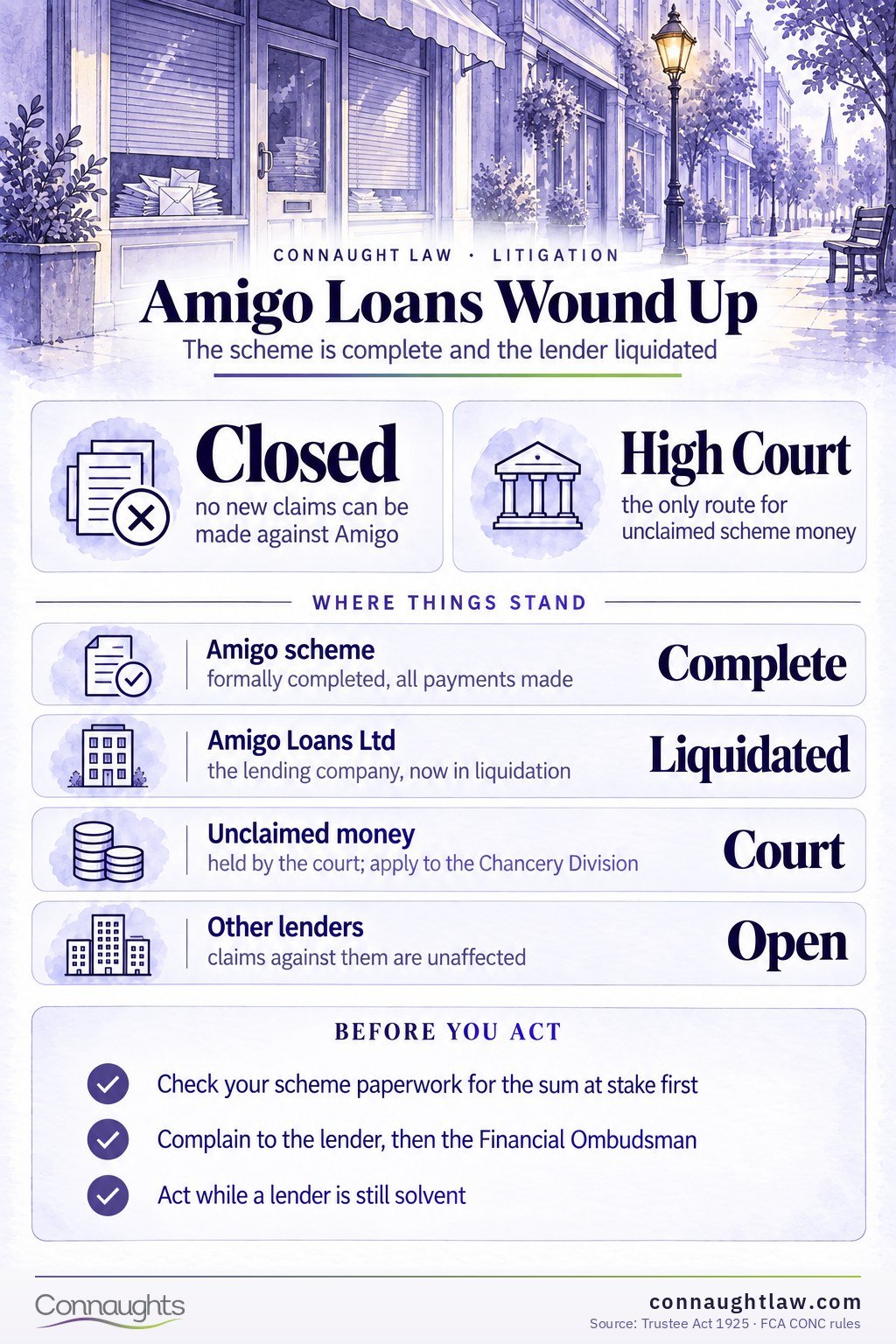
Amigo's status in 2026: scheme complete, lender liquidated
The Scheme of Arrangement was formally completed on 28 August 2025, when the scheme supervisors confirmed it had been implemented in line with the court-approved terms. Amigo Loans Ltd — the lending company — was then placed into liquidation, with Grant Thornton appointed. Customer service operations have ceased, and the company no longer responds to queries about claims, payments or balances.
One point causes confusion: the parent, Amigo Holdings plc, survived the liquidation of its lending subsidiary and remains a listed shell company exploring a possible reverse takeover. That is why an "Amigo" share price still exists — but it relates to the listed shell, not to any continuing lending business. No new borrowing, and no new compensation claims, are possible.
What customers actually received
Upheld claims were calculated in the usual way for unaffordable lending — a refund of the interest and charges paid, plus 8% statutory interest — but that calculated figure was then heavily reduced by the scheme. Customers ultimately received 18.51 pence in the pound of their entitlement: an initial payment of 12.5p distributed in late 2024, and a final payment of 6.01p in early 2025. That was far below the 42p originally proposed when the scheme was put to creditors.
The shortfall came down to scale. Over 210,000 claims were submitted — far more than Amigo had projected — against a compensation fund of around £345 million, while roughly £319 million was consumed in processing and administration costs. Amigo also withheld 20% tax on the statutory-interest element of payments; customers whose income fell within their allowances can reclaim that from HMRC using form R40.
The 18.51p figure reflects an insolvency scheme, not a normal complaint outcome. A customer who complained early — before the scheme took over — and won through the Financial Ombudsman Service received full compensation. Those routed into the scheme received a fraction of the same entitlement. The lesson for other lenders is to complain while the lender is still solvent.
Unclaimed compensation: the High Court process
Customers who did not provide valid bank details by the scheme's deadline had their money transferred into the custody of the High Court rather than paid out directly. That money can still be claimed, but only through a formal application to the Business and Property Courts, Chancery Division, under the Trustee Act 1925.
The application asks the court for "payment out of funds held by the Court on behalf of Amigo Loans," and must be supported by proof of identity and address, evidence of entitlement (such as your scheme decision letter), and documentation of any change of name. There is a non-refundable court fee of £54.
Because payments were reduced to 18.51p in the pound, many sums held by the court are small. Someone whose calculated compensation was £100 received only about £18.51 — less than the £54 fee. It is worth checking your scheme paperwork for the amount at stake before applying, since for small sums the fee can exceed the recovery.
Why Amigo collapsed
Amigo's failure was a regulatory reckoning rather than an ordinary business collapse. The company's affordability assessments were systematically inadequate: it approved loans for customers already showing clear financial stress — multiple payday loans, persistent overdraft use, recent defaults or CCJs — and treated guarantor backing as a way to reduce its own risk rather than an obligation requiring its own affordability check.
When the FCA restricted new lending in May 2020, the business model broke: Amigo could no longer earn from new loans while facing compensation liabilities on its historical book. The Scheme of Arrangement became the only alternative to immediate insolvency — which is precisely why customers ended up with a reduced, percentage-based payout.
Claims against other guarantor lenders
The most useful point for many readers is that Amigo's closure does not affect claims against other lenders. The same legal principles — reasonable and proportionate affordability checks for both borrower and guarantor under the FCA's CONC rules — apply across the sector. Whether you can recover, and how much, depends on the lender's status: full compensation is achievable against a solvent, operating lender, while a lender in administration pays through its administrators, often at a reduced rate.
If you had a guarantor loan from a lender other than Amigo, our guide to guarantor loan mis-selling claims explains how to complain and what you can recover. Where a claim overlaps with wider Consumer Credit Act arguments, or needs to be pursued against a lender in administration, our financial services disputes team can help.
Frequently askedQuestions about the Amigo scheme and liquidation
Can I still make a claim against Amigo Loans?
No. The Amigo scheme closed to new claims on 26 November 2022, all payments were made by 2025, and the lending company is in liquidation. It no longer accepts claims or complaints. The only remaining option is a High Court application under the Trustee Act 1925 for scheme money left unclaimed because bank details were not provided in time.
How much did Amigo customers actually receive?
18.51 pence in the pound of their calculated compensation — an initial 12.5p in late 2024 and a final 6.01p in early 2025 — against the 42p originally proposed. Someone entitled to £5,000 received around £925 in total before tax. The reduction reflected far more claims than expected and heavy administration costs.
What happened to Amigo after the scheme completed?
The lending company, Amigo Loans Ltd, entered liquidation in 2025 after the scheme was formally completed on 28 August 2025. The listed parent, Amigo Holdings plc, continues as a shell company, which is why an "Amigo" share price still appears — but there is no continuing lending business and no new compensation.
How do I claim Amigo compensation held by the court?
Apply to the Business and Property Courts, Chancery Division, for "payment out of funds held by the Court on behalf of Amigo Loans" under the Trustee Act 1925. Provide proof of identity and address, your scheme decision letter, and any name-change documents, with a £54 non-refundable fee. Check the sum at stake first, as small amounts may not justify the fee.
Was tax deducted from Amigo compensation?
Yes — 20% tax was withheld on the statutory-interest element (the 8% added to refunds) and paid to HMRC. Customers whose income fell within their personal or savings allowances can reclaim it using HMRC form R40. Higher-rate taxpayers may owe additional tax through self-assessment.
Can I still complain about other guarantor lenders?
Yes. Amigo's closure does not affect claims against other guarantor lenders. The same irresponsible-lending principles apply. Complain to the lender first, then escalate to the free Financial Ombudsman Service if rejected. Acting while a lender is still solvent offers the best prospect of full compensation rather than a reduced insolvency payout.
Amigo itself can no longer be claimed against. Tell us whether you were a scheme creditor with money left unclaimed, or borrowed from a different guarantor lender — we’ll tell you which route, if any, is worth the effort.
Get Expert Advice