
Soft tissue injury claims in the UK are valued under two separate sets of settlement guidelines, and which one applies can change an award several times over. Drivers and passengers with whiplash lasting up to two years receive fixed statutory tariff amounts between £275 and £4,975. Everyone else — injured workers, pedestrians, cyclists and visitors to unsafe premises — is valued under the Judicial College Guidelines, 18th edition, published April 2026. This guide sets out both sets of settlement guidelines, the current brackets for common soft tissue injuries, and how to assess what a claim is genuinely worth.
On This Page

Understanding Soft Tissue Injury Claims UK 2026
Soft tissue injuries are damage to muscles, tendons and ligaments rather than bone: whiplash to the neck and back, sprained ankles and wrists, strained shoulders and knees, torn muscles, and the deep bruising that follows falls and awkward lifts. Most heal, which is exactly why the law scrutinises them: recovery time, not the label, drives value, and the medical evidence of how long symptoms genuinely lasted is the whole case.
Clinicians grade these injuries. A grade one sprain or strain is overstretching with microscopic damage, typically settling within weeks; grade two is a partial tear of the ligament or muscle, often needing months of physiotherapy; grade three is a complete rupture, which may need surgery and can leave lasting instability. NHS guidance expects most sprains and strains to improve steadily with movement and physiotherapy, so symptoms that break that pattern change both the medicine and the claim.
The typical scenarios repeat: a rear-end shunt at traffic lights, a lifting injury in a warehouse, a slip on an unmarked wet floor, a twisted ankle on a broken pavement, a tackle gone wrong. Sport sits inside the ordinary rules — participants accept the contact inherent in the game, but not a dangerous pitch, missing matting, or recklessness beyond anything the sport contemplates.
Whiplash-associated disorder has its own grading. WAD 0 to I involves complaint without objective signs; WAD II adds reduced range of movement and tenderness; WAD III involves neurological signs such as altered reflexes or sensation; WAD IV, fracture or dislocation, is not a soft tissue injury at all. The grade recorded in the medical report anchors both credibility and prognosis, the two currencies these claims trade in.
Imaging matters more than most claimants expect. X-rays show bone, so a normal X-ray does not disprove a soft tissue injury; ultrasound shows tendon and ligament damage dynamically, and MRI is the definitive test for disc injuries, significant tears and symptoms that fail to resolve on schedule. Nobody needs a scan for a routine sprain, but where symptoms persist, an MRI or ultrasound that documents the damage moves a claim from assertion to evidence.
- Vehicle occupant with whiplash lasting up to 24 months: fixed statutory tariff
- Cyclists, motorcyclists, pedestrians and horse riders: Judicial College Guidelines, even in road accidents
- Workplace, public place and sports injuries: Judicial College Guidelines
- Any prognosis beyond two years: outside the tariff entirely
- Financial losses are recoverable in full under both systems
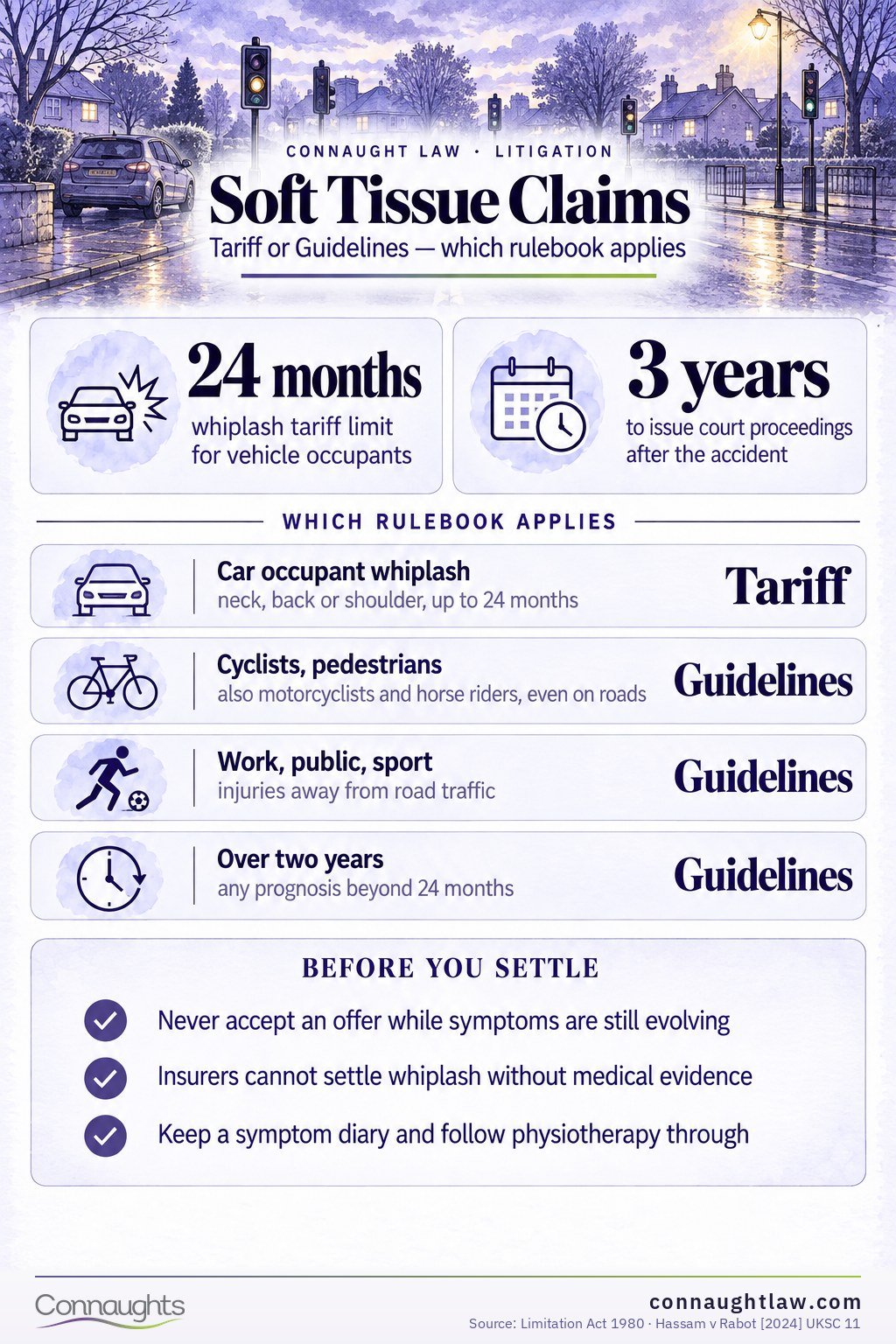
Soft Tissue Injury Settlement Guidelines 2026
Two documents function as the settlement guidelines for soft tissue injury claims. The first is the statutory whiplash tariff: fixed amounts set by regulation for road traffic whiplash suffered by vehicle occupants. The second is the Judicial College Guidelines, the brackets judges and insurers use to value every other injury, now in their 18th edition, published in April 2026 with figures uprated by roughly 8.26 per cent for inflation over the 2024 edition. Any table still quoting 17th edition figures understates current values.
Vehicle occupants with whiplash lasting up to two years receive fixed tariff amounts of £275 to £4,975. Everyone else is valued under Judicial College brackets — minor neck injuries reach £10,420 and modest ankle injuries £18,150 — with lost earnings and treatment costs added in every case.
How Much Is a Soft Tissue Injury Claim Worth?
Three questions fix the value of a soft tissue damage claim. First, which system applies: tariff cases are worth their band and no more, while Judicial College cases start higher and climb. Second, how long recovery took or is forecast to take — the dominant variable in both systems. Third, what the injury cost: lost earnings, physiotherapy, travel and care are added to the injury award in full, and for longer recoveries they routinely exceed it.
There is no official average payout for a soft tissue injury, and quoted averages mislead because the two systems produce such different figures. Most tariff-only claims resolve for under £1,600, because most whiplash recovers within a year. Non-tariff claims for the same recovery period commonly settle in the mid four figures upwards once losses are included, and severe or chronic outcomes belong in a different conversation altogether.
Soft Tissue Injury Compensation Calculators
Online compensation calculators repackage Judicial College brackets, and the honest ones say so. What no calculator can do is apply the tariff boundary correctly, value a mixed injury where tariff and non-tariff elements overlap, forecast your prognosis, or quantify your actual financial losses — the elements that decide real settlements. Treat any calculator figure as orientation, not valuation: a genuine assessment needs the medical report's prognosis and a schedule of what the injury has cost you.
The Whiplash Tariff and the 2025 Changes
The statutory tariff applies to whiplash injuries — defined as soft tissue injuries of the neck, back or shoulder — suffered by drivers and passengers in road traffic accidents, where symptoms last up to 24 months. The Whiplash Injury (Amendment) Regulations 2025 set these bands for accidents on or after 31 May 2025:
Whiplash Tariff Amounts
| Injury duration | Whiplash only | With minor psychological injury |
|---|---|---|
| Up to 3 months | £275 | £300 |
| 3 to 6 months | £565 | £595 |
| 6 to 9 months | £965 | £1,025 |
| 9 to 12 months | £1,510 | £1,595 |
| 12 to 15 months | £2,335 | £2,435 |
| 15 to 18 months | £3,445 | £3,550 |
| 18 to 24 months | £4,830 | £4,975 |
Two details matter more than the headline figures. First, the psychological column covers minor psychological harm such as travel anxiety; the uplift is modest, between £25 and £145 per band, not a doubling. Second, the tariff is a ceiling only within its scope: a prognosis beyond 24 months takes the whole injury outside the tariff and into the Judicial College Guidelines, which is why prognosis is fought over so hard. Accidents before 31 May 2025 remain on the lower 2021 tariff, set out in our whiplash payout scale guide.
What Counts as a Whiplash Injury
The definition has edges worth knowing. The tariff covers soft tissue injuries of the neck, back or shoulder only: a wrist sprained bracing against the wheel or a knee struck on the dashboard falls outside it and is valued under the Guidelines even for a vehicle occupant, alongside the tariff award for the whiplash element. And where the whiplash itself is exceptionally severe, or its circumstances exceptional, the court can uplift the tariff figure by up to 20 per cent.
Official Injury Claim Portal Requirements
Tariff claims are handled through the Official Injury Claim portal, built for road accident claims where the injury element is worth up to £5,000 — the small claims limit for these cases. The claimant registers the claim, the insurer responds on liability within fixed timescales, and an independent medical examination is arranged through the MedCo system. The report's prognosis period then reads directly across to the tariff band.
The MedCo Medical Examination
The MedCo report is not optional: insurers are prohibited by law from settling whiplash claims without medical evidence, a ban aimed at the old practice of pre-medical offers that quietly undervalued injuries which had not yet run their course. Treat the examination as evidence, because it is — describe symptoms at their genuine worst and their genuine best, mention every affected activity, and correct the report promptly if it records something wrongly.
The portal is designed for unrepresented claimants with a single, straightforward whiplash injury, and for that case it can work. It creaks the moment reality intrudes: disputed liability, an injury that is not settling, multiple injuries valued under two systems at once, or an uninsured or untraced driver, whose claim runs through the Motor Insurers' Bureau. Those cases belong with our road accident specialists rather than a self-service form.
Settlement Guidelines Outside the Tariff: JCG Brackets
Outside the tariff, soft tissue injuries are valued individually under the Judicial College Guidelines, 18th edition (April 2026), where recovery time and residual symptoms set the bracket. These are the current published anchors for the most common soft tissue sites:
Soft Tissue Brackets
| Injury | JCG 18th Edition Bracket |
|---|---|
| Neck — minor soft tissue, recovery within about two years | Up to £10,420 |
| Neck — moderate soft tissue, protracted recovery | £10,420 – £18,150 |
| Back — minor soft tissue, extended recovery | £5,750 – £10,420 |
| Shoulder — moderate, symptoms persisting beyond two years | £10,420 – £16,870 |
| Wrist — less severe, recovery over a longer period | £16,640 – £32,370 |
| Ankle — modest sprains and ligament damage | Up to £18,150 |
| Foot — minor soft tissue injuries | Up to £18,150 |
| Psychiatric harm — moderate | £7,740 – £25,190 |
The contrast with the tariff is the point. A vehicle passenger with twelve months of neck symptoms receives £1,510; a cyclist or warehouse worker with the same injury and recovery is valued within a bracket reaching £10,420, plus losses in full. Cyclists, motorcyclists, pedestrians and horse riders are expressly outside the tariff even in road accidents, and workplace and public liability claims never entered it. Site-specific detail sits in our ankle injury compensation and shoulder injury compensation guides, both updated to the 18th edition.
Liability outside the tariff comes from familiar duties. Employers must risk-assess manual handling, provide safe systems and training, and maintain equipment; occupiers must keep premises reasonably safe for visitors; highway authorities must maintain the roads and pavements they are responsible for. The soft tissue injury is often the easy part, and the argument is over whether the duty was broken — which is where early photographs, accident book entries and inspection records earn their keep.
A minority of soft tissue injuries do not follow the script. Chronic pain conditions — including complex regional pain syndrome and fibromyalgia-type presentations triggered by injury — are valued under their own chapters of the Guidelines and can be worth many times a minor bracket where the condition is permanent and disabling. These claims turn on specialist pain evidence and are routinely underestimated by insurers, which is where an experienced personal injury claim team changes outcomes.
Psychological Injury in Soft Tissue Claims
Psychological consequences are valued on a ladder of their own. Minor harm, unpleasant but resolving, is dealt with inside the tariff's second column for vehicle occupants. A diagnosable psychiatric condition — clinical depression, an anxiety disorder or post-traumatic stress — is different: it is valued separately under the psychiatric chapters of the Guidelines, whoever the claimant is, with moderate psychiatric harm alone bracketed at £7,740 to £25,190.
Mixed Injuries: Hassam v Rabot
Mixed cases are governed by the Supreme Court's decision in Hassam v Rabot [2024] UKSC 11. The tariff amount is assessed for the whiplash, a common law valuation is made for the non-tariff injuries, and the court steps back to ensure the combined figure does not compensate the same suffering twice. In practice the non-tariff element frequently exceeds the whiplash figure, and identifying it is one of the clearest ways professional advice changes outcomes in car accident compensation claims.
The practical trigger for a psychiatric claim is simple: symptoms that persist and interfere. Nightmares, avoidance of driving, panic at junctions or low mood months after the accident belong in the GP record and then before a psychiatric expert, not in a footnote of the claim form. Without a diagnosis the tariff uplift is the ceiling; with one, a separate and often larger award opens.
Claims Process and Time Limits
Whatever the system, the sequence is the same: report the accident and see a doctor promptly, preserve evidence including photographs and witness details, obtain the medical report, and value the claim only when the prognosis is reliable. Under the Limitation Act 1980, court proceedings must normally be issued within three years of the accident or of your knowledge that the injury was significant. Children have until their twenty-first birthday, and people lacking capacity face no running limit while incapacity lasts.
Rehabilitation should not wait for settlement. Under the Rehabilitation Code, insurers frequently fund physiotherapy within weeks of notification, because early treatment shortens recovery and everyone's costs. Accepting funded treatment does not commit you to accepting the insurer's valuation later. Be more careful with early contact from the other driver's insurer offering to handle everything: third-party capture is lawful, but the caller's job is to close the claim cheaply before the prognosis is known.
Evidence discipline decides the marginal cases. See a GP or attend urgent care promptly rather than waiting to see if it settles, follow the physiotherapy referral through, and keep a short symptom diary while recovery runs its course. Defendants read gaps in treatment as gaps in symptoms, unfairly but predictably, and the contemporaneous record is the only rebuttal that works.
Costs rules shape tactics at every value. Small claims recover almost no legal costs, which is why the portal exists; fast track claims recover fixed costs scaled to value and stage. Borderline valuations are therefore worth professional attention: whether an injury is honestly worth £4,800 or £5,600 changes not just the award but the entire procedural and costs footing of the claim.
Many soft tissue claims are settled on a six or nine month prognosis that then simply fails to resolve. Once a claim is settled it is settled, even if symptoms continue for years. Never accept an offer while symptoms are still evolving, and never assume the first prognosis is the final word.
Questions about soft tissue injury claims
How much compensation do you get for a soft tissue injury in the UK?
Vehicle occupants with whiplash lasting up to two years receive fixed tariff amounts of £275 to £4,975. Everyone else is valued under Judicial College brackets — minor neck injuries reach £10,420 and modest ankle injuries £18,150 — plus financial losses in both systems.
What is the average payout for soft tissue damage?
No official average exists, and averages mislead because two valuation systems apply. Most tariff-only whiplash claims settle below £1,600; comparable non-tariff injuries commonly settle in the mid four figures upwards once lost earnings and treatment costs are added.
Is there an accurate soft tissue injury compensation calculator?
Calculators repackage Judicial College brackets, so they can indicate a range. None can apply the whiplash tariff boundary, value mixed injuries after Hassam v Rabot, or add your actual financial losses — the elements that determine real settlement figures.
Is whiplash the same as a soft tissue injury?
Whiplash is one type of soft tissue injury, legally defined as neck, back or shoulder soft tissue damage suffered by vehicle occupants in road accidents. Only that definition attracts the fixed tariff; every other soft tissue injury is valued conventionally.
Are cyclists and pedestrians covered by the whiplash tariff?
No. Cyclists, motorcyclists, pedestrians and horse riders are expressly excluded. Their soft tissue injuries are valued under the Judicial College Guidelines even in road accidents, typically producing awards several times the equivalent tariff figure.
What if my symptoms last longer than two years?
A prognosis beyond 24 months takes the injury outside the tariff altogether, into Judicial College neck and back brackets that begin where the tariff ends. That boundary makes the medical prognosis the most valuable contested issue in borderline claims.
Do I need an MRI scan to claim for soft tissue damage?
No — most claims settle on clinical examination and prognosis alone. But where symptoms persist or a significant tear is suspected, MRI or ultrasound evidence documents the damage objectively and typically supports a higher bracket.
How long do I have to make a soft tissue injury claim?
Three years from the accident to issue court proceedings, with the clock starting at 18 for children and suspended for people lacking capacity. Acting early preserves CCTV, vehicle data and witness evidence that limitation law cannot restore.
Tell us how you were injured, whether you were in a vehicle and how long symptoms have lasted. We’ll tell you which of the two systems values your claim, and whether it is worth more than the portal offers.
Get Expert Advice