
UK driving offences carry consequences that reach well beyond a fine — penalty points, disqualification, unlimited fines, and for the most serious offences, prison. This guide explains the Road Traffic Act framework, the current penalties for the main offences, the professional and employment fallout of a conviction, and the defences that can genuinely change the outcome. Acting before the court hearing, not after, is what makes the difference.
On This Page
Understanding UK Driving Offences and Penalties
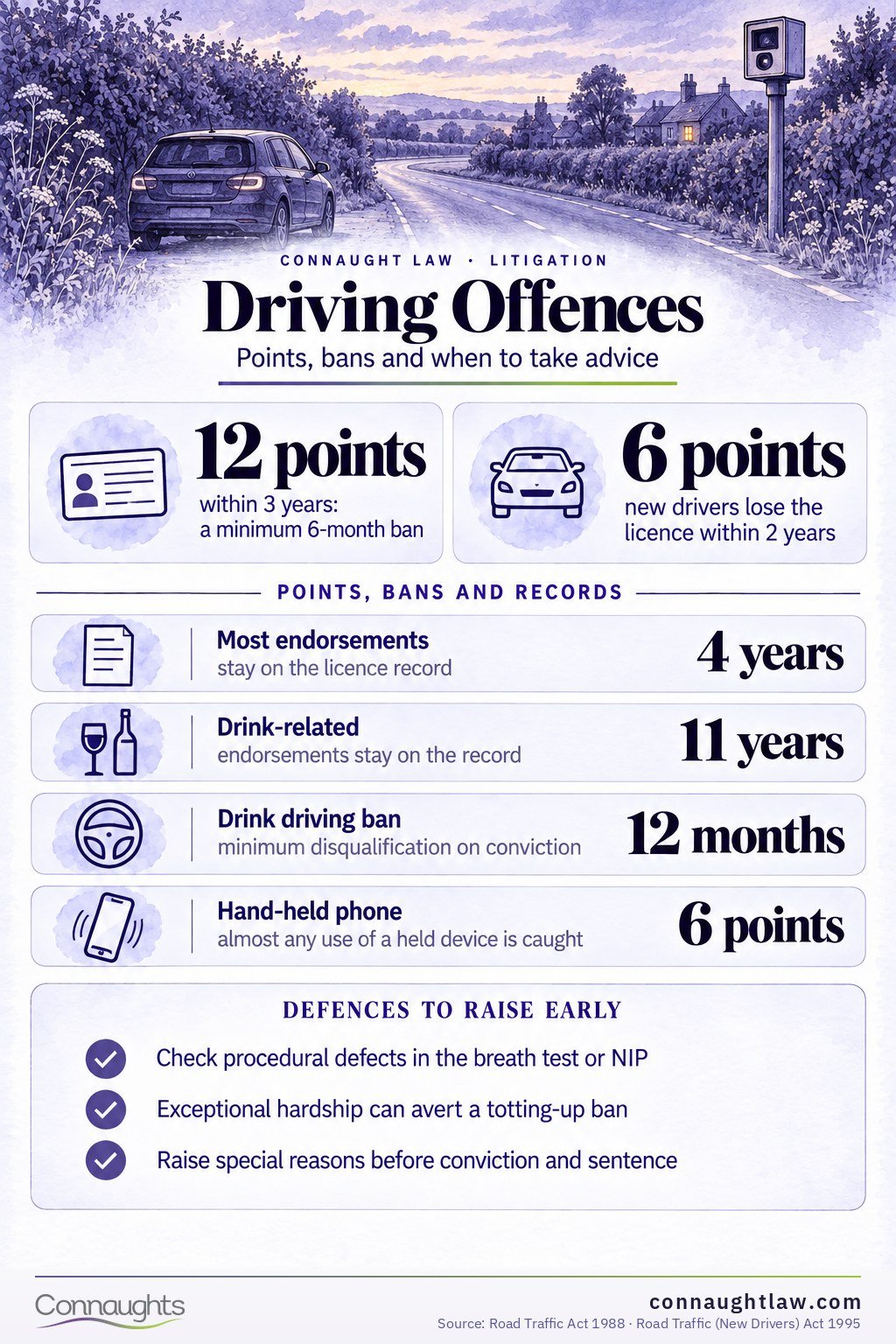
Most driving offences are punished with penalty points and a fine, but many carry discretionary or mandatory disqualification, and the most serious carry prison. Twelve points within three years brings a minimum six-month ban, and new drivers lose their licence entirely at six points. The best chance of a good outcome comes from taking advice before the hearing.
The Road Traffic Act Framework
Road traffic law in Great Britain is built on the Road Traffic Act 1988 and the Road Traffic Offenders Act 1988, which set out the offences and the penalties for them. Convictions are recorded on the driving licence as endorsements with a code and a number of penalty points, which stay on the record for four years for most offences and eleven years for drink-related ones. The number of points, and whether a ban follows, depends on the offence and its seriousness.
Where a fixed penalty is not offered or not accepted, an offence is dealt with by the magistrates' court, applying the Sentencing Council's guidelines. Understanding that a driving charge is a criminal matter, with a criminal record attached, is the starting point — it is not simply an administrative penalty.
Current Penalties for the Main Offences
Drink driving is among the most serious common offences. In England and Wales the limit is 35 micrograms of alcohol per 100 millilitres of breath (80 milligrams in blood). A conviction carries an unlimited fine, up to six months' imprisonment, and a minimum twelve-month disqualification — rising to three years for a second offence within ten years. Failing to provide a specimen and drug driving carry comparable penalties, and refusing a specimen is not a way to avoid them.
Using a hand-held mobile phone while driving carries six penalty points and a £200 fixed penalty, following the tightening of the rules so that almost any use of a held device is caught. Careless and dangerous driving cover a spectrum from points and fines to imprisonment, with the sentence turning on the seriousness of the driving and any harm caused.
- Drink driving: unlimited fine, up to 6 months' prison, minimum 12-month ban.
- Mobile phone: 6 points and a £200 fixed penalty.
- No insurance: 6–8 points, an unlimited fine and possible disqualification.
- Totting up: 12 points in 3 years means a minimum 6-month ban.
Speeding Fines and Penalties
Speeding is dealt with under the Sentencing Council's guideline, which places offences into three bands according to how far over the limit the driver was. Band A, the least serious, typically means three penalty points and a fine of around half of weekly income; Band B and Band C bring higher fines — up to 150% of weekly income — and either more points or a short disqualification. Court fines are capped at £1,000, or £2,500 for motorway offences.
A minor speeding matter is often resolved by a fixed penalty of three points and a fine, or a speed awareness course where eligible. More serious excess speed, however, is a court matter where a short ban is a real possibility, so the level of speed alleged determines how seriously the case must be taken.
Driving Without a Licence or Insurance
Driving without insurance is a strict-liability offence carrying six to eight penalty points, an unlimited fine and, in some cases, disqualification. It is recorded with the endorsement code IN10, which insurers treat seriously and which can inflate premiums for years afterwards — a consequence that often outlasts the immediate penalty. Driving otherwise than in accordance with a licence carries points and a fine, and driving while disqualified is a more serious offence that can lead to imprisonment.
These offences are frequently charged alongside others after a stop, so a driver facing one is often facing several. Because the points and premium consequences compound, they are worth defending properly rather than accepting without advice.
Disqualification and Totting Up
Disqualification comes in two forms. Some offences carry a discretionary or mandatory ban in their own right; separately, the totting-up system disqualifies any driver who accumulates twelve or more penalty points within three years, for a minimum of six months. A driver facing a totting-up ban can ask the court not to impose it on the ground of exceptional hardship — but this is a high bar, requiring real, evidenced hardship going beyond the ordinary inconvenience of losing a licence.
New drivers face a stricter rule. Under the Road Traffic (New Drivers) Act 1995, a driver who accumulates six or more penalty points within two years of passing their test has their licence revoked automatically, and must reapply and pass the test again. For anyone in their first two years, even a single mobile phone offence is enough to end the licence.
Recent Legal Developments
The most significant recent change is the increase in maximum sentences for the most serious offences. The Police, Crime, Sentencing and Courts Act 2022 raised the maximum penalty for causing death by dangerous driving, and for causing death by careless driving while under the influence, to life imprisonment. It also created a new offence of causing serious injury by careless driving.
Enforcement has also become more technological, with greater use of cameras and automated detection, and the mobile phone rules were tightened so that holding a device for almost any purpose while driving is an offence. The overall direction is towards tougher penalties for the offences that cause the most harm, which makes early legal advice on a serious charge more important than ever.
Defence Strategies
A driving charge is not always as straightforward as it appears, and there are recognised routes to challenge one. Procedural defects — in how a breath test was administered, how a Notice of Intended Prosecution was served, or how evidence was gathered — can be decisive. Identity can be in issue, and the strict duty to identify the driver under section 172 of the Road Traffic Act 1988 has its own defences and traps.
Where conviction is likely, "special reasons" arguments can persuade a court not to endorse or disqualify despite the offence being proved, and exceptional hardship can avert a totting-up ban. The consistent theme is timing: these arguments are raised before conviction and sentence, not afterwards, so the short deadlines on the court papers matter more than most drivers realise.
Professional and Employment Consequences
The fallout from a driving conviction often lands hardest at work. Professional drivers — HGV, PCV and taxi licence holders — can lose their livelihood on a disqualification, and licensing authorities may review a vocational licence after even a lower-level conviction. For anyone who drives for work, a ban can mean the loss of a job as well as a licence.
Beyond driving roles, a criminal record for a driving offence can show on enhanced criminal record checks and affect certain professions and travel. These wider consequences are part of why a driving charge deserves proper attention: the penalty imposed by the court is often not the most costly result. For serious or contested charges, our litigation and criminal defence team can advise on the best way forward.
Frequently askedQuestions about driving offences and penalties
What are the penalties for drink driving in the UK?
A drink driving conviction carries an unlimited fine, up to six months' imprisonment, and a minimum twelve-month disqualification — rising to three years for a second offence within ten years. The limit in England and Wales is 35 micrograms of alcohol per 100 millilitres of breath.
Can I be charged for failing to provide a specimen?
Yes. Failing to provide a breath, blood or urine specimen without a reasonable excuse is an offence carrying penalties comparable to drink driving, including disqualification. Refusing a test is not a way to avoid the consequences, and can leave you worse off.
How many penalty points lead to a ban?
Accumulating twelve or more penalty points within three years leads to a minimum six-month disqualification under the totting-up rules. New drivers face revocation of their licence at just six points within two years of passing their test.
What is an exceptional hardship argument?
It is a plea asking the court not to impose a totting-up ban because disqualification would cause hardship beyond the ordinary inconvenience — for example loss of employment affecting dependants. It must be supported by real evidence, and it is a high threshold to meet.
What are the penalties for driving without insurance?
Driving without insurance carries six to eight penalty points, an unlimited fine and possible disqualification, recorded as an IN10 endorsement. Insurers treat the IN10 code seriously, so premiums can remain higher for years after the conviction itself.
What is the maximum sentence for causing death by dangerous driving?
Since the Police, Crime, Sentencing and Courts Act 2022, the maximum sentence for causing death by dangerous driving, and for causing death by careless driving while under the influence, is life imprisonment. A new offence of causing serious injury by careless driving was also introduced.
How long do penalty points stay on my licence?
Most penalty points remain on the licence for four years from the date of the offence or conviction. For drink-driving and certain other serious offences, endorsements stay on the record for eleven years, which is why these convictions have such a long tail.
Should I get legal advice for a driving charge?
For anything beyond a minor fixed penalty — and certainly where a ban, your job or a serious charge is involved — yes. Defences such as procedural challenges, special reasons and exceptional hardship must be raised before conviction, so early advice is important.
Tell us the offence, the notice you received and how many points you already carry. We’ll tell you what the realistic outcome is and whether an exceptional hardship or special reasons argument is open to you.
Get Expert Advice