
Spousal maintenance after divorce is neither automatic nor for life by default — two myths that cause equal and opposite panic. It exists for one situation: a former spouse who cannot meet reasonable needs from their own resources, usually because the marriage shaped their earning capacity. Courts increasingly prefer fixed terms funding a transition to independence, and the clean break remains the statutory preference. This guide covers who qualifies, how figures are set, and how orders end.
On This Page

Neither automatic nor for life
Most divorces produce no spousal maintenance at all: where both parties can meet their own needs, the courts prefer everyone to walk away financially complete. Maintenance compensates the economic architecture of the marriage — careers paused for children, relocations for one spouse's work, earning gaps that outlast the relationship — and it is entirely distinct from child maintenance, which runs through the CMS whatever the adults agree. Housing costs drive quantum, which is why London and south-east courts see the biggest awards.
What Is Spousal Maintenance After Divorce?
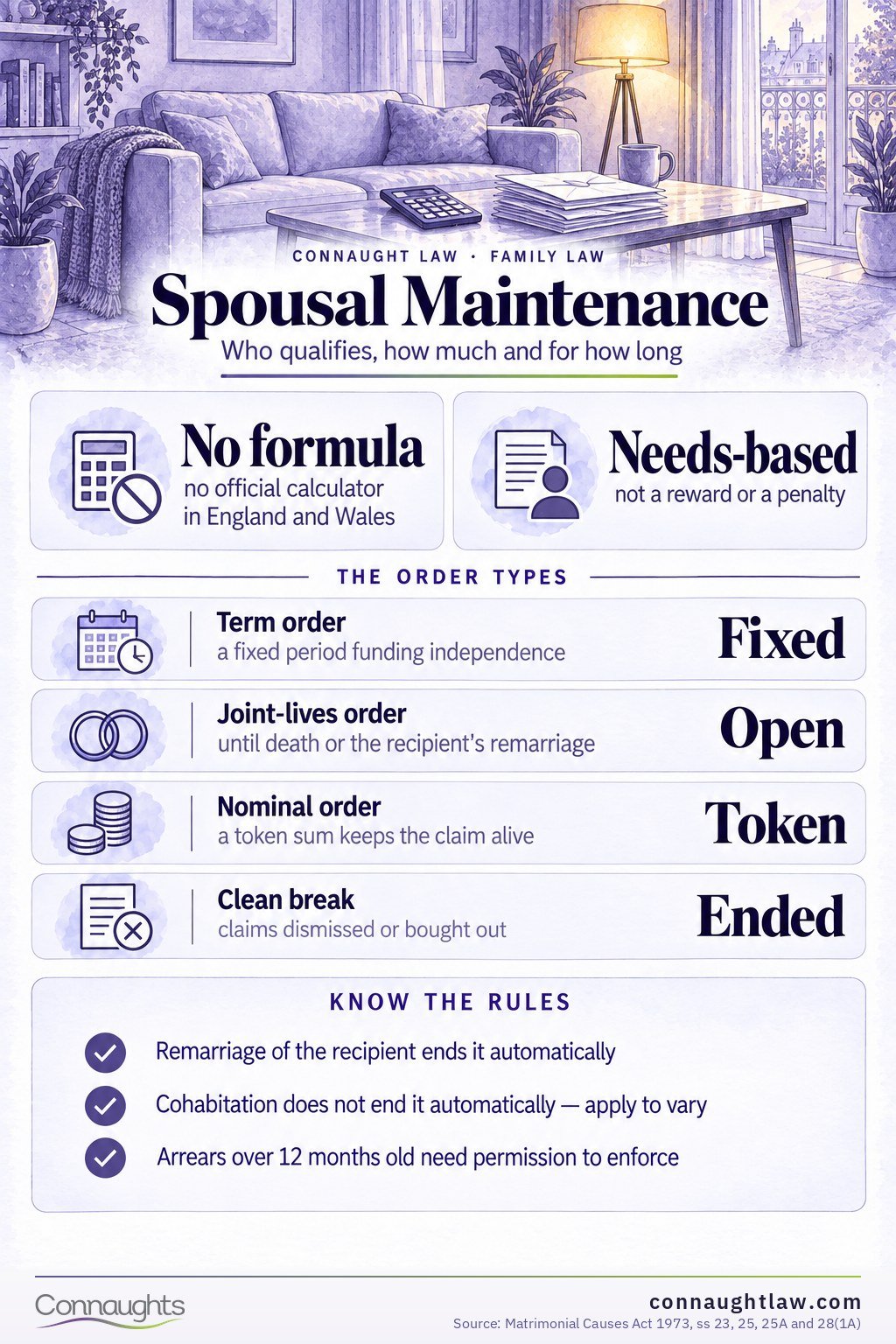
A periodic payment from one former spouse to the other for the recipient's own needs — typically monthly, tax-free in the recipient's hands, and paid from the payer's taxed income with no relief in either direction. It ends automatically on the recipient's remarriage or either party's death, and at the end of any fixed term; cohabitation with a new partner does not end it automatically, though modern orders increasingly say what happens when it occurs.
Legal Framework and Requirements
The power comes from sections 23 and 25 of the Matrimonial Causes Act 1973: needs, resources, the standard of living, the marriage's length and each party's earning capacity all weigh in. Section 25A then pushes the other way — a duty to consider whether the obligations can fairly end at once, or after a defined term. The modern current runs firmly towards transition rather than permanent annuity.
The Law Commission's December 2024 scoping report put maintenance reform on the table, and the government's June 2026 consultation A fairer end to relationships now proposes a "codification-plus" rebuild of financial remedies law. Scotland's model — maintenance limited to three years in most cases — hovers over the debate. Nothing has changed yet: the current discretionary framework governs every order made today.
How Spousal Maintenance Is Assessed
England and Wales has no spousal maintenance formula and no official calculator — searches for one end here honestly. Unlike child maintenance's percentage tables, spousal maintenance is built case by case from two budgets: what the recipient genuinely needs, and what the payer can genuinely afford.
The court constructs the figure from the evidence: the recipient's reasonable income needs measured against their actual and potential earnings — with an expectation of maximising their own capacity — and the payer's ability to pay after meeting their own needs. Budgets are tested line by line, which is why inflated schedules backfire and realistic ones persuade.
- What does the recipient genuinely need, after their own income and realistic earning potential?
- What can the payer genuinely afford, after their own reasonable needs are met?
- How long until the recipient can realistically reach independence — and what funds the transition?
Types of Spousal Maintenance Orders
Order Types Compared
| Order | How It Runs | Where It Fits |
|---|---|---|
| Term order | Fixed period; extendable unless barred under s.28(1A) | The modern workhorse — funds a transition to independence |
| Joint-lives order | Until death or the recipient's remarriage | Long marriages where age or health forecloses earning capacity |
| Nominal order | A token 5p or £1 a year, keeping the claim alive | A safety net — and increasingly contested as anti-clean-break |
| Capitalised or secured | A lump sum (Duxbury basis) or secured fund replaces income | Buying out the income claim for finality |
Application Process and Procedures
Maintenance is resolved inside the wider financial remedy process, not as a freestanding claim: disclosure through Form E, negotiation or mediation, and a consent order approvable from the conditional order stage — or contested financial remedy proceedings issued on Form A (£321 from 13 July 2026) where agreement fails. Interim maintenance can be ordered while the case runs, which matters where one spouse controls all the income.
The Clean Break Alternative
The statute prefers endings. Where both parties can stand alone — or capital can buy out the income claim through a lump sum or pension adjustment — the court dismisses maintenance claims entirely under a clean break order. For payers, the price of finality is usually capital; for recipients, the calculus is security against flexibility: a capitalised sum cannot be varied down later, but nor can it be varied up. GOV.UK's overview covers the framework.
Enforcement and Variation Powers
Maintenance orders stay alive: variable throughout on material change — redundancy, illness, retirement, promotion, new dependants, sustained cohabitation — in either direction. Non-payment has machinery: attachment of earnings, charging orders and committal, with interest on arrears; but arrears more than twelve months old need the court's permission to enforce, so act promptly rather than letting default accumulate.
Frequently askedQuestions about who receives maintenance, how much and for how long
Who qualifies for spousal maintenance in the UK?
A former spouse who cannot meet reasonable needs from their own income and realistic earning capacity, where the other can afford to contribute after meeting their own needs. It is needs-based, not a reward or a penalty — and most divorces produce none at all.
How much spousal maintenance will I get or pay?
There is no formula or calculator. The court compares the recipient's justified budget and income potential against the payer's ability to pay, and tests both line by line. Realistic budgets carry the day; inflated ones cost credibility across the whole case.
How long does spousal maintenance last?
Increasingly, a fixed term designed to fund transition — years, not decades — extendable unless the order carries a section 28(1A) bar. Joint-lives orders persist mainly for long marriages where age or health forecloses independence. Remarriage of the recipient ends any order automatically.
Does living with a new partner stop spousal maintenance?
Not automatically — unlike remarriage. Sustained cohabitation grounds a variation or termination application, and modern orders often provide for it expressly. Keep evidence of the change and apply; nothing adjusts itself.
Can spousal maintenance be changed later?
Yes — on material change of circumstances, either way: up on genuine need, down or off on redundancy, retirement or the recipient's changed position. A term can be extended only if the order allows; a section 28(1A) bar makes the end date absolute.
What happens if my ex stops paying maintenance?
Enforce promptly: attachment of earnings, charging orders and committal machinery exist, and interest runs on arrears. Arrears over a year old need the court's permission to enforce — delay converts an entitlement into an argument.
Is spousal maintenance taxable?
No. Payments come from the payer's taxed income and are tax-free in the recipient's hands, with no relief in either direction under current UK rules. Budget on net figures on both sides of the negotiation.
Can I avoid spousal maintenance with a clean break?
Where the capital allows, yes: claims can be dismissed immediately or bought out through a lump sum or pension transfer, and the statute actively prefers it. The buyout price reflects the maintenance forgone — finality is purchased, not free.
Tell us both incomes, the children's arrangements and what capital exists. We will tell you whether maintenance is realistic here, at what level, and for how long.
Get Expert Advice