
Most partner applications have to meet a £29,000 minimum income requirement. A small group does not: where the sponsoring partner receives a specified disability or carer benefit, the financial test becomes adequate maintenance instead. It is not an easier version of the same test — it is a different calculation, with its own formula, its own rates and its own accommodation requirement, and it opens only through the benefit.
On This Page

When Maintenance Replaces the Income Threshold
Paragraph E-ECP.3.1 of Appendix FM gives three ways to meet the financial requirement for entry clearance as a partner: a gross annual income of at least £29,000; savings of £16,000 plus two and a half times the shortfall; or the requirements of E-ECP.3.3. The third is the adequate maintenance route, and E-LTRP.3.1(c) and E-LTRP.3.3 mirror it for leave to remain.
E-ECP.3.3(b) states the test: the applicant must provide evidence that their partner “is able to maintain and accommodate themselves, the applicant and any dependants adequately in the UK without recourse to public funds”. The last phrase is doing work — the household’s own resources have to reach the threshold, and a no recourse to public funds condition is what the grant will normally carry.
The route is not confined to partners. The same structure applies to children under E-ECC.2.1(c) and E-LTRC.2.1(c), to parents under E-ECPT.3.1 and E-LTRPT.4.1, to adult dependent relatives under ADR 6.1 and ADR 13.1, and to Part 8 legacy cases under their own guidance. The current caseworker guidance is version 13.0, published on 11 November 2025.
Adequate Maintenance or the £29,000 Threshold
The two routes are not alternatives you can choose between. Adequate maintenance opens only where the sponsoring partner is in receipt of one of the specified benefits at the date of application. If no such benefit is in payment, the minimum income requirement applies however modest the household’s circumstances, and no amount of evidence about outgoings changes that.
The corollary catches people at the extension stage. If the qualifying benefit stops, the next application reverts to the £29,000 requirement, and a household that comfortably satisfied adequate maintenance may fail the income test outright. That is a planning point rather than a legal one, and it is best identified at the first grant rather than thirty months later.
Which Benefits Open the Route
E-ECP.3.3(a) lists them exhaustively. Three Scottish payments were added by Statement of Changes HC 733 on 12 March 2025, and lists published before that date are incomplete.
Specified Benefits Under E-ECP.3.3(a)
| Group | Benefit |
|---|---|
| Disability | Disability Living Allowance · Personal Independence Payment · Attendance Allowance · Severe Disablement Allowance · Industrial Injuries Disablement Benefit |
| Carer | Carer’s Allowance |
| Armed forces and police | Armed Forces Independence Payment or Guaranteed Income Payment under the Armed Forces Compensation Scheme · Constant Attendance Allowance, Mobility Supplement or War Disablement Pension under the War Pensions Scheme · Police Injury Pension |
| Scotland | Child Disability Payment · Adult Disability Payment · Carer’s Support Payment · Pension Age Disability Payment · Scottish Adult Disability Living Allowance |
Two of these are missed more often than the rest. Police Injury Pension is on the list and is frequently omitted from summaries. And the Scottish payments matter because a sponsor who has transferred from a DWP benefit to its Scottish successor has not lost the route — the successor payment is named in its own right.
The Calculation
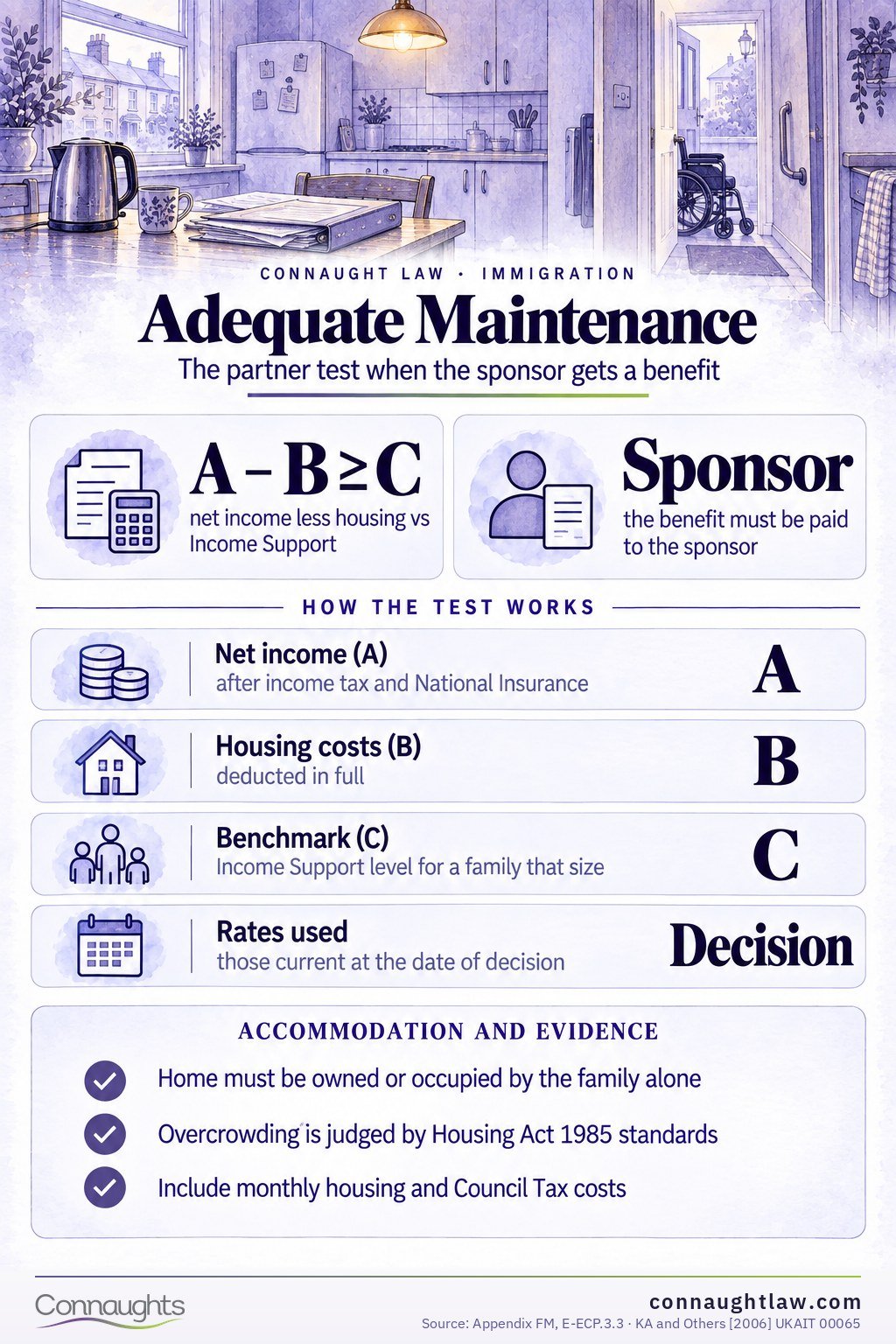
Paragraph 6 of the Immigration Rules defines the standard: after income tax, National Insurance contributions and housing costs have been deducted, there must be available to the family the level of income that would be available to them if the family was in receipt of Income Support. In practice that is expressed as A minus B is at least C — net income, less housing costs, against the Income Support level for an equivalent British family of that size.
The formula comes from KA and Others (Adequacy of Maintenance) Pakistan [2006] UKAIT 00065. It is worth naming correctly, because the case usually cited alongside it — Ahmed (benefits: proof of receipt; evidence) Bangladesh [2013] UKUT 00084 (IAC) — governs how the calculation should be set out and evidenced, not the calculation itself.
- Couple, both aged 18 or over — £150.15 a week.
- Single person aged 25 or over, or lone parent aged 18 or over — £95.55 a week.
- Each dependent child — £87.88 a week.
- Family premium — £20.22 a week.
- The rates that apply are those current at the date of decision, not the date of application — so an application filed near the April uprating should be calculated against the higher figures.
Housing costs are deducted in full, which is why two households on identical incomes can reach opposite answers. Our adequate maintenance calculator works the figures through, but the calculation should be set out in the application itself rather than left for a caseworker to reconstruct.
Accommodation and the Evidence Required
The maintenance test has a twin. E-ECP.3.4 and E-LTRP.3.4 require adequate accommodation which the family own or occupy exclusively, and accommodation is not adequate if it is overcrowded or contravenes public health regulations. Overcrowding is measured by the room standard and the space standard in Part X of the Housing Act 1985, so the question is the number of rooms and their floor area against the number of occupants — not whether the property feels adequate.
Appendix FM-SE sets the evidence. Paragraph 12A lists what must be provided, including at 12A(f) the monthly housing and Council Tax costs for the accommodation, alongside a description of the property and confirmation of the right to occupy it. Paragraph 12B deals with savings, which are divided by the number of weeks of leave sought. Missing the housing-cost evidence is the most common reason these applications go back for further information.
What the MAC Review Recommended
The Migration Advisory Committee published its review of family visa financial requirements on 10 June 2025. It recommended a minimum income requirement in the range of £21,000 to £28,000 based on the sponsor’s income alone, and it was blunt about adequate maintenance, describing the calculation as incoherent and unnecessarily complex and recommending that the government either replace it with a more coherent calculation or substitute an assessment of housing suitability only.
None of that has happened. The requirement remains £29,000, the adequate maintenance route remains in the form set out above, and no implementation date has been announced. A review recommendation is not a change in the law, and an application filed today is decided on the Rules as they stand.
One related change did land. Statement of Changes HC 1491, laid on 9 December 2025, substituted GEN.3.1(2) of Appendix FM, the exceptional circumstances provision that allows other sources of income to be considered where refusal would produce unjustifiably harsh consequences. It is a separate gateway from adequate maintenance and is worth considering where neither the income threshold nor a qualifying benefit is available, and it is where an Article 8 argument on the finances belongs.
Frequently askedQuestions about adequate maintenance
What is adequate maintenance?
The financial test that replaces the £29,000 minimum income requirement where the sponsoring partner receives a specified disability or carer benefit. It asks whether net income, after housing costs, leaves the family at least what an equivalent British family would receive on Income Support.
Who can use it instead of the £29,000 requirement?
Only an applicant whose sponsoring partner is in receipt of one of the benefits listed at E-ECP.3.3(a) — the disability and carer benefits, the armed forces and war pension payments, Police Injury Pension, and the five Scottish payments. It is not open to anyone else.
How is it calculated?
A minus B must be at least C: net income after tax and National Insurance, less housing costs, against the Income Support level for a family of that size. For 2026/27 that is £150.15 a week for a couple both over 18, plus £87.88 for each child and a £20.22 family premium.
Which rates apply, and when?
Those current at the date of decision rather than the date of application. An application decided after an April uprating is measured against the new figures.
Does carer’s allowance qualify?
Yes. Carer’s Allowance is on the E-ECP.3.3(a) list, as is the Scottish Carer’s Support Payment. The benefit must be in payment to the sponsoring partner, not to the applicant.
What counts as adequate accommodation?
Accommodation the family own or occupy exclusively which is not overcrowded and does not contravene public health regulations. Overcrowding is measured by the room standard and space standard in Part X of the Housing Act 1985.
Has the £29,000 requirement changed?
No. The Migration Advisory Committee recommended £21,000 to £28,000 in June 2025 and suggested replacing or simplifying adequate maintenance, but the government has not implemented either. The requirement stands at £29,000.
Tell us which qualifying benefit the sponsor receives, the household income and the housing costs. We will tell you whether the maintenance test is met and what evidence to file.
Get Expert Advice