
A TOC — transfer of conditions — moves UK immigration permission out of an old, expired or full passport and into the modern system: £154, an online application, and an eVisa at the end rather than the sticker the route was named for. This guide covers who still needs a TOC in the eVisa era, the eligible categories, each stage and document, current timing, and the travel questions that arise mid-application.
On This Page

Moving Your Visa Out of a Dead Passport
Immigration permission granted as a vignette lives and dies with the passport that carries it — a renewed passport, a full one, or a name change leaves valid leave marooned in an unusable document. The transfer route fixes that, and the digital transition upgraded the outcome: instead of a fresh sticker, a successful TOC now yields an eVisa in a UKVI account, ending the problem permanently.
When a TOC Is Needed
Eligible Categories
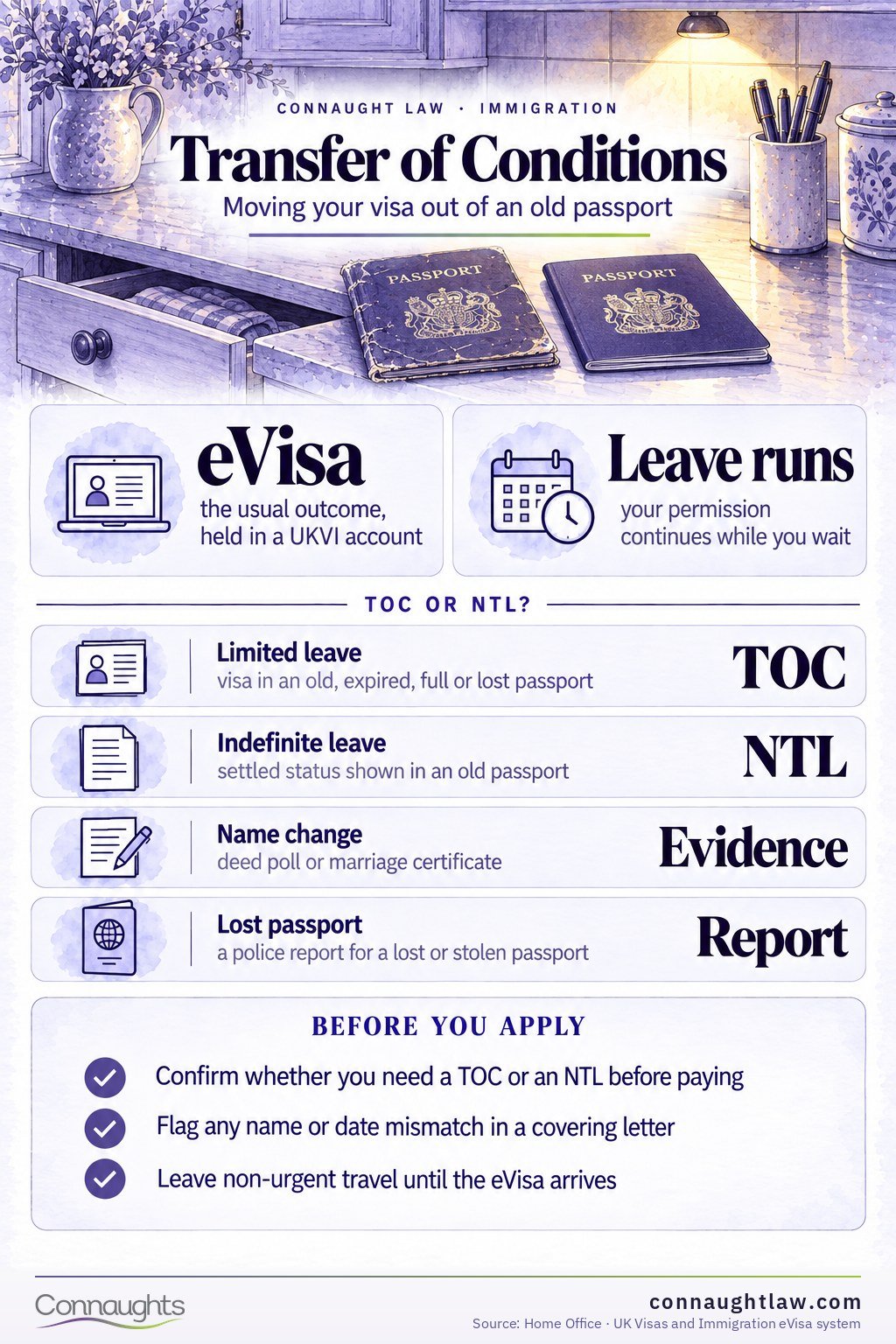
TOC serves holders of limited leave whose proof is paper-bound: work and family visa holders with vignettes in expired passports, students whose passports filled mid-course, and anyone whose name or details changed since the visa issued. Settled residents are the exception — indefinite leave in an old passport routes through the free NTL application instead, and choosing the right one of the two saves both fee and weeks.
eVisa Outcomes
What Changes for Work and Housing
Once the transfer completes, right-to-work and right-to-rent checks run on share codes rather than passport inspection — the mechanics in our eVisa system guide. Employers holding copies of the old vignette should re-check digitally after the transfer; the old document proves nothing once superseded.
Applying
Stages of a TOC Application
The sequence runs: online form, £154 payment, identity verification — the ID Check app or a UKVCAS appointment — then document upload and decision. The application is made from inside the UK with valid leave; nothing about the underlying permission is re-decided, but the checks confirm the leave exists and remains current.
Documents and Evidence
- Current passport, and the old passport carrying the vignette where it survives.
- The visa's details: category, grant and expiry dates, Home Office references.
- Name-change documents where details differ — deed poll or marriage certificate.
- A police report where the old passport was lost or stolen.
- Current photograph meeting the standard requirements.
Timing
What Affects the Speed
Decisions usually arrive within three weeks of proving identity, per the published waiting times guidance. Cases run longer where the original grant needs record-searching — lost passports, very old vignettes, name mismatches — which argues for front-loading the evidence rather than letting the caseworker request it.
Fees
Payment and Refunds
The fee is £154, paid online at submission, covering the transfer whether the outcome is an eVisa or — where digital status is not yet possible for the holder — a vignette in the new passport. Withdrawn applications forfeit the fee once processing begins, and rejected-as-invalid applications (wrong route, no underlying leave) are refunded minus administration, which is one more reason to confirm TOC-versus-NTL before paying.
Troubleshooting
Resolving Discrepancies
The recurring problems are mismatches: names that differ across documents, dates of birth recorded inconsistently decades ago, and grants the digital record shows differently from the vignette. Each resolves on evidence — the certificate chain for names, corroborating documents for dates — and each resolves faster when the covering letter flags the discrepancy and answers it, rather than leaving the caseworker to discover it.
Travel and Work During Processing
International Travel Considerations
Leave continues during the application — TOC does not affect status — but the passport situation makes travel awkward: the old document holds the proof, the new one holds nothing yet. Non-urgent trips belong after the eVisa lands. Sponsored workers and family visa holders juggling business travel against a pending transfer should plan with our business immigration team or family visa team; lost-document variants of the same problem are covered in our recovery guide and the wider service picture by our immigration team.
Frequently askedQuestions about TOC applications
What is a TOC application?
Transfer of conditions — the in-country route moving existing UK immigration permission from an old, expired, full or lost passport into current proof, now normally an eVisa. The underlying leave is unchanged; only its evidence moves.
How much does a TOC cost in 2026?
£154, paid with the online application. The same fee covers vignette replacement where digital status is not available. Settled residents should use the free NTL route instead — TOC is for limited leave.
How long does a transfer of conditions take?
Usually within three weeks of proving your identity. Old grants, lost passports and name changes extend the search time — complete evidence and a covering letter explaining any mismatch keep the case in the fast lane.
Do I get a sticker or an eVisa?
An eVisa in a UKVI account for almost everyone — the sticker era is closing. A vignette in the new passport remains the fallback where digital status cannot yet be issued for the holder's category.
Can I travel while my TOC is pending?
Your leave continues, but your evidence is split between two passports and the Home Office may hold documents. Book essential travel only, and where possible wait for the eVisa — it ends the passport-dependency for good.
Is a TOC the same as an NTL application?
No — TOC transfers limited leave (£154); NTL confirms indefinite leave (free). Filing the wrong one costs weeks and possibly the fee, so check which describes your status before applying.
Tell us the visa, the passports and any name changes. We'll pick the right route — TOC or NTL — and file it with the discrepancies pre-answered.
Get Expert Advice