
Indefinite leave to remain granted decades ago often lives in the wrong place — an ink stamp in an expired passport, a vignette, a BRP that died with the card era. The No Time Limit application converts that legacy proof into an eVisa, free of charge since the fee was abolished, without re-deciding the status itself. This guide covers who needs an NTL application, the stages and evidence, the Windrush and historical-record cases, and life during the wait.
On This Page

Old Proof, Permanent Status
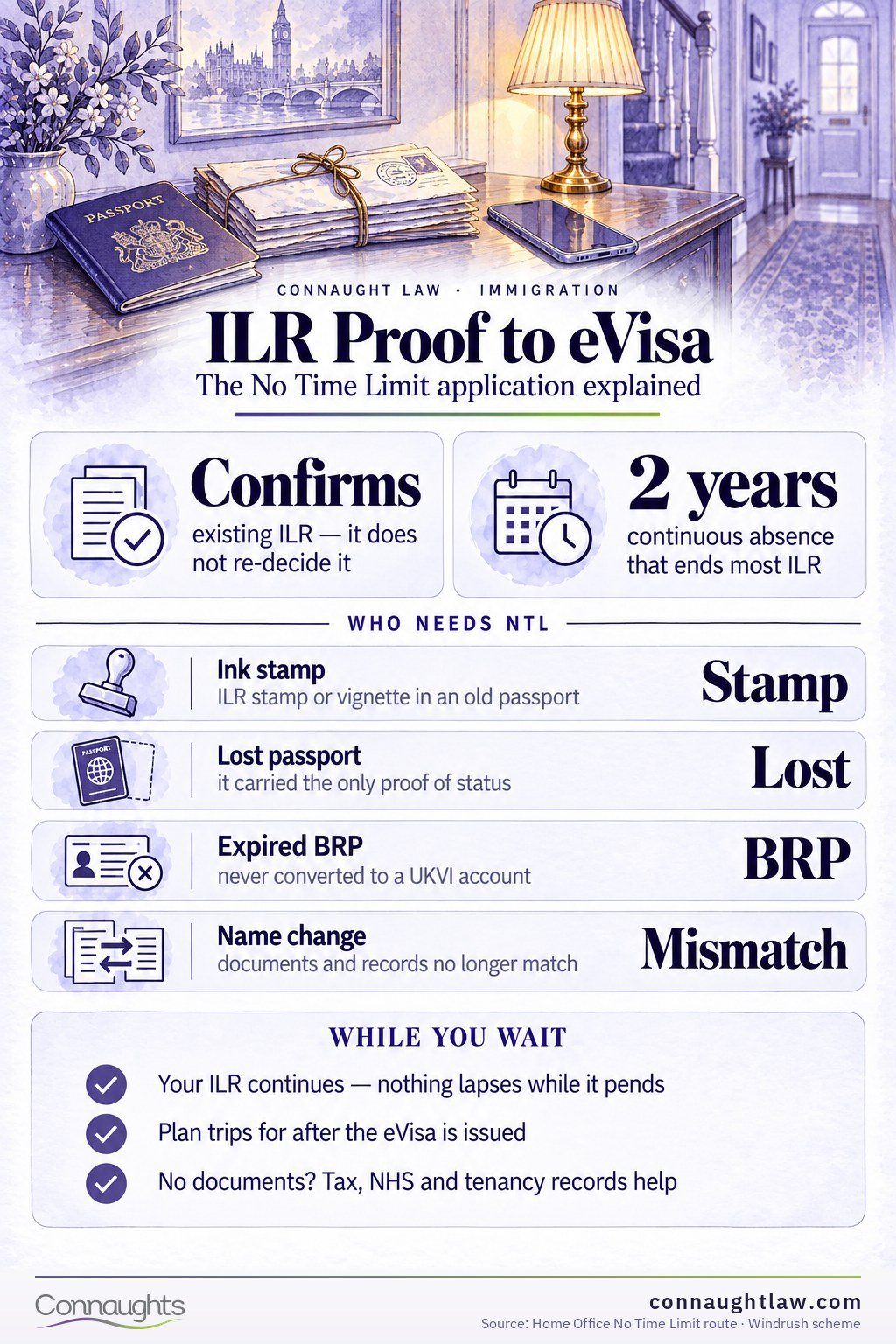
Indefinite leave never expires — only its evidence does. The No Time Limit route exists for exactly that gap: it confirms an existing ILR grant against Home Office records and issues the modern proof, now an eVisa. It is confirmation, not application — the status was yours already; NTL makes it usable at borders, banks and right-to-work checks again.
Who Needs an NTL Application
Qualifying Situations
- ILR evidenced by an ink stamp or vignette in an old or expired passport.
- A lost or stolen passport that carried the only proof of settled status.
- An expired BRP never converted to a UKVI account before the card era ended.
- A legal name change leaving documents and status records mismatched.
- Returning residents whose ILR evidence predates digital records entirely.
The Digital Transition
How the Process Was Streamlined
Two changes transformed NTL from a chore into housekeeping: the fee — once £229 plus biometric charges — was abolished on 6 April 2022 to support the digital transition, and the outcome switched from a plastic card to an eVisa in a UKVI account. The combined effect is that no one with legacy ILR proof has a cost reason to delay, and every reason — travel, work checks, the card-free border — to file now, as our eVisa system guide sets out.
Applying
Stages of an NTL Application
The sequence: complete the online NTL form, create or link a UKVI account, enrol biometrics, and submit the evidence of the original grant. The Home Office checks its own records first — many applications succeed on the strength of the file the department already holds, with your documents corroborating rather than proving.
Documentation and Evidence
Send what exists: the stamped passport, the vignette, the expired BRP, old Home Office letters. Where nothing survives, build the residence story — decades of tax records, NHS registration, tenancy and employment history — because the question is continuity of the settled life the grant anchored. Absences matter too: ILR lapses after two continuous years outside the UK (five for EUSS settled status), and the evidence should show the residence pattern holds.
eVisa vs BRP
What the Digital Version Does Better
The eVisa cannot be lost, updates its passport link online, and generates share codes on demand — the failure points of card-based proof simply disappear. Its one dependency is account access, which is why the recovery routes in our account recovery guide are worth knowing before they are needed.
Special Cases
Windrush, Name Changes and Historical Records
Windrush-generation cases run through the dedicated Windrush scheme rather than bare NTL, with its documentary standard built for lives lived before records were digital. Name changes need the deed poll or marriage certificate chain connecting every document, and historical cases — grants under long-repealed rules, family files split across decades — are where our settlement team and European nationals team spend their NTL time.
Timescales
Waiting Times and Faster Options
NTL carries no headline service standard of its own; straightforward record-matched cases resolve comfortably faster than evidence-built historical ones, and the published in-country waiting times guidance is the reference for what the Home Office currently commits to. Where paid faster-decision services are offered for NTL at your appointment stage, the usual rule applies: they accelerate clean cases and do nothing for ones needing historical reconstruction.
During the Wait
Travel and Work While Pending
ILR continues throughout — the application confirms status rather than granting it, so nothing lapses while it pends. The practical constraints are evidential: travelling on legacy proof invites carrier problems, so plan trips for after the eVisa lands, and use the employer checking service where a work check falls due mid-process.
Employers and Landlords
Checkers meeting legacy ILR documents should use the Home Office's checking services rather than refusing outright — settled status is precisely the case where old paper and continuing rights coexist. Once the NTL completes, checks run on share codes like any other eVisa; our immigration team advises both sides of that transition.
Frequently askedQuestions about NTL applications
What is an NTL application?
No Time Limit — the route by which someone with existing indefinite leave converts legacy proof (stamps, vignettes, expired BRPs) into an eVisa. It confirms the status against Home Office records; it does not re-decide it.
Does an NTL application cost anything?
No — the fee was abolished on 6 April 2022, removing what was then a £229 application fee plus biometric charges. Creating the UKVI account and receiving the eVisa are also free.
Do I need an NTL if I have ILR in an old passport?
Yes, in practice — carriers, employers and landlords now expect digital proof, and an ink stamp cannot generate a share code. The status survives without NTL; the ability to prove it conveniently does not.
Can my ILR be refused through an NTL application?
NTL confirms existing status, but it does check that ILR has not lapsed — two continuous years outside the UK ends most ILR. Long-absent returning residents should take advice before applying rather than after a refusal letter.
What if I have no documents from my original grant?
Apply anyway — the Home Office searches its own records, and a residence history built from tax, NHS, housing and employment evidence corroborates the settled life. Windrush-era cases use the dedicated scheme's documentary standards.
Can I travel while my NTL application is pending?
Your ILR continues, so travel is lawful — but your proof is still the legacy document, which airlines may struggle with. Where possible, schedule international trips after the eVisa issues.
Tell us what evidence survives and how long you've been here. We'll match it to the record the Home Office already holds and file the confirmation.
Get Expert Advice