
In Hirachand v Hirachand the Supreme Court closed the "back door" on litigation funding in inheritance disputes: a conditional fee agreement success fee cannot be recovered as part of a 1975 Act award. Since 18 December 2024, a claimant's uplift comes out of their own pocket — or their own award. This analysis covers what was decided and why, who it affects most, and how claims are funded now.
On This Page

The Supreme Court closes the success-fee back door
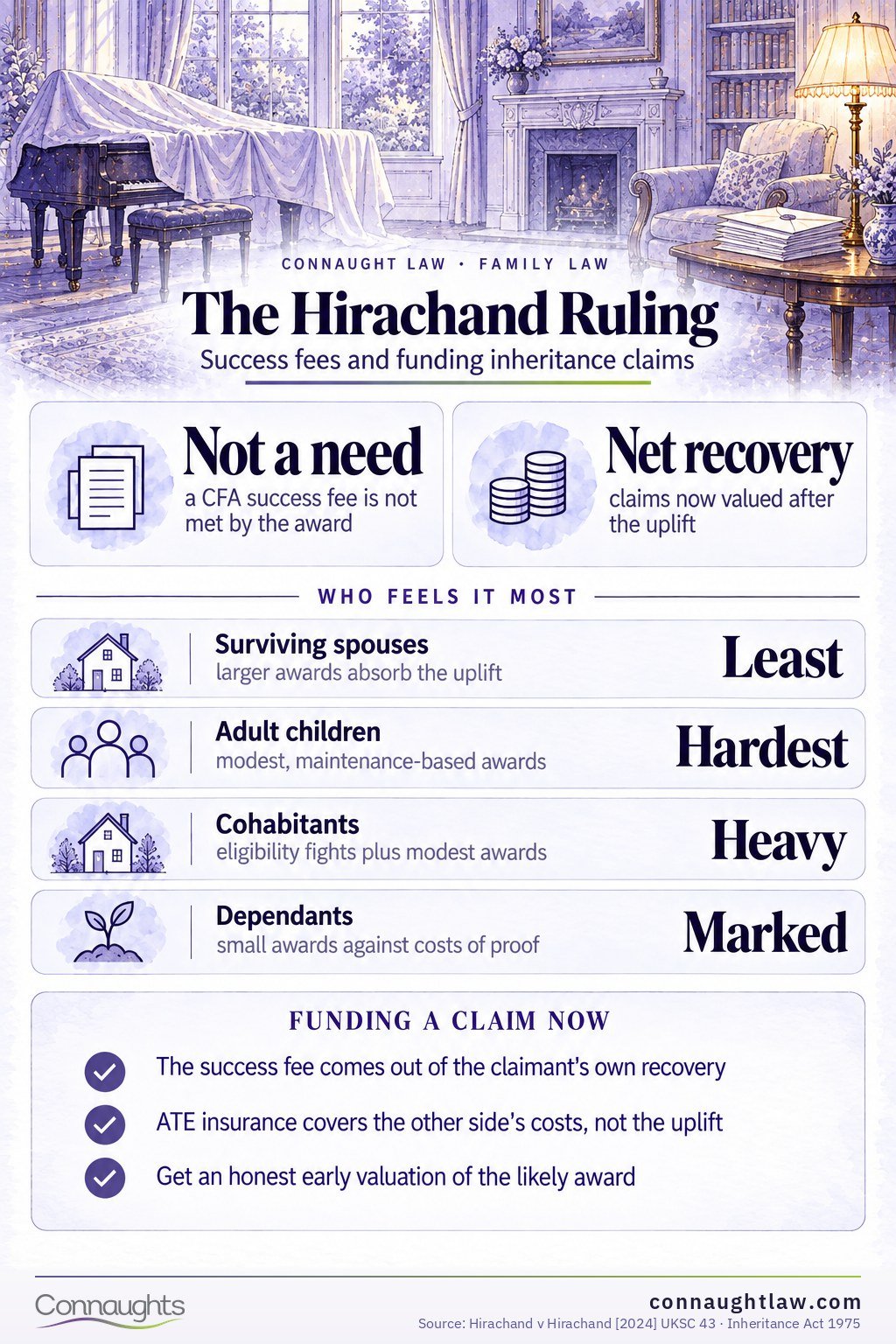
In Hirachand v Hirachand [2024] UKSC 43 (18 December 2024) the Supreme Court held that a CFA success fee is not a financial need the court can meet in an Inheritance Act award. The Court of Appeal's contrary approach is gone: the uplift is the claimant's own liability, paid from whatever they recover.
The ruling matters because of who funds these claims. Inheritance Act claimants are, by definition, people left without provision — the natural users of no-win, no-fee agreements. For three years after the Court of Appeal's 2021 decision, part of the resulting success fee could be routed into the award itself, and the estate effectively paid it. That route is now closed, and every funding conversation in this field starts from the closure.
Hirachand v Hirachand: What the Supreme Court Decided
The underlying claim was familiar: an estranged adult daughter with serious mental health difficulties sought reasonable provision from her father's estate. At first instance she was awarded just under £139,000 — including £16,750 explicitly earmarked as a contribution towards her CFA success fee — and the Court of Appeal upheld that structure in 2021. The Supreme Court reversed on the funding point alone: her provision stood, but the success-fee element could not.
The Reasoning Behind the Reversal
- A success fee is a contractual debt between solicitor and client, not a financial need the 1975 Act exists to meet.
- Routing it through the award undermined the costs regime Parliament built, which deliberately made uplifts irrecoverable from opponents.
- Allowing recovery pressured estates to settle weak claims priced up by their own funding costs.
What It Means for Conditional Fee Agreements
Risk Assessment After the Ruling
CFAs still work — but the arithmetic moved. A claimant weighing a claim must now deduct the success fee from their own projected recovery, which turns marginal claims uneconomic and makes the size of the likely award, not just the merits, the gating question. Solicitors assessing cases run the same sum from the other side before taking the risk on.
Impact by Type of Claimant
Effect by Claimant Type
| Claimant | Post-Hirachand Position | Why |
|---|---|---|
| Surviving spouses | Least affected | Larger awards absorb the uplift; the spouse standard is generous |
| Adult children | Squeezed hardest | Modest, maintenance-based awards leave little room for the fee |
| Cohabitants | Heavily affected | Complex eligibility fights plus modest awards compound the exposure |
| Dependants | Substantially affected | Maintenance-scope awards, often small against the costs of proving dependency |
Access to Justice: The Trade-Off
Where the Burden Falls
The criticism writes itself: the Act protects people without money, CFAs are how people without money litigate, and the ruling makes CFAs dearer for exactly the modest claims vulnerable people bring. An elderly cohabitant or a disabled adult child with a sound but small claim now needs the award to clear the uplift before the claim makes financial sense at all.
Counterbalancing Benefits
The other side of the ledger is real: speculative claims priced up by their own funding costs lost their leverage, estates negotiate without paying an opponent's uplift, and the claims that do proceed are better vetted. Whether the filter catches more chancers than genuine claimants is the live policy question — the Supreme Court's answer was that the statute, not sympathy, sets the boundary.
Practical Impact on Running a Claim
How Practice Has Adapted
Case selection tightened first: merits assessments now model net recovery after the uplift before a CFA is offered. Costs warnings grew teeth, settlement posture shifted earlier — a negotiated outcome avoids the uplift compounding through trial — and both sides now open negotiations from the claimant's net position. Howe v Howe, the first substantial adult child award under the new regime, shows the machinery working: our Howe v Howe analysis covers it in full.
Funding a Claim After Hirachand
After-the-Event Insurance
ATE insurance covers the risk of paying the other side's costs, with staged premiums limiting exposure early in the case. It does not pay your own solicitor and it does not absorb the success fee — but paired with a CFA it turns catastrophic downside into a priced, survivable one, which is often what makes a sound claim runnable.
Third-Party Funding and Hybrids
Commercial funders will finance strong, sizeable claims in exchange for a share of the recovery, and hybrid structures — partial CFA, capped fees, staged funding — now populate the space the old success-fee recovery used to occupy. The common thread is candour at the outset: every funding route is priced from the realistic award, so the honest early valuation has become the most valuable document in the case.
Where Inheritance Litigation Goes Next
Claim Volume and Quality
Most practitioners expect fewer but better claims — a contraction concentrated at the speculative end, though no official figures measure it and this guide will not invent any. The structural pressures pushing disputes upward — estate values, blended families, the tax changes enlarging estates — have not gone anywhere, which is why contentious probate teams remain busy despite the tighter funnel.
Long-Term Systemic Implications
The deeper effect may land in estate planning rather than litigation: with claims harder to fund, the premium on preventing them — sensible provision, documented reasoning, advice around exclusions — has grown. A testator who forces a vulnerable relative into litigation now forces them into a harder-funded one, a point courts weighing conduct will not miss. Claims from the disappointed side of a will are mapped in our disappointed beneficiary guide.
Frequently askedQuestions about funding a 1975 Act claim after Hirachand
How does the Hirachand ruling change legal funding?
Success fees under no-win, no-fee agreements can no longer be recovered through the award — the claimant pays the uplift from their own recovery. Claims are now assessed on net figures, and marginal cases that only worked with recoverable uplifts stopped being viable.
Does the ruling affect cases that are already running?
Yes — it states the law as it is, so courts cannot include success fees in awards whatever the CFA's date. Existing agreements remain valid between solicitor and client; what changed is who ultimately bears the uplift.
What alternatives exist for funding an inheritance claim now?
CFAs paired with after-the-event insurance remain the workhorse; third-party funding suits larger claims; hybrid and capped-fee structures fill the middle. Every route is priced off the realistic award, so an honest early valuation drives all of them.
Which claimants are most affected by the change?
Adult children and cohabitants — their awards are maintenance-based and modest, so a success fee consumes proportionally more. Surviving spouses, with larger awards under a more generous standard, feel it least.
Does Hirachand reduce access to justice?
It cuts both ways: genuine small claims are harder to fund, while speculative claims lost their pricing leverage. The Supreme Court's position is that funding gaps are for Parliament and the market to solve — not for stretching the statute.
What did the claimant in Hirachand actually receive?
Her substantive provision — just under £139,000 at first instance — survived; what fell away was the £16,750 element contributed towards her CFA success fee. The case reset the funding rule, not the principles governing provision itself.
How should solicitors run inheritance claims after Hirachand?
Model net recovery before offering a CFA, put the funding mathematics in writing at the start, push for early settlement while the uplift is small, and negotiate openly from the client's net position — the award figure alone no longer tells either side what a case is worth.
Should families change their estate planning after Hirachand?
The incentives strengthened: preventing a claim now protects relatives from a harder funding environment as well as from litigation itself. Sensible provision, a documented explanation for unequal treatment and advice around deliberate exclusions remain the toolkit.
Tell us your relationship to the deceased, the estate's rough value and your financial position. We will tell you what a realistic award looks like — and exactly how the funding would work after Hirachand.
Get Expert Advice