
Howe v Howe is the 2025 decision in which an estranged adult daughter — described in her father's will file as "lazy" and "useless" — was awarded £125,000 from his £1.4 million estate under the Inheritance Act 1975. It landed weeks after the Supreme Court reset the costs rules in Hirachand, and together the two cases redrew the landscape for adult child claims. This analysis covers the facts, the award, and what both decisions mean for wills and disputes now.
On This Page

An estranged daughter, a £1.4m estate, a £125,000 answer
Estrangement did not defeat the claim. Despite years of separation and a will file condemning her, the court found the daughter's health-driven financial need compelling and awarded £125,000 on discretionary trust — the first significant adult child award made after the Supreme Court's Hirachand costs ruling. Testamentary freedom bends where need is real.
Adult children are the hardest category of Inheritance Act claimant: capable adults are expected to maintain themselves, and disinheritance of an estranged child usually stands. Howe matters because it maps the exception — genuine incapacity for self-support, traced honestly to the family history — and because it shows the courts administering it through a trust rather than a cheque. Anyone drafting a will around an estranged child, or contemplating a claim against one, now reads the ground through this case.
The Case: Facts and Award
Roger Howe died on 27 March 2020 leaving an estate of approximately £1.4 million and a will, made in 2017, that excluded his only child. The exclusion was not silent: he recorded his view of his daughter Jenna — then in her thirties, unable to work through ill health — in terms the judgment quotes: "lazy", "useless", "greedy" and "addicted to drugs". She claimed reasonable financial provision under the Inheritance (Provision for Family and Dependants) Act 1975.
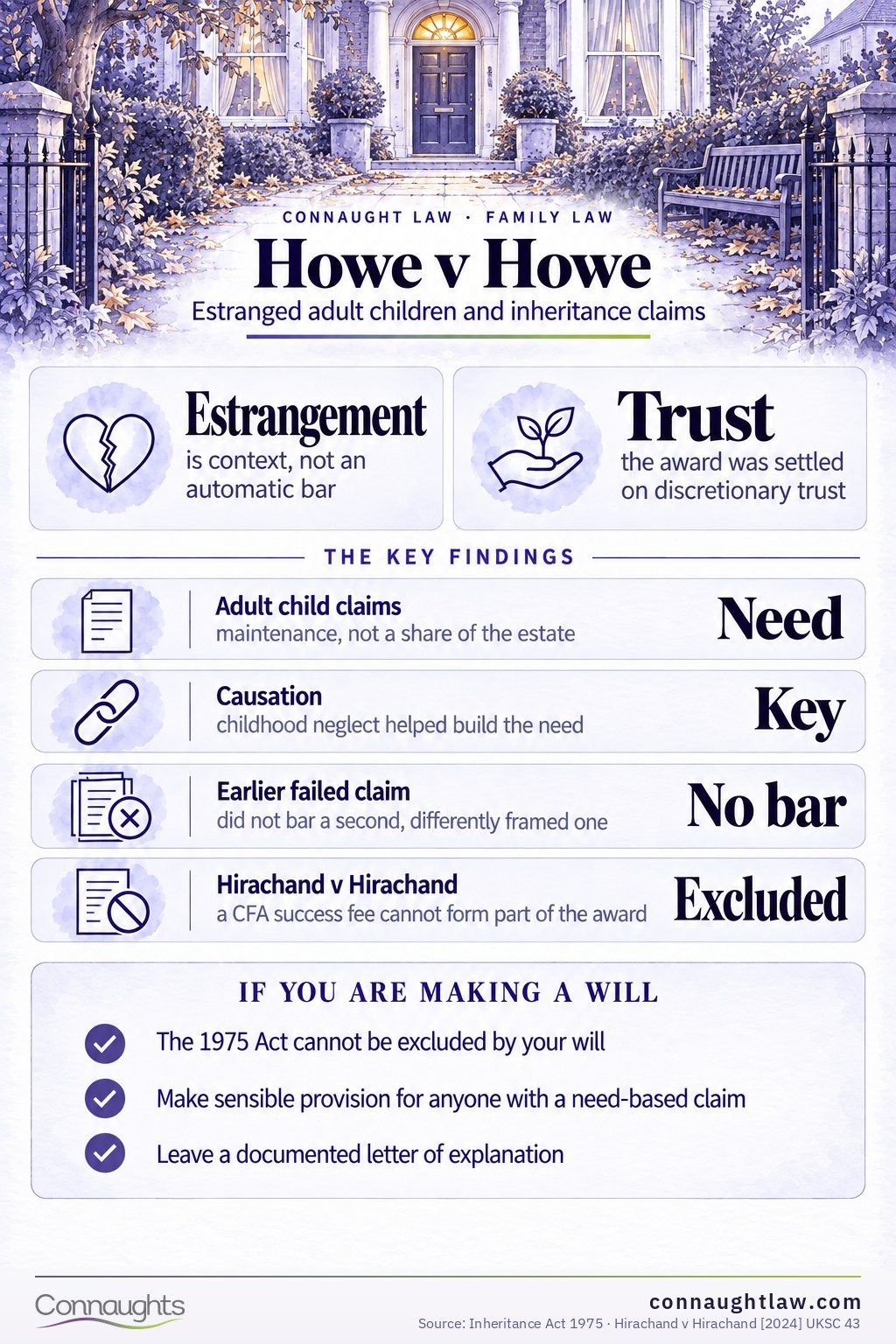
The court awarded £125,000, settled on discretionary trust rather than paid outright: provision for debts — including an adverse costs order from her earlier failed challenge to the will — essential purchases, therapy and health needs, and roughly a decade of income support. The structure is as instructive as the sum: the court met need while keeping the money managed, a template now visible in adult child awards generally.
A Causation Argument That Worked
What lifted the claim above the ordinary estrangement case was causation: the court accepted that childhood neglect and cruelty had contributed to the very difficulties — ill health, addiction history, incapacity for work — that created her need. The deceased's own conduct, in other words, helped build the claim against his estate. For testators, the uncomfortable lesson is that the family history travels with the will.
- It rewarded a claimant the deceased had deliberately and articulately excluded — testamentary freedom's core case.
- It treated estrangement as context rather than disqualification, where earlier authority leaned the other way.
- It funded items critics called lifestyle rather than maintenance — though the court anchored each to health-based need.
- It confirmed that a failed earlier challenge, and even its costs order, does not bar a second, differently framed claim.
Recent Inheritance Act Cases: The Post-Howe Landscape
Hirachand v Hirachand: The Supreme Court on Success Fees
On 18 December 2024, in Hirachand v Hirachand [2024] UKSC 43, the Supreme Court held that a conditional fee agreement success fee cannot form part of a 1975 Act award — reversing the Court of Appeal's approach. Our Hirachand analysis covers the decision in full; its practical bite is on funding.
- A CFA-funded claimant now absorbs the success fee out of their own award — the estate cannot be made to cover it.
- Marginal claims funded on CFAs became harder to run economically, filtering the speculative end of the market.
- Settlement arithmetic changed on both sides: net recovery, not headline award, drives negotiation.
- Howe was, on the commentary's reckoning, the first substantial award made under the new regime.
Adult Child Claims That Have Succeeded
Howe is not an outlier. In Isaacs v Green [2025] EWHC 1951 (Fam), decided in July 2025, an adult son excluded from his mother's will took 25% of the residuary estate — on the judge’s estimate around £150,000 of a c.£600,000 estate — on the strength of housing need, his state of health, and the court’s finding on why he had been left out. The pattern across the recent decisions is consistent: adult children win where genuine incapacity or housing need exists, and lose where the claim is really about fairness between capable siblings.
Recent Adult Child Claims
| Case | Outcome | What Carried It |
|---|---|---|
| Howe v Howe (2025) | £125,000 on discretionary trust from a £1.4m estate | Health-based incapacity for work, traced to the family history |
| Isaacs v Green [2025] EWHC 1951 (Fam) | 25% of the residuary estate — around £150,000 | Housing need and vulnerability to homelessness |
Are Inheritance Disputes Really Rising?
What the Numbers Do and Do Not Show
Practitioners across the market report more contested estates, and the structural drivers are visible enough: property values pushing ordinary estates into serious money, blended families multiplying potential claimants, and longer lives leaving more capacity disputes for contentious probate teams to untangle. What does not exist is a reliable official statistic for 1975 Act claims — most settle before any reportable stage — so this guide quotes no percentages. The honest statement is directional: the pressure on estates is growing, and the recent case law is making claims easier to assess and fund realistically.
Conditional Fee Agreements After Hirachand
CFAs remain the practical funding route for claimants without money — the very people the Act protects — but the success fee now comes out of the award, not the estate. Expect better-vetted claims, earlier settlement offers pitched at net recovery, and defendants pricing the claimant's funding pressure into negotiation. Funding strategy has become case strategy.
Inheritance Tax Reform and Dispute Risk
The 2025–2030 Tax Timetable
- April 2025: the non-domicile regime abolished, moving long-term residents onto a residence-based tax footing.
- April 2026: agricultural and business property relief capped — 100% relief limited to the first £1 million, per the government's announced reform.
- April 2027: unused pension funds due to come within estates for inheritance tax.
- The share of estates paying IHT — currently a small minority, per HMRC's liabilities statistics — is set to grow as these changes bite.
Practical Implications for Planning
Every one of those changes moves money and motive: farms and family businesses facing relief caps will restructure, pensions stop being the IHT-free residue everyone ignored, and larger taxable estates mean larger stakes when a will is challenged. Tax planning and dispute-proofing are converging — a will that saves tax but invites a 1975 Act claim has optimised the wrong variable, as our guide to preventing estate disputes explains.
Strategic Considerations for Claims and Defences
What "Reasonable Financial Provision" Now Means
For adult children the standard remains maintenance, not a share — but Howe shows maintenance construed generously where health forecloses work: debts, therapy, transport, a decade of income. The judgment's trust structure also signals how courts will square generosity with control. Claimants should evidence need medically and financially, not morally; estates defending should attack the causation and the arithmetic, not re-litigate the estrangement.
Litigation Strategy After Hirachand
Both sides now negotiate around net figures. Claimants must budget the success fee inside the award; estates can no longer be leveraged with the threat of paying it. Early neutral evaluation and mediation have grown correspondingly attractive — and for testators, the cheapest strategy remains the pre-emptive one: provision, documentation and a letter of explanation, made while alive. Our disappointed beneficiary guide covers the claim landscape from the other side.
Frequently askedQuestions about adult child claims and reasonable provision
What makes Howe v Howe significant for inheritance law?
It confirmed that estrangement and an explicit disinheritance do not defeat an adult child's claim where genuine health-based need exists — and it was the first substantial award made after Hirachand reset the costs rules. The discretionary trust structure has become a template.
What did the Supreme Court decide in Hirachand v Hirachand?
That a conditional fee agreement success fee cannot be included in a 1975 Act award ([2024] UKSC 43, 18 December 2024). The claimant bears it from their own recovery, which reshaped funding economics and settlement negotiations on both sides.
Can estranged adult children win Inheritance Act claims?
Yes, where they can evidence genuine need — typically health-driven incapacity for work or real housing vulnerability. Estrangement is context, not an automatic bar; Howe even treated the deceased's role in causing the estrangement and its consequences as strengthening the claim.
What are the success rates for adult child claims?
No reliable official statistic exists — most claims settle privately, so quoted percentages are marketing rather than measurement. What the case law shows is the pattern: need-based claims with medical and financial evidence succeed; fairness-based claims between capable adults rarely do.
What counts as reasonable financial provision for an adult child?
Maintenance, not a legacy: what the claimant needs to live at a standard appropriate to their circumstances. Howe construed that to include debt clearance, therapy and health costs, essential purchases and time-limited income support — administered through a trust.
How do the 2026–2027 inheritance tax changes affect disputes?
The £1 million cap on agricultural and business reliefs from April 2026 and the inclusion of unused pensions from April 2027 enlarge taxable estates and force restructuring — both of which raise the stakes, and the claim risk, around wills that were drafted for the old rules.
How are conditional fee agreements used in inheritance claims now?
Still widely — they remain the practical route for claimants without funds — but post-Hirachand the success fee comes out of the award. Expect tighter case selection by firms, and settlement discussions framed around what the claimant actually keeps.
Can a will be drafted to prevent claims like Howe?
Not absolutely — the 1975 Act cannot be excluded — but risk shrinks with sensible provision for anyone with a plausible need-based claim, a documented letter of explanation, and advice taken where exclusion is deliberate. Silence and insults, Howe shows, actively feed the claim.
Tell us your relationship to the deceased, your financial and health position and the estate's rough size. We will tell you honestly whether a 1975 Act claim is viable — and what it would cost to run.
Get Expert Advice