
Most estates pass without argument, and the ones that do not tend to fail in predictable places: a will that can be misread, the wrong executor, a family taken by surprise, a plan nobody updated. Each of those is preventable while you are alive — and none is fixable afterwards. This guide works through the four prevention strategies in turn, and through what the Inheritance Act 1975 lets someone argue once you are gone.
On This Page

Most estates pass without argument — here is why some do not
Estate disputes are rarely about the money alone. They ignite where grief meets surprise: a sibling who expected equality and found none, a second spouse and first family discovering the will served neither, a homemade document that two readings can support. Every contested probate file tells a version of the same story — something the deceased could have clarified, appointed, said or updated, and did not.
Prevention is therefore not one act but four habits: a will drafted so it cannot be misread, executors chosen for temperament rather than seniority, expectations managed while you are alive, and a plan that keeps pace with your life. What follows deals with each in turn, and with the claims the Inheritance Act 1975 keeps open whatever the will says.
Making a Will That Cannot Be Misread
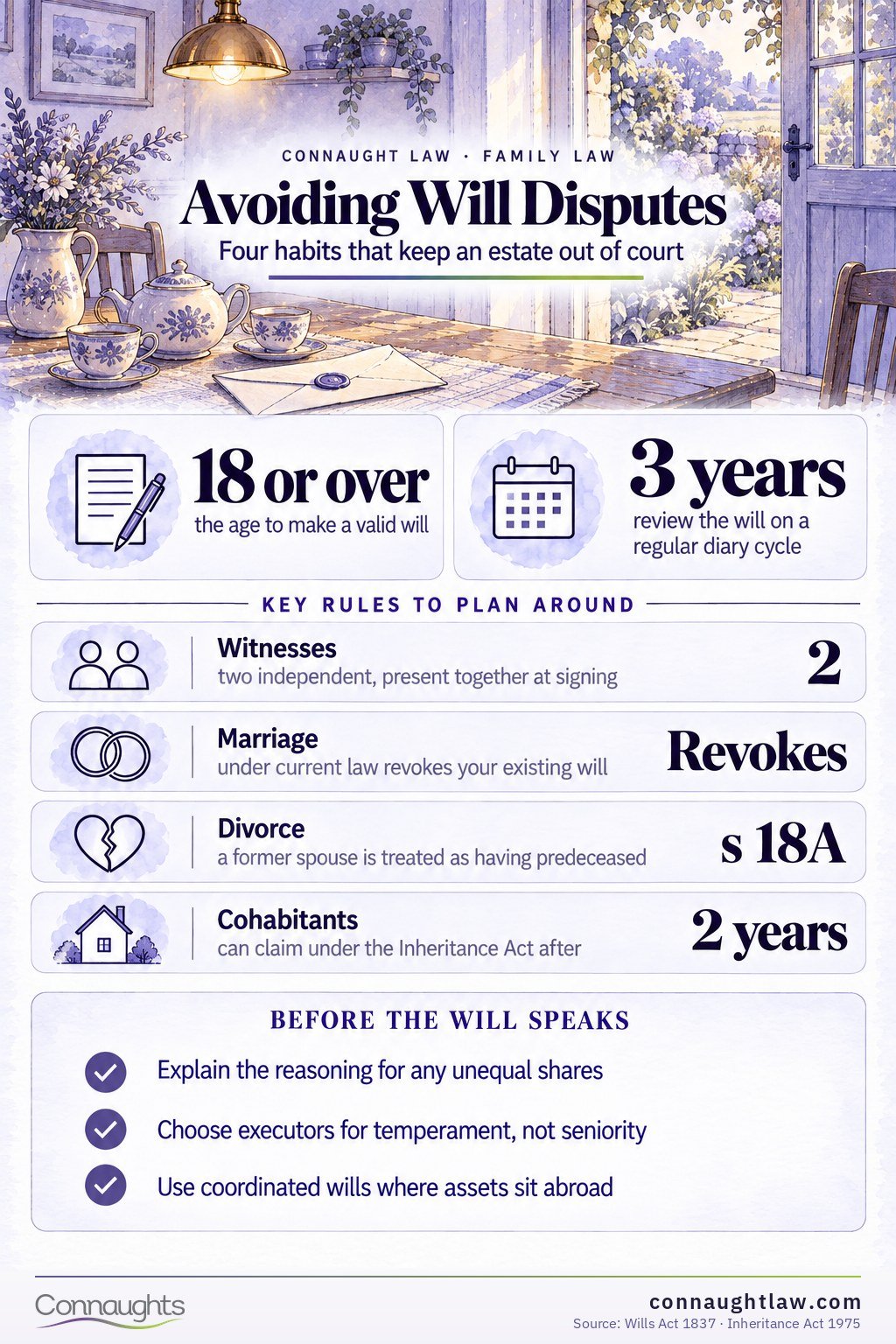
The Wills Act 1837 sets the formalities: a testator aged 18 or over, a written will signed by them (or at their direction), and two independent witnesses present together when they sign or acknowledge the signature. Formal validity, though, is the floor. Most disputes attack wills that were technically valid but carelessly made — ambiguous gifts, forgotten assets, no explanation for an unequal split.
Professional drafting closes those doors, and it does a second job the drafting itself cannot: a solicitor's file records the advice given, the instructions taken and the capacity observed at the time. Challenges built on capacity or undue influence run into that contemporaneous record — which is why solicitor-drafted wills are markedly harder to attack than homemade ones.
Will Drafting Elements
| Component | What It Prevents |
|---|---|
| Precise beneficiary identification | Mistaken-identity and ambiguity arguments; covers predeceasing with contingent gifts |
| Specific bequest descriptions | Interpretation fights over which property, vehicle or item was meant |
| An explanatory letter of wishes | Resentment at unequal shares — the reasoning survives you |
| A comprehensive residuary clause | Partial intestacy over forgotten accounts, digital assets and later acquisitions |
| Guardian and trust provisions | Conflict over minor children's care and money |
The Law Commission's Modernising Wills Law report of 16 May 2025 published a draft Bill proposing electronic wills, abolition of the rule that marriage revokes a will, the Mental Capacity Act 2005 capacity test, a minimum age of 16 and easier inference of undue influence. These are recommendations only: no Bill is before Parliament and no commencement date exists. Today, marriage still revokes an existing will — plan on the current law.
Choosing Executors Who Will Not Become the Problem
The executor administers everything the will decides — and a poor appointment can manufacture a dispute out of a perfectly clear document. The classic error is appointing on seniority or sentiment: the eldest child who lives abroad, the sibling in the middle of every historic argument, the friend with no time. Administration takes months of paperwork under bereaved scrutiny; choose for temperament and capacity, not rank.
What to Look For
- Financial competence and basic organisation.
- Neutrality — no stake in the family's old arguments.
- Time to do the job within a reasonable period.
- Practical proximity to the assets and the paperwork.
- The temperament to de-escalate rather than win.
- Willingness to take professional advice early rather than late.
Where the estate is substantial, the family blended, or conflict foreseeable, a professional executor — alone or alongside a family member — buys neutrality no relative can offer. Professionals charge for the role, so ask for the charging basis in writing before appointing; for straightforward estates with a harmonious family, a well-chosen lay executor with solicitor support usually serves better and cheaper.
Talking to the Family Before the Will Speaks
Most families put this conversation off — it feels morbid, awkward, or simply premature — and the silence is exactly what converts disappointment into litigation. A will that lands as a surprise is read in grief, without you there to explain it. The same terms, explained across a kitchen table years earlier, are just a decision people had time to accept.
A Framework That Works
- Choose a calm moment, not a crisis — and never the hospital ward.
- Explain the reasoning, especially for unequal shares: lifetime gifts, caregiving, need.
- Listen for expectations you did not know existed — they surface now or in court.
- For blended families or foreseeable friction, a solicitor-facilitated family meeting gives the conversation structure and a witness.
Keeping the Plan Current
A large share of adults have no will at all, and plenty more have one executed decades ago that no longer describes their family or their assets. A stale will can be worse than none: it distributes to a life that has moved on, and the mismatch is fertile ground for a claim. Review on a diary cycle — every three years or so — and immediately after the events below.
When to Re-Read the Will
- Marriage or civil partnership — under current law this revokes your existing will entirely.
- Divorce — section 18A of the Wills Act treats a former spouse as having predeceased you, unseating gifts and appointments.
- Births, adoptions, and the death of a beneficiary or executor.
- Significant acquisitions or disposals — a property, a business, an inheritance received.
- Declining health or any doubt about capacity: update while capacity is beyond argument.
Reducing the Risk of an Inheritance Act 1975 Claim
However clean the will, the Inheritance (Provision for Family and Dependants) Act 1975 stays open: spouses and civil partners, former spouses who have not remarried, cohabitants of two years' standing, children of any age, people treated as children of the family and financial dependants can all ask the court for reasonable provision. You cannot draft the Act away. You can shrink its target — sensible provision for anyone with a plausible claim, a letter explaining the choices, and advice taken where an exclusion is deliberate. Our guides to disappointed beneficiary claims, the Howe v Howe decision and the Hirachand ruling show how these claims run in practice.
Cross-Border Estates and Foreign Assets
Estates with property abroad add a conflict-of-laws layer: foreign real estate often passes under the law where it sits, some jurisdictions impose forced heirship that overrides an English will, and a single document rarely works cleanly in two systems. The standard architecture is coordinated wills — one per jurisdiction, drafted so neither revokes the other — with advice taken in both. For families spread across countries, this is where disputes are prevented or created.
Frequently askedQuestions about wills, executors and inheritance claims
How can professional will drafting prevent family conflict after death?
Precise beneficiary identification, specific gift descriptions, a residuary clause and an explanatory letter remove the ambiguities disputes feed on — and the solicitor's file records advice, instructions and capacity, making challenges on capacity or undue influence far harder to run.
What role does the Inheritance Act 1975 play in preventing disputes?
It defines who can claim against your estate regardless of the will: spouses, former spouses not remarried, two-year cohabitants, children and dependants. Planning around it — sensible provision, documented reasoning, advice on deliberate exclusions — shrinks the realistic pool of claims before they exist.
Should I appoint family members or professional executors?
Match the appointment to the estate. A capable, neutral family member with solicitor support suits straightforward estates and harmonious families. A professional executor earns their charges where the estate is complex, the family blended, or conflict foreseeable — ask for the charging basis in writing first.
How often should I review my will to avoid family conflict?
Every three years or so, and immediately after marriage, divorce, a birth, a death among beneficiaries or executors, or a significant change in assets. Marriage revokes an existing will under current law, and divorce unseats a former spouse's gifts — neither fixes itself.
Can family communication prevent inheritance disputes?
More reliably than any clause. Explaining your intentions while alive removes surprise, lets expectations adjust outside a bereavement, and surfaces objections you can still answer. For blended families or foreseeable friction, a solicitor-facilitated family meeting adds structure and a record.
Tell us who is in the family, what the estate holds and where you expect friction. We will tell you which of the four strategies your plan is missing.
Get Expert Advice