
You must be 18 to marry in England and Wales — parental consent no longer creates any exception — while Scotland allows marriage at 16 and Northern Ireland permits it at 16 with parental consent, for now. Both of those positions are under active reform. This guide sets out the rules nation by nation, what changed in February 2023, the ages people actually marry, and what every marriage must satisfy beyond age.
On This Page
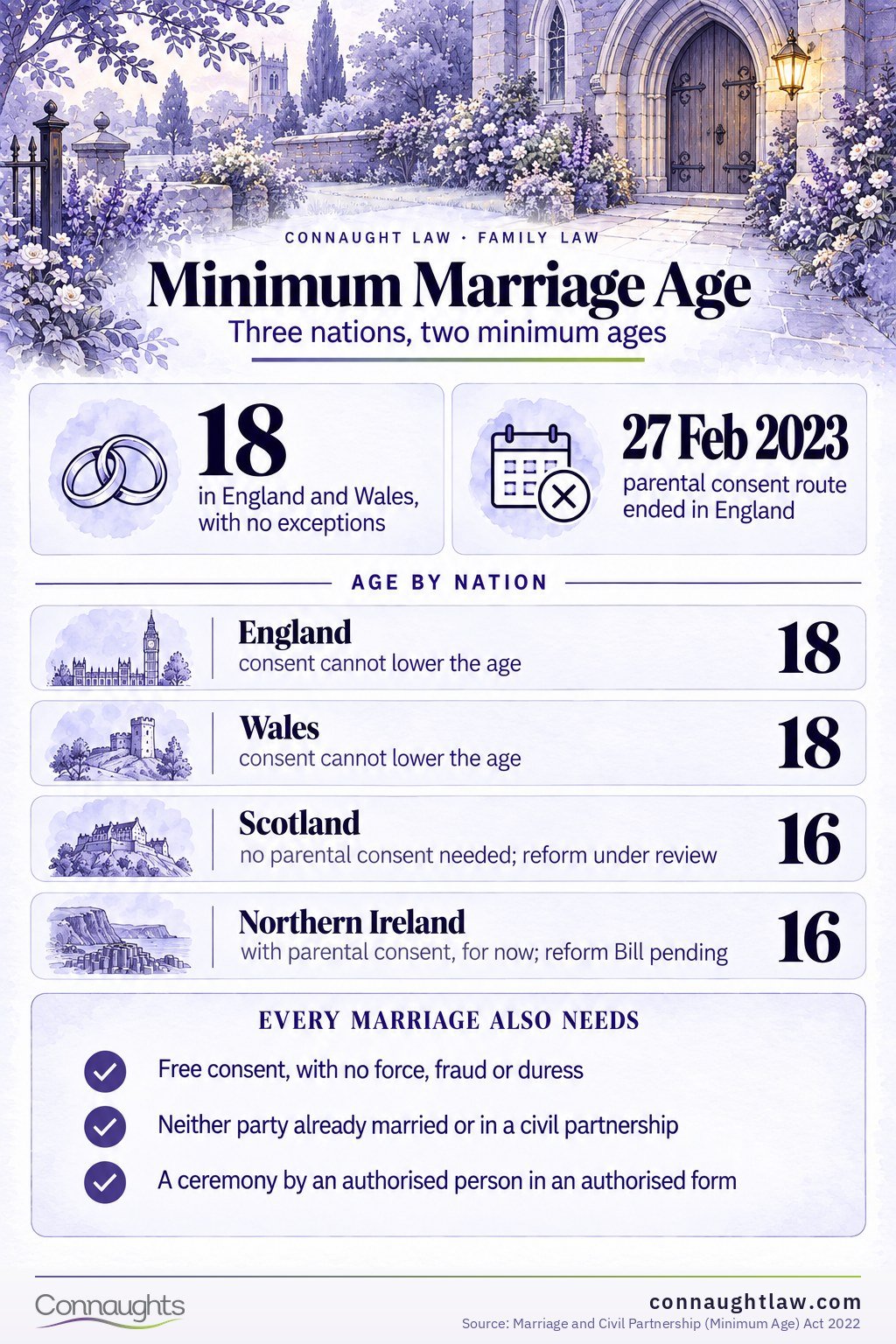
Three nations, two minimum ages
In England and Wales you must be 18 to marry or form a civil partnership, with no exceptions — parental consent stopped working on 27 February 2023. Scotland allows marriage from 16 without anyone's consent. Northern Ireland allows it at 16 with parental consent, though a Bill before the Assembly would raise that to 18.
The United Kingdom has three marriage law systems, and they currently disagree about the single most basic question: how old you must be. England and Wales raised their minimum age to 18 in February 2023; Scotland and Northern Ireland kept 16, and both are now actively reconsidering. For anyone planning a wedding — or worried about a young person being pressured into one, something our family law solicitors advise on — the rules depend entirely on where the ceremony takes place.
UK Marriage Age by Country
Marriage law is devolved, which is why one United Kingdom produces three answers. The table below states the position in each nation and where reform stands — and in 2026, for the first time in decades, every cell of the reform column is live.
Minimum Age by Country
| Country | Minimum Age | Parental Consent | Reform Status |
|---|---|---|---|
| England | 18 | No route — consent cannot lower the age | Settled since 27 February 2023 |
| Wales | 18 | No route — consent cannot lower the age | Settled since 27 February 2023 |
| Scotland | 16 | Not required | Consultation on raising to 18 closed 21 April 2026 |
| Northern Ireland | 16 | Required for 16 and 17-year-olds | Bill to raise the age to 18 introduced March 2026 |
Key Differences Between the Nations
The differences are not cosmetic. A 17-year-old cannot marry in Manchester on any terms, can marry in Glasgow without asking anyone, and can marry in Belfast if their parents agree. The same couple, the same ages, three different legal outcomes — decided by geography. That asymmetry is precisely what the Scottish and Northern Irish reform processes are now examining, and it is why cross-border couples should check the rules where the ceremony will actually happen, not where they live.
Can You Get Married at 16 in the UK?
- Scotland: yes, from 16, with no parental consent required.
- Northern Ireland: yes, from 16, but only with parental consent — and a Bill to end this is before the Assembly.
- England and Wales: no. Since 27 February 2023 there is no route at 16 or 17, with or without consent.
Scotland: Marriage at 16, No Consent Needed
Scots law has allowed marriage from 16 without parental consent for generations, and that remains the position today. It is now the outlier: the Scottish Government's family law consultation asked directly whether the minimum age should rise to 18, and its own figures show how rare young marriage has become — around 21 of 26,753 Scottish marriages in 2023 involved a party under 18, roughly 0.07%.
England and Wales: 18, No Exceptions
The Marriage and Civil Partnership (Minimum Age) Act 2022 removed every route to marriage under 18 in England and Wales from 27 February 2023 — parental consent and court permission included. Northern Ireland sits between the two: 16 remains possible with parental consent, but the Assembly is legislating to close that door too.
Parental Consent Rules: What Changed in 2023
Before February 2023
For over 70 years, English law allowed 16 and 17-year-olds to marry with parental consent — a rule inherited from an era when early marriage was common. By the 2020s it had become the mechanism through which family pressure operated: a young person "consenting" to a marriage arranged around them, with the paperwork signed by the very relatives applying the pressure. Campaigners called it a legal loophole for child marriage, and Parliament ultimately agreed.
After February 2023
The 2022 Act did two things. It raised the minimum age to 18 in England and Wales with no consent-based exception, and it widened the criminal law: arranging for a child under 18 to marry is now an offence in England and Wales even where no coercion can be proved — religious and unregistered ceremonies included. The change deliberately shifted protection from the child's ability to refuse onto the adults doing the arranging.
Marriage Statistics: Average Ages and Young Marriages
The legal minimum and the social reality are decades apart. People in England and Wales now typically marry in their thirties, and marriage under 20 — let alone under 18 — had all but vanished before the ban arrived. Northern Ireland's own figures tell the same story: 183 marriages involving a party under 18 across 2020 to 2024, falling to 13 in provisional 2025 data.
Recent Figures from the 2023 Release
The Office for National Statistics published its marriages and civil partnerships figures for 2023 in November 2025 — the first full data year under the new minimum age.
Marriage Numbers and Ages
| Measure | 2023 Figure (England & Wales) |
|---|---|
| Marriages and civil partnerships formed | 231,949 |
| Opposite-sex marriages | 216,901 |
| Median age at marriage — men | 34.8 years |
| Median age at marriage — women | 33.0 years |
| Busiest age band for marriages | 30 to 34 years |
Average Marriage Age Trends
The median ages — 34.8 for men and 33.0 for women in opposite-sex marriages — are among the highest the ONS has recorded, and the direction of travel has been upwards for decades. The practical consequence reaches beyond demographics: couples marrying in their thirties arrive with property, pensions and savings already built, which is one reason prenuptial agreements have moved from celebrity curiosity to ordinary financial planning.
Legal Requirements Beyond Age
Age is only the first hurdle. A marriage that fails the other conditions can be void — treated as never having existed — or voidable, and the ceremony itself must be one the law recognises. A religious-only ceremony with no civil registration may create no legal marriage at all, as our guide to Islamic marriage and UK law explains.
Essential Legal Requirements
- Capacity: both parties of legal age and mentally capable of understanding marriage.
- Free consent: no force, fraud or duress behind either "I do".
- Single status: neither party already married or in a civil partnership.
- Not closely related: within the prohibited degrees, no marriage is possible.
- Proper ceremony: conducted by an authorised person in an authorised form.
Documentation and Giving Notice
Civil preliminaries come first: formal notice to the register office within the statutory notice period, documents proving identity, age, nationality and address, and evidence that any previous marriage or civil partnership has ended — a final divorce order or death certificate. The detail varies by nation and by immigration status, and GOV.UK's marriages guidance sets out the current requirements. Where a previous marriage has not yet been dissolved, that must be resolved first — our divorce team deals with exactly this sequencing.
Gretna Green and Scottish Marriage Traditions
Why Gretna Green Remains Popular
Gretna Green's fame rests on a legal difference that still exists. Because Scots law permits marriage at 16 without parental consent, Scotland — and its most famous border village in particular — remains the one part of the UK where a 16 or 17-year-old can marry without anyone's agreement. For most modern visitors the draw is romance and history rather than necessity, but the legal distinction underneath is real.
A Border Trade Born in the 1750s
When England tightened its marriage formalities in the 1750s, requiring parental consent for minors, Scots law did not follow — so eloping English couples simply crossed the border, and the first building in the first Scottish village became the wedding venue. The blacksmith's anvil became the enduring symbol: marriages "forged" over it by the village smith, no clergy required.
Future Changes Under Consideration
The Scottish Government's family law consultation, which closed on 21 April 2026, asked whether the minimum age should rise to 18 and whether arranging a child marriage should become criminal in Scotland. Northern Ireland's Marriage and Civil Partnership Bill, introduced on 19 March 2026, would raise its age to 18 and criminalise arranging under-18 marriages. If both pass, the UK-wide minimum becomes 18 — and Gretna Green's last legal distinction disappears.
Questions about age limits, consent and where the rules differ
What age can you get married in the UK?
It depends on the nation. England and Wales: 18, with no exceptions. Scotland: 16, with no parental consent needed. Northern Ireland: 16 with parental consent — though a Bill before the Assembly would raise that to 18.
Can you get married at 16 in the UK?
Only in Scotland, where no consent is required, or in Northern Ireland with parental consent. In England and Wales marriage at 16 or 17 has been impossible since 27 February 2023, and parental agreement makes no difference.
Can you get married at 16 with parental consent in the UK?
Not in England and Wales — the consent route was abolished in February 2023. Northern Ireland still allows marriage at 16 with parental consent while its reform Bill progresses. Scotland allows marriage at 16 without consent, so the question does not arise there.
What is the legal marriage age in Scotland?
Sixteen, without parental consent. That has been the settled Scots position for generations, but the Scottish Government consulted in 2026 on raising the minimum age to 18; the consultation closed on 21 April 2026 and a response is awaited.
How many 16 year olds get married in the UK?
Vanishingly few. Around 21 of 26,753 Scottish marriages in 2023 involved a party under 18. Northern Ireland recorded 13 in provisional 2025 figures. In England and Wales the answer is none — under-18 marriage has been unlawful since February 2023.
Can you still get married at Gretna Green at 16?
Yes. Gretna Green is in Scotland, so Scots law applies: marriage from 16 with no parental consent. That would change if Scotland legislates to raise its minimum age following the 2026 consultation.
What changed about UK marriage age in 2023?
On 27 February 2023 the Marriage and Civil Partnership (Minimum Age) Act 2022 took effect in England and Wales: the minimum age rose to 18, the parental consent route was abolished, and arranging a marriage involving anyone under 18 became a criminal offence. Scotland and Northern Ireland were unaffected.
What is the average age to get married in the UK?
For opposite-sex marriages in England and Wales in 2023, the median age was 34.8 for men and 33.0 for women — among the highest on record, and still rising. The busiest age band for marrying is 30 to 34.
Tell us where the ceremony took place, the ages of the parties and what form it took. We will tell you whether the marriage is recognised and what to do if it is not.
Get Expert Advice