
A disappointed beneficiary is someone who should have inherited and did not — because a will was drafted too slowly, executed badly, or made by someone who lacked capacity while professionals looked away. English law gives that person real remedies, including negligence claims against the solicitor who mishandled the will. This guide covers the recent cases raising the bar, how to assess a claim, what compensation recovers, and the time limits that decide everything.
On This Page

When the will fails you, someone may be liable
Since White v Jones, a solicitor preparing a will owes a duty of care not just to the client but to the intended beneficiaries. Where negligent delay, defective execution or a missed capacity problem costs a beneficiary their inheritance, they can sue the solicitor for the lost legacy — a professional negligence claim, distinct from challenging the will itself.
Two routes run from the same disappointment. If the will is invalid — incapacity, want of knowledge and approval, undue influence — the challenge runs in probate. If a valid intention was defeated by professional failure — the will never drafted in time, witnessing botched under section 9 of the Wills Act 1837, warning signs ignored — the negligence route reaches the drafter's insurers. Many cases hold both, and the early strategic choice between them shapes everything after.
Recent Legal Developments
The wider claims landscape has moved in parallel — our Howe v Howe and Hirachand analyses cover the Inheritance Act side — while two capacity decisions reset the standards will drafters are judged against.
Leonard v Leonard: Capacity Scrutiny Raised
In Leonard v Leonard [2024] EWHC 321 (Ch), after a twelve-day trial, Mrs Justice Joanna Smith held a 2015 will invalid for lack of testamentary capacity and want of knowledge and approval — restoring the earlier will. The judgment's message for will drafters is the enduring part: a solicitor's view on capacity counts only where it rests on a proper assessment, and a complex will demands capacity equal to its complexity. Files that show no engagement with visible warning signs now read as evidence for the disappointed.
Baker v Hewston: Banks v Goodfellow Confirmed
Baker v Hewston [2023] EWHC 1145 (Ch) settled a running argument: the Victorian test in Banks v Goodfellow — understanding the act of will-making, the extent of the property, and the claims of potential beneficiaries, free of disordering delusion — remains the test for testamentary capacity, with the Mental Capacity Act 2005 useful as a cross-check rather than a replacement. Practitioners assess against both; the common law governs.
Assessing Whether You Have a Claim
Claim Strength Indicators
| Factor | Strengthens the Claim | Weakens It |
|---|---|---|
| Instructions | Written, clear, evidenced intention to benefit you | Oral recollections only, contested intentions |
| Delay | Urgency flagged — illness, age, hospital admission — and ignored | Reasonable timescale, no urgency indicators |
| Capacity handling | Warning signs visible on the file, golden rule ignored | Proper medical assessment, documented capacity |
| Evidence | Solicitor's file, medical records, witness statements | Little documentation either way |
| Loss | Substantial, quantifiable lost inheritance | Modest or speculative entitlement |
The Four Elements of a Negligence Claim
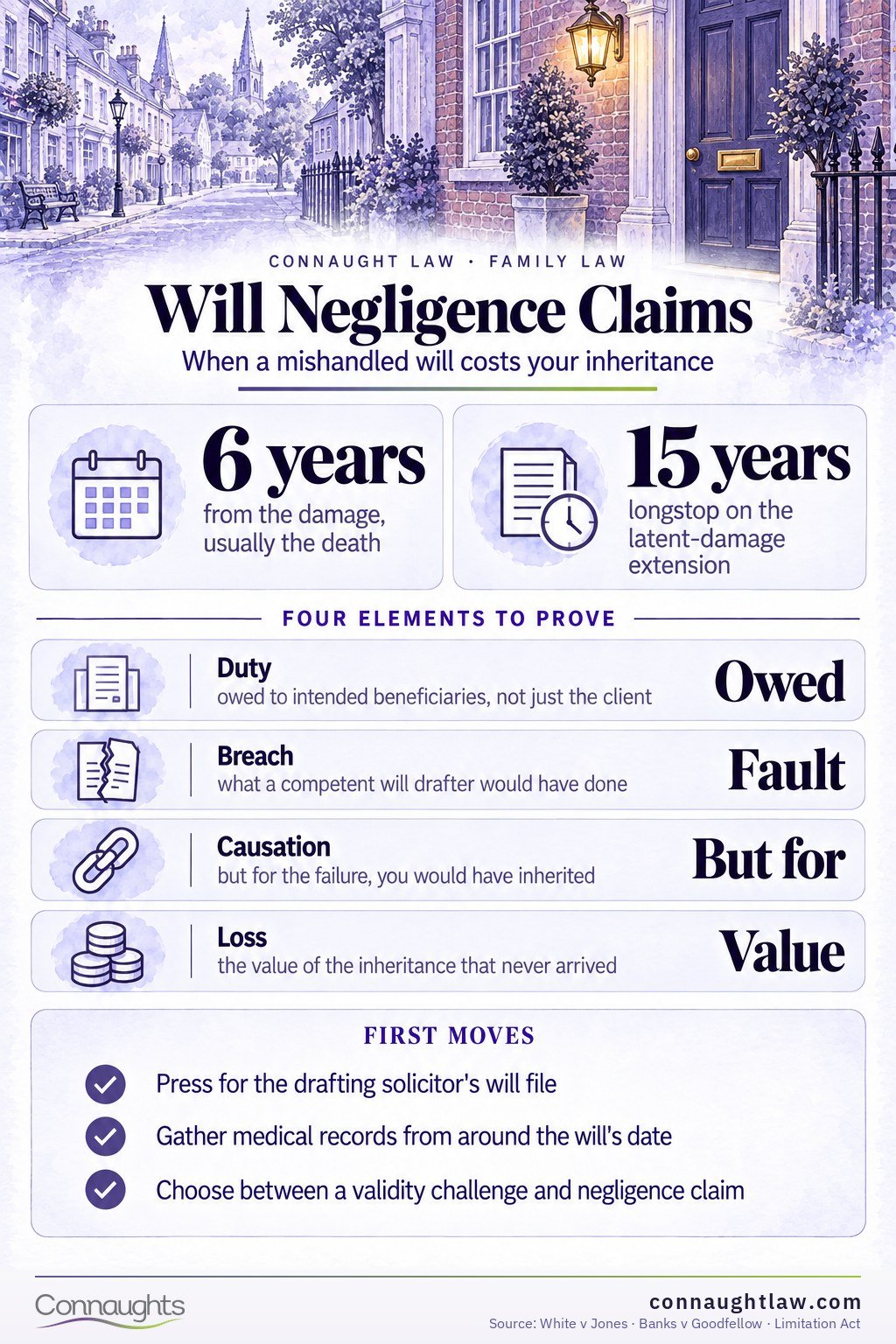
- Duty: owed to intended beneficiaries under White v Jones, not only to the testator.
- Breach: what a competent will drafter would have done — acted promptly, executed properly, assessed capacity — and was not done.
- Causation: but for the failure, you would have inherited.
- Loss: the value of the inheritance that never arrived, quantified.
Testamentary Capacity Standards
Capacity is where validity challenges and negligence claims meet: the same medical and file evidence that invalidates a will can convict its drafter of ignoring the warning signs. Banks v Goodfellow sets the standard, Leonard shows it being applied with modern rigour, and the practitioner's protective habits — attendance notes, capacity assessments, medical input — are precisely what a disappointed beneficiary's solicitor reads first.
What the Golden Rule Expects
- For an aged or seriously ill testator, have capacity assessed or witnessed by a medical practitioner.
- Record the assessment and the reasons for proceeding, contemporaneously.
- The rule is guidance, not law — but ignoring it with a vulnerable client hands the challenger their opening.
- Post-Leonard, a file silent on visible capacity concerns is itself the negligence evidence.
Compensation in Disappointed Beneficiary Claims
Heads of Recovery
| Element | How It Is Measured |
|---|---|
| The lost inheritance | The value you would have received, assessed with growth since death where appropriate |
| Consequential tax | Additional tax flowing from the altered inheritance structure |
| Interest and lost returns | What the inheritance would have earned in your hands |
| Legal costs | Recoverable in the ordinary way on success |
Time Limits for Bringing a Claim
Negligence claims run to the Limitation Act: six years from the damage — usually the death, when the loss crystallises — with a latent-damage extension of three years from the date you knew, or should have known, the essential facts, subject to a fifteen-year longstop. The practical rule is blunter: investigate immediately. Files get destroyed, witnesses fade, and estates get distributed — a claim delayed is a claim discounted, whatever the statute technically allows.
Strategic Steps Before Claiming
- Secure the will file: a beneficiary with a prospective claim can press for the drafting solicitor's file.
- Gather the medical picture around the will's date — capacity evidence decides both routes.
- Quantify the loss properly before choosing between a validity challenge and a negligence claim.
- Notify early: insurers engage differently with claims intimated before positions harden.
Law Commission Reform and What Comes Next
The Law Commission's Modernising Wills Law report of 16 May 2025 published a draft Bill proposing electronic wills, a Mental Capacity Act capacity test, easier inference of undue influence and a dispensing power for failed formalities. It remains a recommendation — no Bill is before Parliament and no dates exist — but its direction matters here: a dispensing power would rescue some intentions that currently die on section 9 formalities, moving disputes from execution technicalities towards capacity and influence, exactly where Leonard already points. Until then, today's law governs — and today's claims run through our contentious probate team.
Frequently askedQuestions about claiming against a solicitor over a will
What is a disappointed beneficiary claim?
A claim by someone who lost an intended inheritance through professional failure — a will drafted too slowly, executed defectively, or made without proper capacity checks. Under White v Jones the drafting solicitor owes intended beneficiaries a duty of care, so the claim targets the solicitor and their insurers.
How has Leonard v Leonard affected these claims?
It raised the scrutiny on capacity work: the 2015 will failed, and the court made clear a solicitor's capacity view counts only if based on proper assessment. Files showing no engagement with warning signs now serve as the disappointed beneficiary's best evidence.
What is the time limit for a disappointed beneficiary claim?
Six years from the damage — normally the death — extendable to three years from when you discovered the essential facts, capped by a fifteen-year longstop. Move long before any deadline: evidence and undistributed estates are worth more than limitation arguments.
How does the golden rule affect solicitor negligence claims?
It sets the professional benchmark for elderly or seriously ill testators: medical involvement in capacity assessment, properly recorded. It is not statute — but a solicitor who skipped it with a vulnerable client has handed the negligence claim its central exhibit.
What compensation can a disappointed beneficiary recover?
The value of the lost inheritance, measured at or grown from the date of death, plus consequential tax, lost returns and legal costs. The aim is to put you where the competently handled will would have put you — no more, no less.
Does Baker v Hewston change capacity requirements?
It confirmed rather than changed: Banks v Goodfellow remains the test for testamentary capacity, with the Mental Capacity Act 2005 as a useful cross-check. Practitioners assess against both frameworks, and challengers frame their evidence to the common law test.
What evidence strengthens a disappointed beneficiary claim?
The solicitor's file above all — instructions, attendance notes, what was known about health and urgency — plus medical records around the will's date, written evidence of the intended gift, and a clean quantification of what you lost. Secure all three early.
How would the Law Commission's reforms affect future disputes?
The draft Bill's dispensing power would let courts uphold clearly intended but formally defective wills, shrinking execution-failure claims and shifting the battleground further towards capacity and undue influence. It is not law: no Bill is before Parliament and no commencement dates exist.
Tell us what you were meant to receive, what went wrong and when the death occurred. We will tell you which route — validity challenge or negligence claim — your evidence actually supports.
Get Expert Advice