
Collaborative divorce settles a separation in face-to-face meetings, each of you advised by your own solicitor throughout — with one rule that changes everything: if the process fails and either of you goes to court, both solicitors must withdraw. That disqualification agreement is what makes the negotiation serious. This guide covers how the process runs, how it differs from mediation, what it costs, and who it suits — including international couples.
On This Page

Divorce by negotiation, with teeth
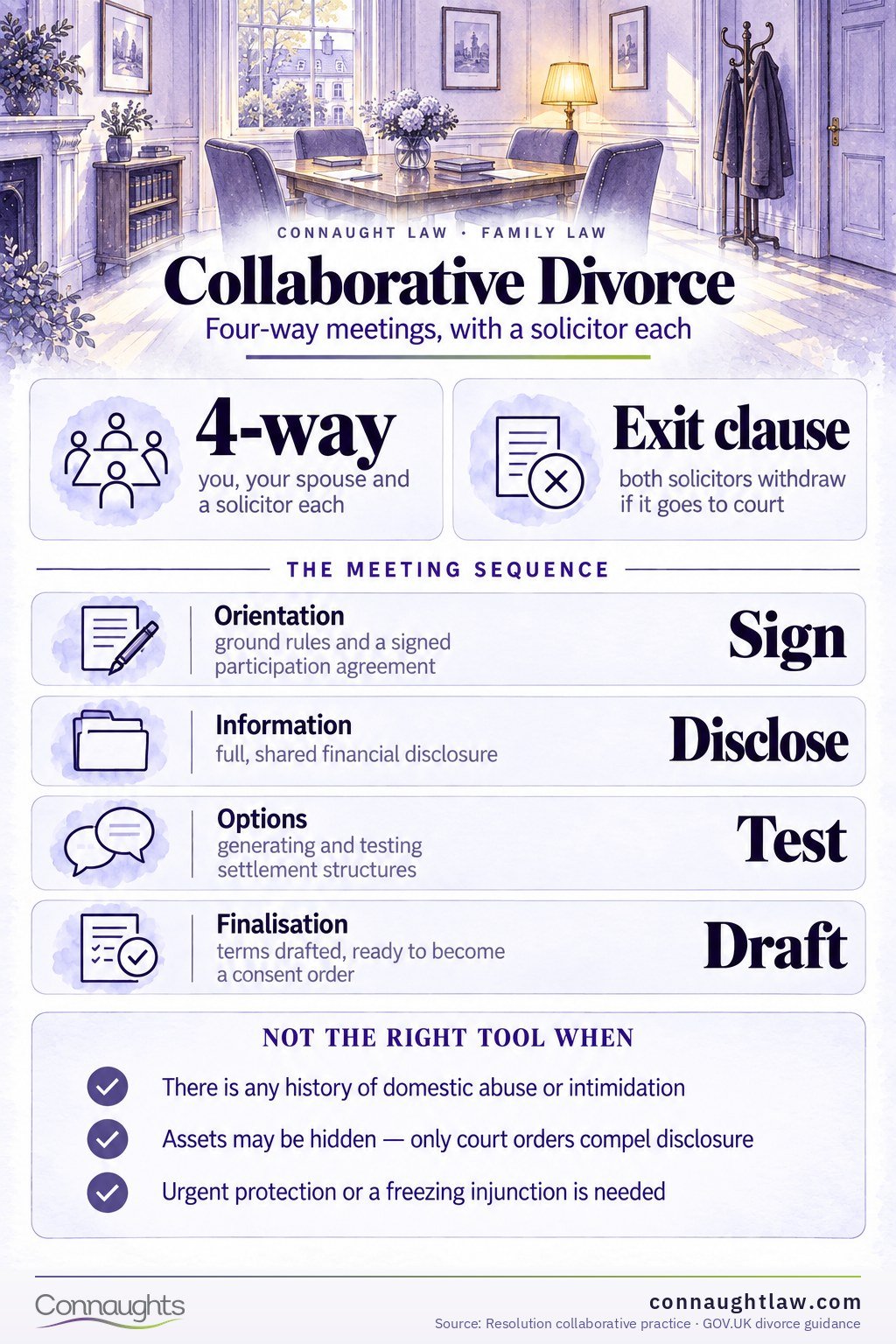
Collaborative divorce resolves the finances and the children's arrangements through structured four-way meetings: you, your spouse, and a collaboratively trained solicitor for each of you. Everyone signs a participation agreement whose disqualification clause bars both solicitors from any later court battle — so every professional in the room succeeds only if the negotiation does.
That structure separates collaborative practice from ordinary solicitor negotiation, where positioning for a possible trial shadows every letter. Here the trial option is deliberately expensive to reach: walking out means starting again with new lawyers. Couples choose the model for privacy, for speed they control, and for keeping two sets of family law advisers in the same room instead of at opposite ends of correspondence.
How Collaborative Law Works
Each party instructs their own collaboratively trained solicitor — in England and Wales, typically lawyers trained through Resolution, the family justice professionals' body — and the four of you work through the issues in meetings rather than through correspondence and hearings. Nothing is filed at court about the money until there is an agreement to approve. Your solicitor advises you privately before and after each session, and negotiates beside you in it.
Ground Rules the Agreement Locks In
- Full and honest financial disclosure, matching the standard a court would demand.
- Interest-based negotiation — solving the problem, not scoring the point.
- Confidentiality across everything said in the meetings.
- The disqualification clause: if either party issues contested proceedings, both collaborative solicitors must withdraw and cannot act in the litigation.
The Process, Meeting by Meeting
How to Start a Collaborative Divorce
Both of you need to choose the model — collaborative practice cannot be imposed — and each of you instructs a collaboratively trained solicitor. The first four-way meeting sets the framework and signs the participation agreement; the substance follows at whatever pace the disclosure and the issues demand. There is no court timetable driving the diary, which is precisely the point.
Inside the Four-Way Meetings
Meetings happen in a neutral setting with all four participants present, agenda agreed in advance. Because both lawyers hear the same conversation, the usual cycle of offer, misreported offer and counter-offer disappears — and legal reality-testing happens in the room, not weeks later in a letter.
The Meeting Sequence
| Meeting Phase | Primary Focus | Outcome |
|---|---|---|
| Orientation | Ground rules, communication protocols | Signed participation agreement |
| Information gathering | Financial disclosure, priorities | A complete, shared financial picture |
| Option development | Generating and testing settlement structures | Viable options on every issue |
| Agreement finalisation | Refining terms, drafting | Settlement ready to become a consent order |
Neutral Experts, Jointly Instructed
Where a valuation or a pension analysis is needed, the collaborative team instructs one neutral expert who reports to everyone — the same single-expert logic the courts use, applied consensually. Family consultants can support the communication side, and financial neutrals can model settlement options live in a meeting rather than by exchanged spreadsheets.
Collaborative Divorce vs Mediation: Critical Distinctions
Both are voluntary, private, non-court routes — the resemblance ends at the door of the meeting room. Our guide to the advantages and disadvantages of family mediation covers that route in full; the structural differences are below.
Advice in the Room
A mediator is neutral and cannot advise either of you: legal advice happens between sessions, from solicitors who were not there. In collaborative practice your adviser hears every word and responds in real time — which suits parties who feel exposed negotiating alone, and any case where the finances need a lawyer's eye on them as the discussion moves.
Who Sits at the Table
Mediation is three people and a flipchart; collaboration is four professionals-and-parties working from shared disclosure with jointly instructed neutrals on call. That makes the collaborative hourly burn higher and the process heavier — and correspondingly harder to justify where the assets are simple and both parties negotiate confidently.
Side by Side
| Aspect | Collaborative Divorce | Mediation |
|---|---|---|
| Legal advice | Your solicitor is in every meeting | Between sessions, outside the room |
| If it breaks down | Both solicitors must withdraw | Your existing solicitor carries on |
| Experts | One neutral, instructed by the team | Sought separately by each party |
| Cost shape | Heavier per meeting, fewer surprises | Lighter per session, advice billed separately |
Success Rates: An Honest Note
No official body publishes success statistics for collaborative divorce in England and Wales, so this guide quotes none. The structural argument is real enough without them: both clients have paid for lawyers they lose if the process fails, both lawyers succeed only through settlement, and disclosure happens before positions harden. Commitment devices work — that is the honest case, and it is sufficient.
Benefits and Limitations
Why Couples Choose It
- Nothing contested is filed: the finances stay out of court records and published judgments.
- The diary is yours — meetings happen when you are ready, not when a list office says so.
- Advice lands in real time, so agreements are made with eyes open rather than unpicked afterwards.
- Outcomes can be creative: phased buy-outs, shared school-fee structures, arrangements no court order menu offers.
Where It Is the Wrong Tool
- Any history of domestic abuse or intimidation: a negotiation table does not neutralise a controlling dynamic.
- Suspected hidden assets — only court disclosure orders compel honesty.
- Urgency: freezing injunctions and protective orders cannot wait for a meeting cycle.
- A party using the process to delay. The disqualification clause deters this, but cannot prevent it — and its cost falls on both of you.
What Collaborative Divorce Costs
Honest answer: it depends on how many meetings your issues need, so treat any quoted range with suspicion — including ranges you may have read on this page in an earlier version. The structure of the cost, though, is predictable, and the court fees within it are published: the divorce application costs £628 and a financial consent order £62 from 13 July 2026. Our fees page sets out how we price collaborative work.
The Cost Structure
| Cost Element | Collaborative | Contested Court Route |
|---|---|---|
| Legal teams | Two collaborative solicitors, billed around meetings | Two litigation teams, billed around hearings and correspondence |
| Experts | One neutral, jointly instructed and shared | Often duplicated, one per side |
| Court fees | £628 divorce application; £62 consent order | £628 divorce application; £321 to issue financial remedy proceedings, then the hearings |
| Cost driver | The number of meetings you need | The number of hearings the court needs |
Timeline and the Divorce Itself
Running Alongside the No-Fault Process
Collaborative meetings run inside the divorce timetable, not instead of it. The no-fault process imposes a 20-week reflection period between application and conditional order, then a further six weeks and a day before the final order — a built-in minimum of roughly six months that most collaborative negotiations use productively: the money is usually agreed before the law would let you finish anyway. GOV.UK's divorce guidance covers the procedural mechanics.
Divorce Stages and Activity
| Legal Stage | What the Law Requires | Collaborative Activity |
|---|---|---|
| Application | £628 fee; sole or joint application | Orientation meeting, participation agreement |
| 20-week reflection period | Waiting time before the conditional order | Disclosure, option development, expert input |
| Conditional order | Court confirms entitlement to divorce | Settlement drafted into a consent order (£62) |
| Final order | Six weeks and a day after conditional order | Consent order approved; divorce completed |
The Consent Order: Do Not Skip It
The final order ends the marriage; it does not end the financial claims between you, which stay open until a court dismisses them — while remarrying without a settled claim can extinguish your own right to apply. The final order also ends inheritance and spousal pension rights. Convert the collaborative agreement into a consent order before completing the divorce; our guide to financial orders on divorce explains the mechanics, and GOV.UK's money and property guidance covers the basics.
International and US-Connected Couples
Collaborative law began in the United States, and for American families in London the model often feels familiar in a way English court proceedings do not. It travels well: the meetings are private, the timetable flexes around two countries' diaries, and a jointly instructed neutral can value assets held across borders once. For couples weighing where to divorce, that question comes first — jurisdiction can change the financial outcome substantially, and needs specialist advice before any process is chosen.
Where a settlement must hold in two legal systems, the collaborative team drafts with both in view — mirror advice from a lawyer in the other jurisdiction, and terms structured to survive recognition. That coordination is far easier around a table than across contested proceedings in two countries at once, which is why internationally mobile couples are disproportionately drawn to the model.
Frequently askedQuestions about collaborative divorce, cost and the process
What makes collaborative divorce different from traditional divorce proceedings?
Everything happens in four-way meetings rather than through courts and correspondence, each party keeps their own solicitor throughout, and the signed participation agreement disqualifies both solicitors from acting if the case later goes to court — aligning everyone's incentives with settlement.
How long does the collaborative divorce process typically take?
As long as your issues need — the meeting cycle runs at your pace, not a court's. The divorce law itself imposes a minimum of roughly six months (the 20-week reflection period plus six weeks and a day), and most collaborative negotiations conclude within that legal window.
What happens if collaborative divorce negotiations fail?
The disqualification clause bites: both collaborative solicitors must withdraw, and each of you instructs new lawyers for contested proceedings. You lose the fees paid and the momentum built — which is exactly the deterrent that makes the negotiation serious.
Are collaborative divorce agreements legally binding?
They become binding when drafted into a consent order and approved by the court — the same conversion step every negotiated settlement needs. Until then the agreement rests on good faith, which is why the consent order is drafted as part of the process, not left for later.
Can collaborative divorce deal with both money and children?
Yes — finances, property and child arrangements can all be resolved in the same meeting series. Terms about children remain subject to the court's welfare jurisdiction, as in every process, but agreed parenting plans carry real persuasive weight.
How much does collaborative divorce cost compared to court proceedings?
No honest fixed figure exists — it depends on the meetings your case needs. Structurally it avoids the biggest litigation costs: duplicated experts and contested hearings. The published fees are modest by comparison: £628 for the divorce application and £62 for the consent order, against £321 just to issue contested financial proceedings.
What does a collaborative lawyer do during the process?
Advises you privately before and after each meeting, negotiates beside you in it, reality-tests proposals as they arise, and drafts the settlement into a consent order. Collaboratively trained solicitors commit to the process model — including their own disqualification if it fails.
Do both parties need separate lawyers for collaborative divorce?
Yes. One lawyer cannot advise both of you — the model depends on each party having independent advice in the room. What is shared is the neutral expertise: valuers, pension experts and family consultants are jointly instructed rather than duplicated.
Is collaborative divorce suitable for international couples?
Often, yes — the model originated in the United States and suits internationally mobile families: private meetings, flexible scheduling across time zones, and settlements drafted to be recognised in both jurisdictions. Take jurisdiction advice first; where you divorce can matter as much as how.
Tell us what needs resolving and whether both of you would sit down to do it. We will tell you whether collaborative practice, mediation or another route fits — and what it involves.
Get Expert Advice