
The sole representative visa closed to new applicants on 11 April 2022 — but unlike the entrepreneur routes, its holders were never forced to switch. Existing sole representatives can still extend, still settle after five years, and still bring dependants, provided the business establishment they came to build keeps meeting the old rules. This guide covers what remains available in 2026, the evidence extensions and settlement demand, and where new applicants go instead.
On This Page

Closed to Newcomers, Open to Its Own
The representative of an overseas business route let one senior employee establish a UK branch or subsidiary without sponsorship — and its closure in April 2022 was prospective only. Holders keep the route's full lifecycle: two-year extensions, settlement at five years, dependants throughout. The one surviving entry door is for employees of overseas media organisations, for whom the representative route on gov.uk continues.
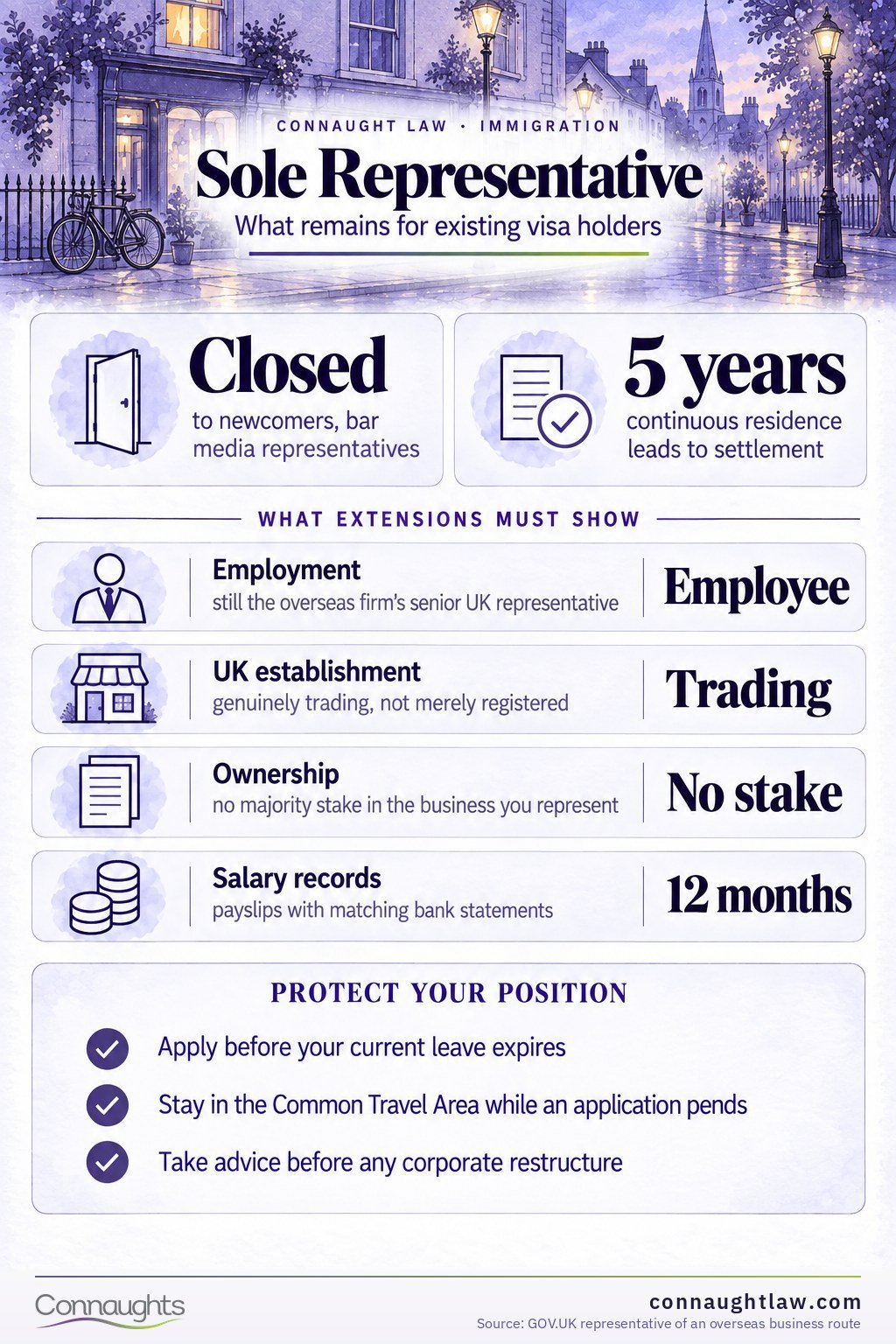
Where the Cohort Stands in 2026
What Remains Available
Extensions remain open to compliant holders, settlement follows five years' continuous residence with B1 English and the Life in the UK test, and dependants can apply and settle alongside. What closed is entry: nobody new joins the route except qualifying media representatives, and new corporate expansion runs through the UK Expansion Worker system instead.
Extensions That Get Granted
The Evidence That Carries Them
An extension is an audit of the original promise: you are still employed by the overseas business as its senior UK representative, still supervising a genuinely trading UK establishment, and still not the owner of the business you represent. The recurring failures are evidential — vague employer letters, salary records with gaps, a UK entity that exists at Companies House but barely trades on paper.
Extension Documents Table
| Category | What to provide | Common failure |
|---|---|---|
| Employment | Employer letter confirming the continued role and business need | Generic wording that proves nothing specific |
| Salary | Twelve months of payslips and matching bank statements | Gaps, or remuneration that does not match the letter |
| UK trading | Accounts, invoices and contracts showing the branch genuinely operating | A registered entity with no commercial substance |
| Corporate records | Companies House filings and ownership evidence | Outdated filings or unclear shareholdings |
Timing the Application
Apply before your current leave expires — in-country applications typically decide in around 8 weeks at the standard service — and plan travel around the fact that leaving the Common Travel Area while an in-country application is pending withdraws it. Extensions granted now are carrying holders towards settlement, so build each extension file as if the settlement caseworker will read it later; they often do.
Settlement at Five Years
What the ILR Application Must Show
Settlement needs five years' continuous residence in the route within the absence limits, English at B1, the Life in the UK test, and the through-line that decides these cases: a UK establishment genuinely built and still operating, with your role and the ownership restrictions intact across the whole period. The fee is the standard £3,226 settlement charge at the rates in force from 8 April 2026. Where the record is clean, these are strong applications — the route's survivors are by definition its compliant members.
Where New Applicants Go Instead
Old Route, New Framework
Corporate expansion now runs through the UK Expansion Worker route: sponsored rather than independent, a team of up to 10 workers rather than one representative, but a hard two-year limit and no settlement of its own — the full mechanics are in our Expansion Worker guide, and the wider menu in our sponsorship routes directory. Founders weighing entrepreneurial paths instead compare the closed-route positions in our Start-up and Tier 1 Entrepreneur guides.
Dependants on the Route
Who Can Join
Partners and children under 18 can apply and extend alongside the main holder, with the health surcharge and maintenance requirements applying as usual. The route's historic quirk survives too: a partner who holds a majority interest in the overseas business is excluded — the rule that stops ownership entering by the side door it was barred from at the front.
Families Settling Together
Dependants build their own five-year paths to settlement, and the family's applications are strongest when synchronised — shared evidence of residence, aligned absences and a single narrative of the establishment's growth. Where timings have diverged, plan the sequence rather than filing ad hoc; a granted main-applicant ILR strengthens everything filed after it.
Staying Compliant to the End
The Changes That Must Be Managed
- You must remain the overseas business's employee and senior UK representative — a drift into running your own venture breaks the route's terms.
- Ownership restrictions persist: taking a majority stake in the employer ends eligibility.
- The UK establishment must keep genuinely trading; dormancy reads as the promise abandoned.
- Corporate restructures — mergers, ownership changes overseas — need advice before they happen, not explanations afterwards; our business immigration team handles exactly these junctions.
Questions about the sole representative route
Can I still apply for a sole representative visa?
Not unless you are a qualifying media representative — the route closed to other new applicants on 11 April 2022. Overseas businesses expanding to the UK now use the sponsored UK Expansion Worker route, which works very differently and leads nowhere permanent by itself.
Can existing holders still extend?
Yes. Compliant holders extend in the route on the original terms: continued senior employment, a genuinely trading UK establishment, and the ownership restrictions intact. Extensions decide in around 8 weeks in-country, and each one should be evidenced with the eventual settlement application in mind.
What does settlement require?
Five years' continuous residence in the route, B1 English, the Life in the UK test and evidence the UK establishment was built and maintained throughout, with the £3,226 fee at current rates. Absence limits apply across the whole period, so reconcile travel records before applying.
Can my family join me?
Partners and children under 18 can apply, extend and settle alongside you, paying the surcharge and meeting maintenance requirements. The exception: a partner holding a majority stake in the overseas business is excluded by the route's ownership rules.
What could still go wrong before settlement?
The classic three: the UK branch stops genuinely trading, the holder's role or ownership position changes past what the rules allow, or an overseas corporate restructure changes the employer without advice taken first. All three are manageable prospectively and damaging retrospectively.
Is the media representative route the same thing?
It is the surviving branch of the same route: employees of overseas newspapers, broadcasters and agencies posted long-term to the UK can still apply, extend and settle on broadly the old framework. The business-expansion branch is what closed in 2022.
Tell us when your leave was granted, when it expires and what the UK branch is doing now. We'll tell you what an extension or settlement application has to evidence, and which route applies to anyone new.
Get Expert Advice