
The Start-up visa closed to new applicants on 13 July 2023, and because its grants ran for a maximum of two years, the final Start-up permissions expired during 2025 — nobody lawfully holds one today. What remains is the aftermath: former holders now on the Innovator Founder route, founders who missed the switching window, and entrepreneurs researching what replaced it. This guide covers the closure record and the 2026 position for each.
On This Page

The Two-Year Route That Ran Out
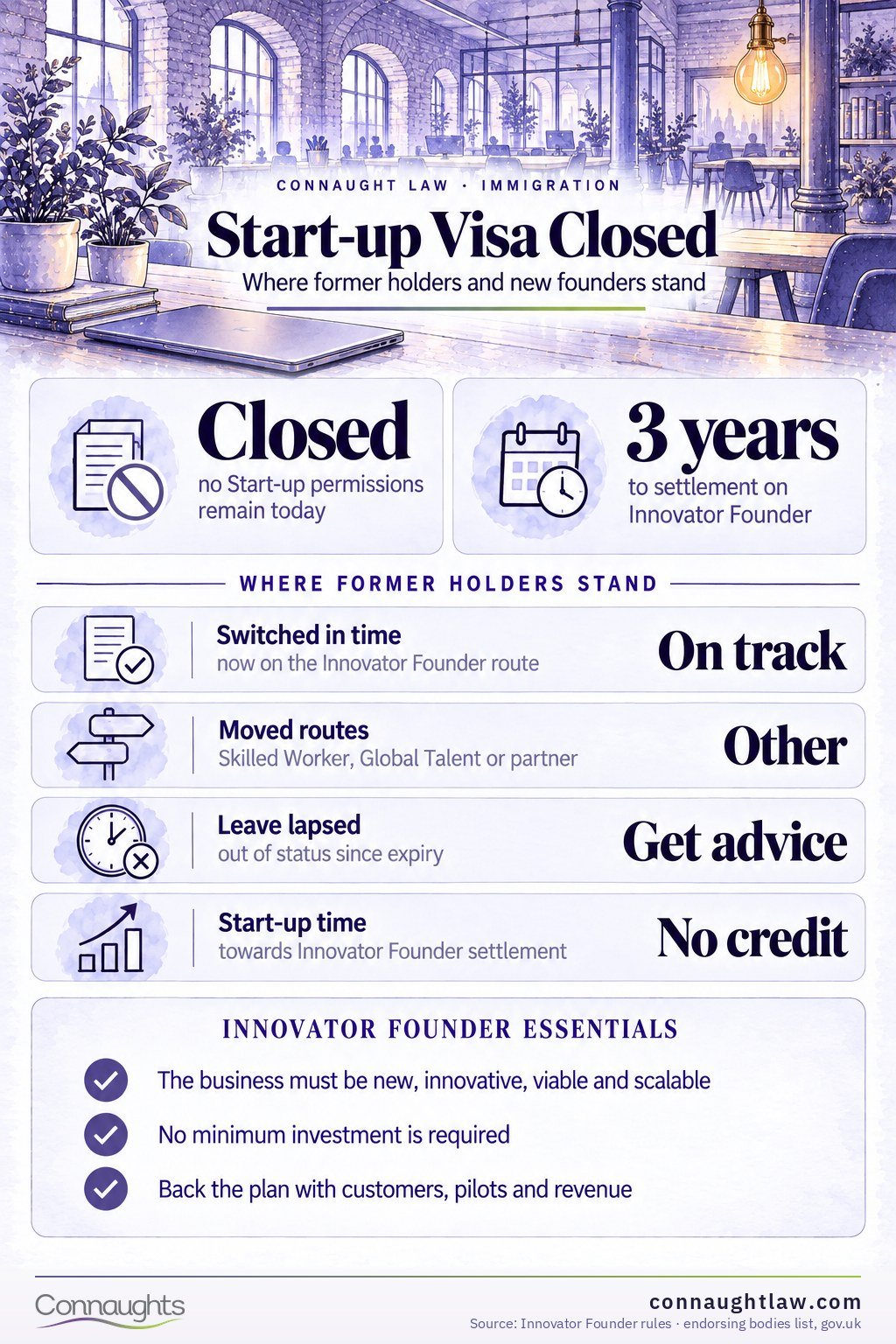
The Start-up visa closed to applications on 13 July 2023 and, with two-year non-extendable grants, its final permissions expired during 2025. Former holders are now on the Innovator Founder route, on another visa, or out of status — and the right next step is different for each.
The Start-up visa was the entry-level founder route: no investment funds required, a two-year grant, and no settlement path of its own — it existed to feed the Innovator route above it. When the 2023 reforms merged that pair into the Innovator Founder visa, the Start-up route closed first at the endorsement stage, then to applications, and its last permissions have since aged out entirely.
Why the Route Closed
The Consolidation Logic
Running two endorsed founder routes doubled the machinery — separate rules, separate cohorts, one endorsement industry — for a combined intake that published statistics put in the hundreds per year. The Innovator Founder route absorbed the Start-up visa's best feature, the absence of an investment minimum, and attached it to a route that actually leads to settlement.
What the Route Required
For the record: endorsement of an innovative, viable and scalable idea by an approved body (then a long list including universities), £945 in maintenance funds, English at B2, and a two-year, non-extendable grant with secondary work allowed. No investment threshold and no direct route to indefinite leave — progression meant switching up to Innovator, and later to Innovator Founder.
Who Was Left Where
The closure split the cohort three ways: founders who switched into Innovator Founder in time and are now progressing towards its three-year settlement; founders who moved to other routes — Skilled Worker, Global Talent, partner routes; and a residue who let permission lapse, whose problem is now regularisation rather than route choice. Each group's position in 2026 is covered below.
The Closure Record
How the Shutters Came Down
Start-up Closure Key Dates
| Date | Milestone | Position now |
|---|---|---|
| 13 April 2023 | Final new Start-up endorsements; Innovator Founder route launched | Passed |
| 12 July 2023 | Last visa applications using pre-April endorsements | Passed |
| 13 July 2023 | Route closed to applications entirely | Permanent |
| Through 2025 | Final two-year grants reached expiry | No valid Start-up permissions remain |
If You Were a Start-up Holder
There is no live Start-up permission left to extend or switch from, so the 2026 question is what you hold now. On Innovator Founder: your progression is the standard one, covered in our requirements guide. On another route: your Start-up history is simply part of the record. Out of status since expiry: take advice promptly — regularisation options narrow with time, and honesty about the gap is the only workable starting point.
The Successor Route in Brief
What Innovator Founder Kept and Fixed
The successor kept the no-minimum-investment principle and secondary skilled employment, and added what Start-up never had: extendability and a three-year settlement path. Fees at the rates in force from 8 April 2026 are £1,357 outside the UK or £1,693 in-country, plus the £1,000 endorsement and £500 contact-point meetings — the full cost and requirement detail lives in the requirements guide rather than here.
The Same Three Tests, Sharpened
Endorsement still turns on innovation, viability and scalability — with the successor adding the explicit requirement that the business be new, not one already trading. Start-up-era endorsements were assessed at an earlier, more forgiving stage of business life; founders who found the step up to Innovator Founder assessment steep were experiencing the design, not bad luck. Former Innovator holders sit differently again — their legacy position is covered in our Innovator closure guide.
Requirements at a Glance
Endorsement (50 points), B2 English (10) and £1,270 held for 28 days (10) make up the 70-point test, with settlement after three years against the two-of-seven achievement criteria. All of it, verified against the current rules with the fee table, is in the Innovator Founder guide — kept in one place deliberately.
Endorsing Bodies After the Universities
The biggest structural change from the Start-up era is the endorsement market: the long university-heavy list is gone, replaced by a small appointed panel.
Innovator Founder Endorsing Bodies
| Body | Focus at appointment |
|---|---|
| Envestors | High-growth businesses across sectors |
| Innovator International | International founders and expansion |
| UK Endorsement Services | Cross-sector consortium assessment |
| Global Entrepreneurs Programme | Invitation-based, government-backed tech founders |
Checking the Current List
Appointments change; the live list with each body's remit is published on gov.uk, and checking it is step one of any new endorsement plan — an application built around a body's outdated remit wastes both the fee and the months.
How the Switch Worked — and Who Missed It
Same Business, New Business, No Business
Innovator Founder Switching Requirements
| Position | What it required | Where it leads |
|---|---|---|
| Same business switch | Endorsement that the endorsed venture was trading and progressing | Now on Innovator Founder, settlement clock running |
| New business switch | The full new-business assessment from scratch | Now on Innovator Founder on a fresh plan |
| Missed the window | — | Out of status since expiry; regularisation advice needed, not route comparison |
The Lesson the Deadline Taught
The founders who switched comfortably started six months out; the ones who scrambled discovered that endorsement runs on assessors' timetables, not visa expiry dates. That lesson carries forward unchanged to every endorsed route: the Home Office stage is quick, the endorsement stage is not, and only one of them can be paid to hurry.
Plan Standards Under the Successor
The Plan Is the Application
Everything a switching founder learned about plans applies double now: the document must prove the four tests — new, innovative, viable, scalable — with claims specific enough to check. The full treatment of what endorsing bodies accept and reject is in the requirements guide; this section stays short on purpose.
Evidence Beats Assertion
Bodies weigh validation — customers, pilots, revenue, signed interest — far above projections. A Start-up-era plan full of intent was assessable then; the successor route assesses track, and former holders' trading history is exactly the evidence a same-business endorsement wants to see.
The Founder Is Assessed Too
Endorsers and caseworkers both test whether this founder can deliver this plan: relevant experience, role in the venture day to day, and credible answers at interview. Ghost-founder arrangements — a plan fronted for someone else's business — are what the genuineness checks exist to catch.
Other Routes for Founders in 2026
Skilled Worker Self-Sponsorship
A UK company you establish can hold a sponsor licence and sponsor you into a genuine skilled role in it — the so-called self-sponsorship model. It is legitimate but heavily scrutinised: the licence, the genuine vacancy and the salary threshold all apply in full, and the set-up is covered across our sponsorship routes directory.
Global Talent
For founders with recognised standing in tech, science, arts or academia, Global Talent offers endorsement-based permission with no employer and flexible settlement. Its bar is prestige rather than a business plan — the right answer for a minority, the wrong first idea for most.
UK Expansion Worker
Where the venture is an overseas business expanding here rather than a UK start-up, the Expansion Worker route sends up to 10 workers to build the first UK presence on a provisional licence — mechanics, costs and its two-year limit are in our Expansion Worker guide, with the closed Sole Representative route it replaced covered separately.
Investment Options, Honestly Stated
There is no UK investor visa to buy into: Tier 1 (Investor) closed in February 2022, and the mooted successor remains unlegislated — tracked in our investor route watch. High-net-worth founders route through the same doors as everyone else: Innovator Founder for ventures, sponsorship for employment, with our business immigration team mapping the fit.
Frequently askedQuestions about the closed Start-up route
Is the UK Start-up visa still available?
No — it closed to new applications on 13 July 2023, with final endorsements ending that April. Because grants were two years and non-extendable, the last Start-up permissions expired during 2025. The entry point for founders now is the Innovator Founder route.
I held a Start-up visa and switched — where does that leave me?
On the standard Innovator Founder track: extensions through your endorsing body, settlement after three years on that route against the two-of-seven achievement criteria. Your Start-up time does not count towards the three years — only Innovator and Innovator Founder time combines.
What if my Start-up visa expired and I never switched?
You have been without leave since expiry, and the options — fresh entry clearance on a route you qualify for, or regularisation where grounds exist — narrow as the gap lengthens. Take advice before making any application; the explanation for the gap matters as much as the route.
What replaced the Start-up visa?
The Innovator Founder visa, from 13 April 2023: no minimum investment, skilled secondary work permitted, extendable, and settlement after three years. It costs £1,357 from outside the UK plus £1,000 endorsement at the current rates — the full requirements live in our dedicated guide.
What was the Start-up visa's approval rate?
No official approval rate was published, and high percentages quoted online are unsourced. The route's published story was about volume, not refusals: grants ran in the hundreds annually, which is why consolidation, not tightening, ended it.
Can universities still endorse founders?
Not on this system. The Start-up era's long endorsing list, universities included, ended with the route; Innovator Founder runs on a small appointed panel whose current membership is published on gov.uk. Choosing among them is now a strategic decision, not a formality.
Tell us what status you hold now, what the business is doing and when your Start-up leave ended. We'll tell you which route — or which fix — actually fits from here.
Get Expert Advice