
The Innovator visa closed to new applicants on 13 April 2023, but thousands of existing holders are still on it — and their position is better than most closure guides suggest. Extensions and settlement continue through the Innovator Founder rules, legacy endorsing bodies can keep supporting the same business, and time already spent on the Innovator route counts in full towards the three-year settlement clock. This guide covers exactly what former Innovator holders do next.
On This Page

Closed, but Not Over
You cannot extend in the Innovator category itself; further applications are made under the Innovator Founder rules. Your original endorsing body can continue supporting the same business as a legacy endorser, your Innovator years count in full towards the three-year settlement requirement, and settlement itself runs on the standard two-of-seven achievement criteria at the £3,226 fee.
Why the Route Closed
The Innovator visa and its sibling Start-up route ran as a confusing dual track: one demanded £50,000 of investment funds, the other led nowhere permanent, and both fed the same small pool of endorsed founders. The April 2023 reform merged them into the single Innovator Founder route — dropping the investment minimum, opening secondary skilled employment and keeping the three-year settlement clock.
The Numbers Behind the Decision
Uptake, not failure, closed the route: published Home Office statistics show grants on the Innovator and Start-up routes ran to a few hundred a year — a fraction of any mainstream work route — and consolidation was the response. Treat any article quoting a precise pre-closure "success rate" with suspicion; the Home Office publishes grant volumes in its quarterly immigration statistics, not approval percentages for this route.
What the Successor Changed
Advantages of the Successor Route
- The £50,000 minimum investment requirement was abolished — funding is now a business question, not a rules question.
- Founders may take skilled secondary employment alongside the venture, which Innovator holders could not.
- The checkpoint burden with endorsing bodies reduced, with meetings now at least twice during the stay at £500 each.
- The three-year settlement path survived intact. Full current requirements, fees and the business-plan tests live in our Innovator Founder requirements guide — this post deliberately does not repeat them.
Endorsing Bodies Now
New applicants use the small panel of approved endorsing bodies on the current gov.uk list. Former Innovator holders are the exception to that funnel — the legacy arrangements below let your original endorser stay in the picture, which is usually the simpler and cheaper path for a business already trading to plan.
Extending as a Former Innovator
Legacy Endorsing Body Provisions
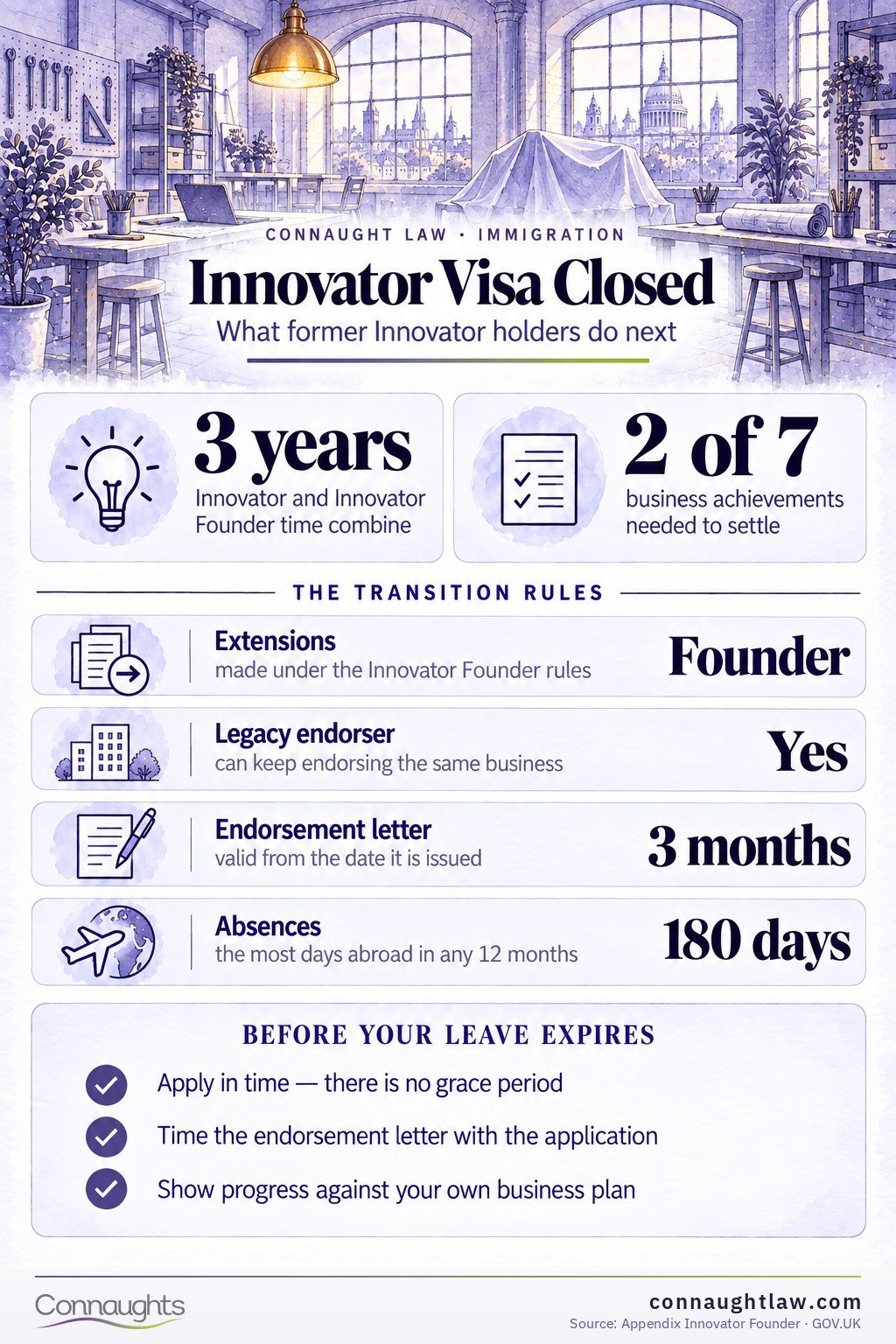
Where you are continuing the same business concept your original endorsement covered, your legacy endorsing body can issue the new endorsement letters needed for an extension, for settlement and for dependant applications — even though it no longer takes new customers. That continuity is the transition's most valuable feature: the business does not have to re-prove innovation from scratch to a stranger, only progress against its own plan.
Documents and Timing
Apply before your current permission expires — the switch into the Innovator Founder rules is an in-time application, not a grace period — and remember endorsement letters are valid for three months from issue, so sequence the letter and the application together. The application itself runs at the Innovator Founder fees and evidence standards current on the day, which is another reason not to leave it to the final week.
Settlement for Innovator Time
Your Innovator Years Count in Full
Per gov.uk on the day of writing, settlement requires three years in the UK "using an Innovator Founder or Innovator visa" — the two count together. A founder two years into an Innovator visa is one year from eligibility, not starting over. The standard conditions apply: the £3,226 fee, the Life in the UK test, and no more than 180 days' absence in any 12 months.
Achievement Criteria in Brief
Settlement needs a fresh endorsement confirming the business has met at least two of the seven achievements in Appendix Innovator Founder — from £50,000 invested and spent, through the customer, revenue and R&D measures, to the two job-creation thresholds. The full verified table sits in the requirements guide's settlement section; what matters here is the transition overlay below.
Settlement Under Transition
| Element | Position for former Innovator holders |
|---|---|
| Qualifying residence | Innovator and Innovator Founder time combine towards the three years |
| Endorsement at settlement | Your legacy body can endorse the same business's achievements |
| Achievement criteria | Any two of the seven — the same test as new-route founders |
| Fee and tests | £3,226, Life in the UK, 180-day absence limit per 12 months |
The Closed Routes, Side by Side
Evolution of Business Routes
| Route | Investment rule | Work flexibility | Settlement |
|---|---|---|---|
| Tier 1 Entrepreneur (closed 2019) | £200,000, or £50,000 from approved sources | Business only | 3–5 years, route now fully wound down |
| Innovator (closed April 2023) | £50,000 minimum | Business only | 3 years |
| Start-up (closed April 2023) | None | Secondary work allowed | No direct settlement route |
| Innovator Founder (current) | None | Skilled secondary work allowed | 3 years |
Each closed route left its own stranded cohort with its own rules — covered in our guides for Start-up visa holders, Tier 1 Entrepreneurs and Sole Representatives — while the investor route's possible return and the wider White Paper programme shape what comes next.
If Your Position Is Unclear
The awkward cases are real: businesses that pivoted away from the endorsed concept, endorsing bodies that have wound down, permissions already expired. Each has a route — a new-business endorsement, a different legacy pathway, or prompt regularisation — but they are fact-specific and time-sensitive. Our business immigration team maps the options, our settlement team handles the ILR stage, and where an application has already been refused, the visa refusal, administrative review and appeals teams take it from there. The wider practice is at Connaught Law immigration.
Frequently askedQuestions about the closed Innovator route
Can I still extend my Innovator visa?
Not in the Innovator category itself — further applications are made under the Innovator Founder rules before your current permission expires. With a legacy endorsement for the same business, the extension continues your existing venture rather than starting the route again.
Does my time on the Innovator visa count towards settlement?
Yes, in full. The settlement requirement is three years in the UK on an Innovator Founder or Innovator visa, counted together. Someone two years into the old route needs one more qualifying year, not three, before applying at the £3,226 fee.
Do I now need £50,000 in investment funds?
No — the successor route abolished the investment minimum entirely. The £50,000 figure survives only as one of the seven optional settlement achievements, where investing and spending that amount is one way of evidencing business growth.
My endorsing body no longer exists — what happens?
Where the legacy body has genuinely gone, the transition runs through the current approved endorsing bodies instead, usually as a same-business assessment. It adds cost and process rather than closing the door — but start earlier than you otherwise would.
What was the Innovator visa's success rate?
No official approval rate was published, and figures circulating online are reconstructions. What the published statistics do show is scale: grants ran to a few hundred a year, and that low uptake — not poor decisions — is why the route was consolidated.
Is the Innovator Founder route better?
For most founders, yes: no investment minimum, permission to take skilled secondary employment, fewer checkpoints and the same three-year settlement clock. The trade-off is a smaller endorsing panel for new businesses — which legacy holders largely bypass.
Tell us when your permission expires, whether you are continuing the endorsed business and who endorsed it. We'll tell you which transition path applies and what the next application must contain.
Get Expert Advice