
The Ankara Agreement route closed to new applicants when the Brexit transition ended on 31 December 2020 — but for Turkish nationals already holding ECAA leave, the deal quietly kept its best features: free extensions, no English requirement until settlement, no minimum investment, and a preserved five-year path to indefinite leave under Appendix ECAA. This guide covers who can still use the route in 2026, how extensions and settlement work, and where the case law drew the lines.
On This Page

A Closed Door With Everyone Inside Still Housed
The European Communities Association Agreement with Turkey — the Ankara Agreement — gave Turkish businesspeople and workers privileged UK access for decades. Brexit ended new entry, but the government preserved the position of everyone already in the system: existing holders extend and settle under Appendix ECAA Settlement, with the route's unusual generosity — free extensions, light requirements — intact.
Where the Rights Come From
Foundation Documents
The framework dates to the 1963 agreement and bound the UK from its EEC accession in 1973: the freedom-of-establishment provisions carried the business route, Decision 1/80 carried workers' progressive rights, and the standstill clause froze the applicable rules at their 1973 generosity — the feature that made ECAA applications famously cheap and light on requirements.
Key Legal Precedents
The European Court's decision in Tum and Dari (C-16/05) confirmed the standstill clause protected first-time applicants under the old rules, and the domestic litigation of 2017 — R (Aydogdu) v SSHD [2017] UKUT 167 (IAC) chief among them — established the limit: the standstill protected entry and extension terms, but not the settlement expectations applicants had assumed. That distinction built the modern framework, covered below.
The Post-Brexit Position
Who Can Still Apply
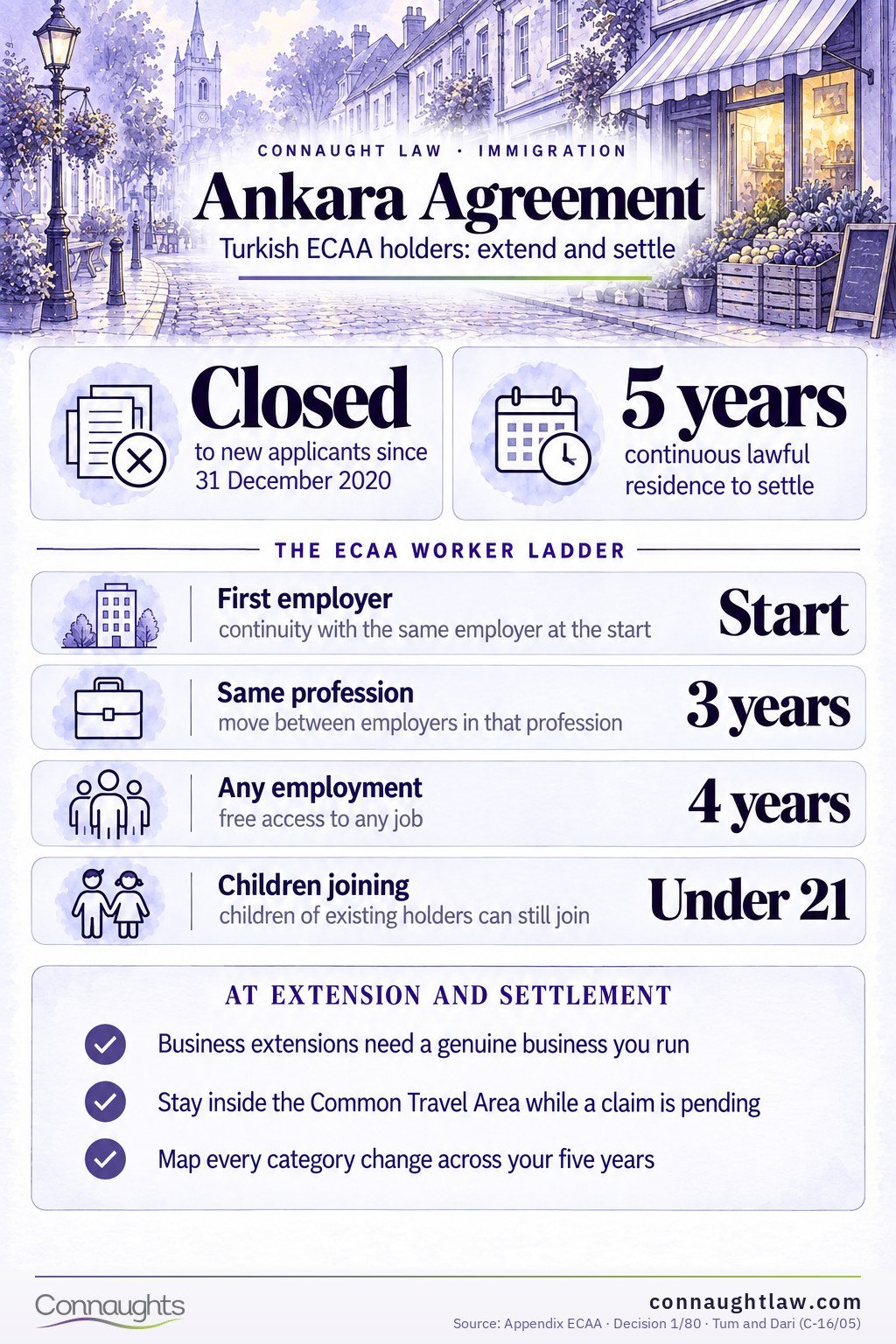
No new ECAA applications since 31 December 2020. Turkish nationals who already held ECAA leave can extend and settle; children under 21 of existing holders can still join; partners in the household before the cut-off can extend, but new partners cannot enter under the route. Everyone else uses the current immigration system.
Forms and Procedures
Extensions run on the ECAA-specific process in the Home Office's Appendix ECAA extension guidance, with biometrics and the usual in-country rule that leaving the Common Travel Area withdraws a pending application. Settlement runs on the Turkish worker and businessperson settlement route.
The Business Route for Existing Holders
What Extensions Must Show
The businessperson extension tests one thing with old-fashioned directness: a genuine business you actually run, generating enough to support you without other work or public funds. There is no minimum investment and no English test at this stage — the 1973 standard, preserved.
Why the Route Stayed Precious
Free extensions and exemption from the health surcharge make this the cheapest business immigration status in the UK by a distance — which is exactly why holders should protect it carefully rather than switching casually into fee-bearing routes.
Evidence That Works
Accounts, invoices, contracts and bank statements telling one story: real trading. The businesses that struggle at extension are the ones that exist mainly on paper — caseworkers have seen twenty years of ECAA files and know the difference between an enterprise and an arrangement.
Where Extensions Tighten
A business in difficulty does not end the route, but it shortens the leash: struggling ventures attract shorter extensions and closer scrutiny next time. The strategic response is documentation — showing the difficulty as a phase with a plan, not a permanent state.
The Worker Route's Progressive Rights
Where a Worker Starts
ECAA workers' rights build with time in the labour market under Decision 1/80, starting with continuity at the same employer.
Rights That Grow by Year
The classic ladder: after three years' lawful employment, movement between employers within the same profession; after four, free access to any employment. Holders deep into that ladder in 2026 hold rights close to settlement in practical effect — and should convert them into settlement in law.
Keeping the Record Clean
Continuity is the currency: gaps in employment or registration are what complicate worker-route files. Keep contracts, payslips and any employer changes documented against the ladder's timing rules.
Settlement Under Appendix ECAA
The Core Requirements
Five years' continuous lawful residence in the route, English at B1, the Life in the UK test, and the standard suitability rules — with the fee at the ordinary settlement rate, £3,226 per person under the table in force from 8 April 2026. The old assumption that ECAA leave rolled automatically into free settlement died in 2017; what replaced it is predictable and achievable, but it is an application, not an entitlement.
Qualifying Time
Time as an ECAA businessperson or worker counts, with the usual continuity and absence disciplines. Holders who moved between the business and worker limbs should map their five years precisely before filing — category changes are where qualifying-period arguments get lost.
Family Members
Partners
Partners build their own five-year qualifying periods and meet the same knowledge requirements at settlement; their timelines often trail the main applicant's, and filing in the right order strengthens the later application.
Children
Children under 21 can still join existing holders — a wider age window than most routes — and children generally settle with their parents, with registration as British an option afterwards for those who qualify.
Applying in Practice
Extensions
Free of charge, surcharge-exempt, decided on the business or employment evidence above. File before expiry, keep travel inside the Common Travel Area while pending, and treat each extension file as a building block of the settlement file to come.
Settlement Applications
Paid, knowledge-tested and less forgiving: allow up to six months for a decision at the standard service and do not book anything that assumes faster. An application filed with the five-year record fully reconciled — dates, absences, category changes — is the single best predictor of a quiet grant.
The Settlement Bundle
Residence evidence across the whole period, the business or employment record, English and Life in the UK certificates, and identity documents for every applicant. Assemble it as a chronology, not a heap; the caseworker's question is continuity, so answer it in order.
Cases That Shaped the Modern Route
The 2017 Settlement Crisis
When the courts held in 2017 that the standstill clause did not freeze settlement terms, the government suspended ECAA settlement in March 2018 — stranding families who had planned around the old expectations. It remains the route's defining shock, and the reason its modern framework is statutory rather than assumed.
How Policy Responded
Appendix ECAA, introduced in July 2018, rebuilt settlement as a defined five-year route with fees and knowledge requirements — less generous than the old assumption, far more secure than litigation. That framework, as amended, is what today's applications are decided under.
Protected Rights, Honestly Framed
What survives Brexit is contractual in spirit: those inside the system keep their path. What does not survive is expansion — no new cohort is coming, so the route's population only shrinks. Holders should treat their status as an appreciating asset and complete the journey to settlement rather than drifting on extensions indefinitely.
How ECAA Compares Now
UK Business Routes Compared
| Route | Investment rule | English | Extension cost | Settlement |
|---|---|---|---|---|
| ECAA business (existing holders) | No minimum | None until settlement (B1 then) | Free | 5 years |
| Innovator Founder | No fixed minimum; endorsed plan | B2 | £1,693 in-country | 3 years |
| Skilled Worker (incl. self-sponsorship) | Salary threshold £41,700 | B1 | £943–£1,865 by length | 5 years |
| Representative of overseas business (media) | Employer-funded role | A1 entry, B1 at settlement | Standard work-route fees | 5 years |
For anyone outside the preserved cohort, the live options are the Innovator Founder route, the sponsorship system mapped in our routes directory, and for corporate postings the surviving representative provisions.
When Advice Pays for Itself
The High-Stakes Moments
- Settlement applications, always — the five-year record deserves reconciling before a caseworker does it.
- Business turbulence: restructures, downturns and dormancy periods all have better and worse tellings.
- Any previous refusal — the record follows every later application.
- Family sequencing, especially partners' timelines and children approaching age limits.
Our business immigration team has acted through every phase of this route, including the 2017–18 upheaval, and our settlement team carries holders through the final stage.
Frequently askedQuestions about the Ankara Agreement route
Can Turkish nationals still apply under the Ankara Agreement?
Not as new applicants — the route closed when the Brexit transition ended on 31 December 2020. Existing ECAA holders extend and settle under the preserved rules, children under 21 can still join them, and everyone else uses the current immigration routes.
Do ECAA extensions really cost nothing?
Yes — extensions are free and exempt from the health surcharge, a preserved feature of the 1973 standstill terms and unique in today's system. Settlement is the paid step: £3,226 per person at the rates in force from 8 April 2026.
What does ECAA settlement require?
Five years' continuous lawful residence in the route, B1 English, the Life in the UK test and a clean suitability record, applied for under Appendix ECAA. Allow up to six months for a decision and reconcile the full residence history before filing.
Can ECAA workers change employer?
On the Decision 1/80 ladder: continuity with the first employer initially, movement within the same profession after three years' lawful employment, and free access to any employment after four. Document each step — the ladder's timing is where disputes arise.
What happens if my business struggles?
The route survives, but extensions shorten and scrutiny rises. Present difficulty as a documented phase with a recovery plan rather than leaving accounts to speak for themselves — and take advice before an extension, not after a refusal.
Why did ECAA settlement change in 2018?
The 2017 cases held that the standstill clause never froze settlement terms, the old practice was suspended in March 2018, and Appendix ECAA rebuilt settlement that July as a defined five-year route with fees and knowledge requirements — the framework still in force.
Tell us when your ECAA leave was granted, which limb you are on and when it expires. We'll tell you what your next extension needs and how close you already are to settlement.
Get Expert Advice