Sponsoring overseas workers is one licence system with many doors: Skilled Worker for long-term hires, Global Business Mobility for moves within a group, Scale-up for fast-growth employers, and the Temporary Worker routes for defined, short assignments. Choosing the wrong door wastes fees and months. This guide maps every sponsored route as it stands in 2026 — current names, current thresholds — and links to our deep guides on each.
On This Page

One Licence System, Many Doors
Since the post-Brexit reset, every nationality outside the resident workforce is recruited through the same machinery: the employer holds a sponsor licence, assigns a Certificate of Sponsorship on a specific route, and the worker applies against it. The routes differ in almost everything else — cost, duration, thresholds and whether they lead anywhere permanent — which is why route selection is the first real decision in any sponsored hire.
How the Sponsorship Framework Fits Together
The licence comes first — the process is covered in our sponsor licence application guide — and it is granted for licence families, not individual jobs: a Worker licence, a Temporary Worker licence, or both. The route is chosen certificate by certificate within those families, so a single licence can run Skilled Worker hires alongside group transfers and short-term placements, provided each certificate meets its own route's rules. The official framework sits in the gov.uk employer sponsorship guide.
- EU and non-EU citizens have been sponsored identically since January 2021; only those with settled or pre-settled status sit outside the system.
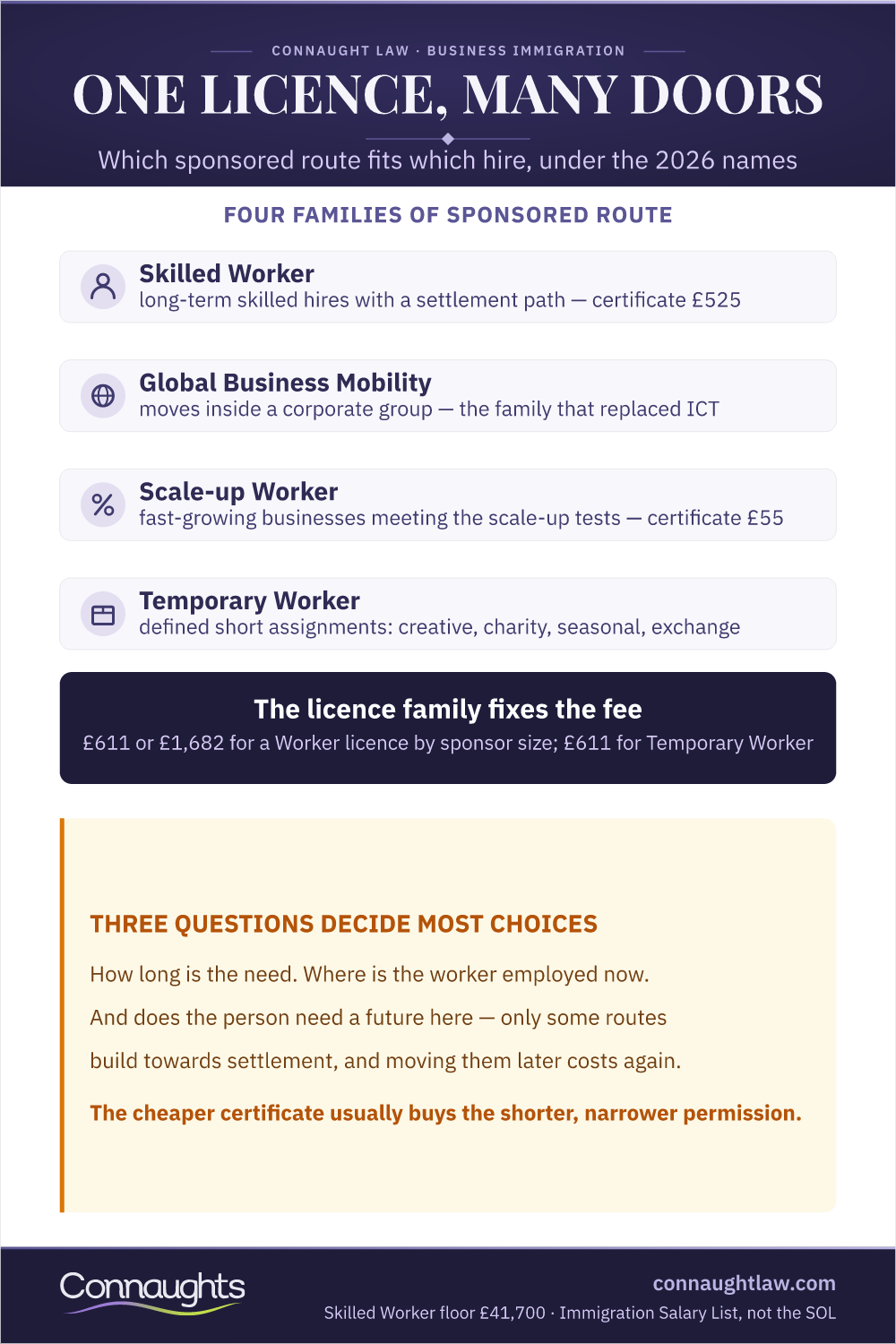
- The licence family fixes the fee: £611 or £1,682 for Worker licences by sponsor size, £611 for Temporary Worker licences.
- Certificates cost £525 on the Worker routes and £55 on the Temporary Worker routes.
- Compliance duties are identical across routes — the route changes the worker's terms, never the sponsor's obligations.
The Route Map
Routes by Licence Family
| Route | Certificate | Built for |
|---|---|---|
| Skilled Worker | £525 | Long-term skilled hires, with a settlement path |
| Senior or Specialist Worker (Global Business Mobility) | £525 | Transfers of senior staff within a corporate group |
| Minister of Religion | £525 | Faith leaders in pastoral roles |
| International Sportsperson | £525 over 12 months; £55 under | Elite athletes and qualified coaches |
| UK Expansion Worker (Global Business Mobility) | £55 | Teams establishing a first UK presence |
| Graduate Trainee, Service Supplier, Secondment (Global Business Mobility) | £55 | Programmes, contracts and secondments within groups |
| Scale-up Worker | £55 | Fast-growing businesses meeting the scale-up tests |
| Creative, Charity, Religious, Seasonal, Government Authorised Exchange, International Agreement | £55 | Defined short-term work under the Temporary Worker licence |
Choosing Between Them
Three questions decide most selections. How long is the need — permanent roles point to Skilled Worker, projects to the temporary menu. Where is the worker now — already employed in a linked overseas entity points to Global Business Mobility. And does the person need a future here — only some routes build towards settlement, and moving someone later costs another application. Price is rarely the right tiebreaker: the cheaper certificate usually buys the shorter, narrower permission.
Skilled Worker — the Default Route
Current Thresholds
The July 2025 changes reset this route. Roles must sit at degree level (RQF6), the general salary floor is £41,700 — with discounted floors of £33,400 for new entrants and Immigration Salary List roles and £37,500 for relevant PhD holders — and new applicants since 8 January 2026 must meet B2 English. The care route is closed to new overseas recruitment. Salary discounts now run through the Immigration Salary List and its successor arrangements, and current requirements live on gov.uk.
Points, After the 2025 Reset
The 70-point structure survives: 50 mandatory points for a job offer from a licensed sponsor, at the required skill level, with the required English, plus 20 more from salary or the tradeable options. What changed is how much the tradeable points can rescue — with the floors this high, points planning is now mostly salary planning, and a role that needs every discount going deserves a hard look before the certificate is assigned. Assignment mechanics are in our Certificate of Sponsorship guide.
Group Transfers — Where the ICT Visa Went
The Intra-Company Transfer visa was replaced in 2022 by the Global Business Mobility family, led by the Senior or Specialist Worker route. Content still describing "ICT visas" is describing a closed route — the corporate-link logic survived, but the names, thresholds and sub-routes are all different now.
The Corporate Link
Global Business Mobility routes require the UK sponsor and the overseas employer to sit in the same group — by common ownership or control — and the link must be evidenced, not asserted: group structures, shareholdings and joint-venture agreements are checked. Where no UK entity exists yet, the group's route is UK Expansion Worker, which runs on its own provisional-licence rules.
Who Can Transfer
Transferees normally need 12 months' service with the group before moving, with a high-earner exemption above the route's earnings level, and every transfer must be a genuine senior or specialist assignment at the route's salary threshold — the going-rate check bites harder here than on Skilled Worker. Time on these routes does not build towards settlement, so long-stay plans usually mean switching the worker to Skilled Worker later.
The Genuine Vacancy Test
What Convinces a Caseworker
The old Resident Labour Market Test is gone — no route requires advertising — but its replacement is broader: the Home Office may test whether any sponsored role genuinely exists at the skill level claimed, at application or at a visit years later. Our genuine vacancy guide covers the assessment in detail.
Documentation That Holds Up
The convincing file is the boring one: an organisation chart the role fits into, a job description matching the occupation code, recruitment records showing how the person was chosen, and contracts consistent with the certificate. Sponsors who assemble this when the role is created never have to reconstruct it under investigation deadlines.
Temporary Worker Routes
The Short-Term Menu
The Temporary Worker licence covers Creative Worker for arts and entertainment, Charity Worker for unpaid voluntary placements, Religious Worker for non-pastoral religious roles, Seasonal Worker for horticulture, Government Authorised Exchange for approved schemes, and International Agreement for treaty-based work. Certificates cost £55, permissions are short, and most of these routes lead nowhere permanent by design — check each route's current duration limits on gov.uk before promising anyone a timeline.
When Temporary Beats Permanent
The temporary menu earns its place where the work genuinely ends: a production run, a season, an exchange year. It is the wrong answer for a permanent role the business hopes to convert later — switching options from these routes are limited, and a Skilled Worker hire done properly at the start is almost always cheaper than a temporary placement unwound and redone.
Duties Across Every Route
The Standing Obligations
Whatever the route, the sponsor keeps Appendix D records, reports worker events within 10 working days and organisational changes within 20, and keeps every sponsored role matching its certificate. Enforcement against those duties has hardened sharply — our compliance crackdown analysis tracks the data and what it means in practice.
Managing the Risk
Route choice is also risk choice: an ambitious occupation-code fit or a strained corporate link is a finding waiting for a visit. Where enforcement does arrive there is no appeal — the consequences and the routes back are mapped in our refusal and revocation guide — so the economical strategy is picking the route whose tests the business actually passes.
Planning a Sponsored Workforce
Fitting Routes to the Business
Multi-route employers plan the mix deliberately: Skilled Worker for the permanent core, Global Business Mobility for group moves, temporary routes for defined work, each with its own budget line — the full cost arithmetic is in our sponsor licence fees guide. The mix should be reviewed whenever the business model shifts, not when a renewal letter forces it.
Keeping the Programme Current
The rules underneath every route keep moving: fees usually reset each April, sponsor guidance editions arrive several times a year, and the Temporary Shortage List is due to run only to the end of 2026 with a review of what follows already underway. A sponsored-workforce plan is a living document — the employers who treat it that way never discover a rule change from a refusal letter.
Frequently askedQuestions about sponsoring overseas workers
What is the difference between Worker and Temporary Worker licences?
Worker licences cover long-term employment — Skilled Worker, Senior or Specialist Worker, Minister of Religion, International Sportsperson — with £525 certificates and, on Skilled Worker, a settlement path. Temporary Worker licences cover defined short-term work with £55 certificates and no settlement by design. Many sponsors hold both.
Does the intra-company transfer visa still exist?
Not under that name. It was replaced in 2022 by the Global Business Mobility routes, principally Senior or Specialist Worker for established group transfers and UK Expansion Worker for building a first UK presence. The corporate-link requirement survived; the thresholds and rules are new.
Do we have to advertise the job first?
No. The Resident Labour Market Test was abolished — no sponsored route requires advertising. What replaced it is the genuine vacancy assessment: the Home Office can test whether the role truly exists at the claimed skill level, so recruitment evidence still earns its keep even though advertising is optional.
Can we sponsor EU nationals?
Yes — since January 2021 EU citizens are sponsored through exactly the same routes as everyone else. The exception is anyone holding settled or pre-settled status under the EU Settlement Scheme, who has the right to work without sponsorship and needs no certificate at all.
How fast can sponsorship be set up?
Most sponsor licence applications are decided in under eight weeks, and the £750 priority service — limited daily slots — cuts that to ten working days. After licensing, certificate assignment and the worker's own visa application add their own timelines, so recruitment plans should run from the licence decision, not the application date.
What if we pick the wrong route?
Usually a fresh certificate and a fresh application — fees are not refunded, and some moves force the worker to apply again from scratch. Route selection is where advice pays for itself: the tests are knowable in advance, and the wrong-door cost is measured in months as well as money.
Tell us the role, where the worker is now and whether they already work for a linked overseas business. We'll tell you which route fits and what your licence has to cover.
Get Expert Advice