Sponsor licence compliance has moved from background administration to the sharpest risk on an employer's immigration file. Home Office enforcement visits rose 58% in 2025, suspensions and revocations are running at record levels, and the duties themselves — records, reporting, monitoring — are unchanged but policed harder than ever. This guide sets out what the data shows, what the duties require, and how sponsors keep an A-rating through it.
On This Page

The Crackdown, Measured
Two things are true at once about sponsor compliance in 2026. The duties have not changed in years — keep the prescribed records, report the prescribed events, sponsor only genuine roles. And the consequences of missing them have changed completely, because the Home Office now checks, visits and acts at a scale that makes discovery the expectation rather than the exception.
A sponsor must hold the Appendix D records for every sponsored worker, report worker events within 10 working days and organisational changes within 20, and be able to show at an unannounced visit that every sponsored role matches its certificate. Failures no longer produce advisory letters — they produce downgrades, suspensions and revocations.
What the Enforcement Data Shows
The Home Office publishes sponsorship compliance activity — suspensions and revocations by quarter — in its transparency data, and the recent releases tell one story: action against sponsors in 2024–25 ran at multiples of the levels seen in the preceding years, with the care sector hit hardest. We deliberately quote the register trend rather than a fixed count here, because the quarterly figures move faster than any article; the direction has not changed for two years.
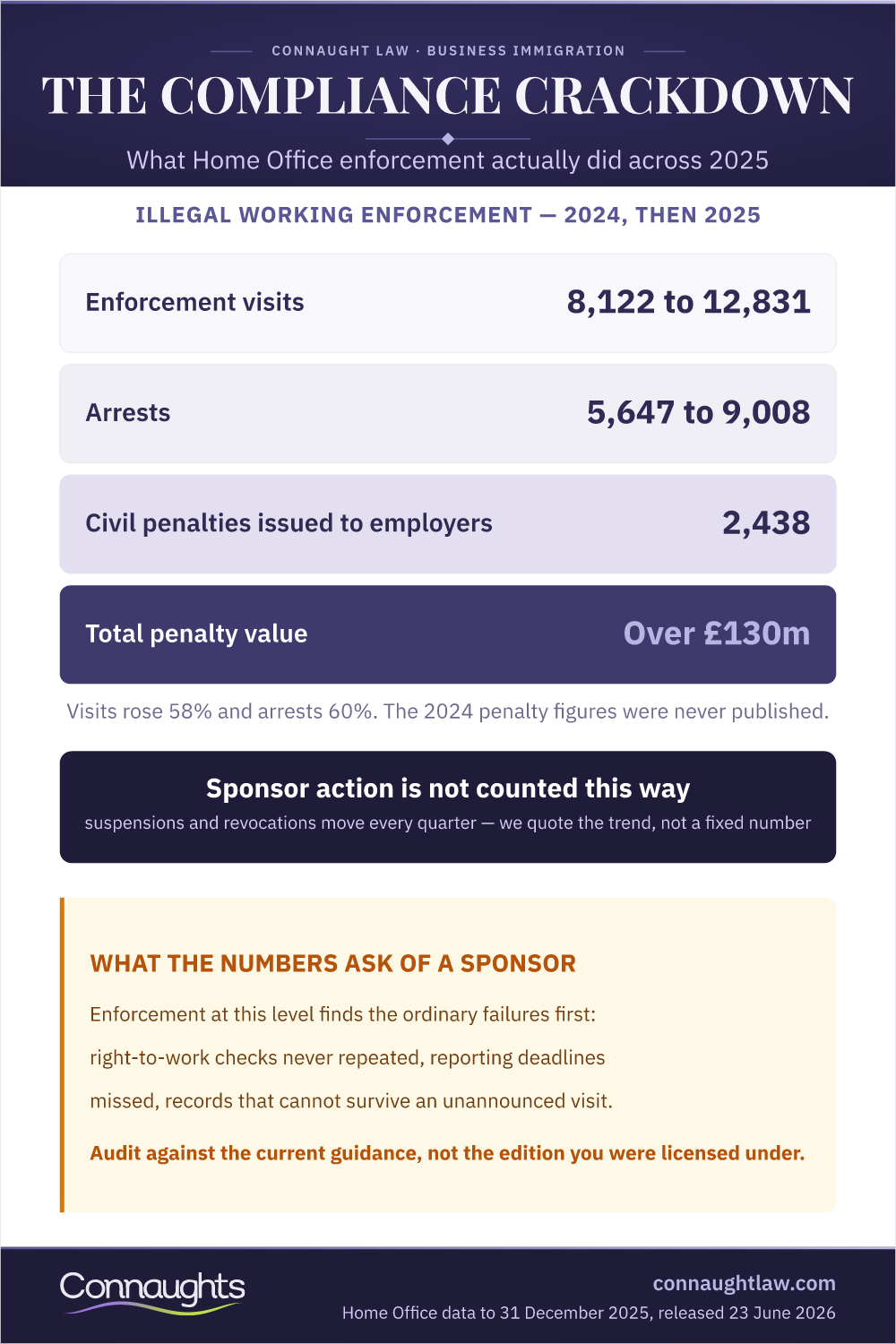
Illegal working enforcement — the regime that runs alongside licence compliance — is measured precisely. Home Office data to 31 December 2025, published 23 June 2026, shows the step change in the table below.
Enforcement Activity by Year
| Measure | 2024 | 2025 | Change |
|---|---|---|---|
| Enforcement visits | 8,122 | 12,831 | +58% |
| Arrests | 5,647 | 9,008 | +60% |
| Civil penalties issued to employers | — | 2,438 | Not published for 2024 |
| Total penalty value | — | Over £130 million | Not published for 2024 |
How the System Got Here
The post-Brexit rules pulled tens of thousands of first-time sponsors into the system — many of them small employers licensed quickly during the care recruitment wave, without the HR infrastructure the duties assume. The register of licensed sponsors grew faster than compliance capacity, and the correction, when it came, arrived as enforcement.
Why Breaches Became Common
- First-time sponsors treated licensing as a one-off application rather than a standing legal status with daily duties.
- The care expansion put licences into businesses whose staffing models — shifts, turnover, agency cover — strain record-keeping; the route has since closed to new overseas recruitment.
- Guidance editions change several times a year, and systems built to an old edition fail against the current one.
- Growth outpaced governance: roles evolved away from their certificates with nobody assigned to notice.
How Enforcement Lands Today
The pattern in current practice is suspension first and questions during: the licence is frozen, the sponsor comes off the public register of licensed sponsors, and a response window opens on the allegations. Fixable cases end in a B-rating and a £1,579 action plan; serious ones end in revocation, with every sponsored worker's permission curtailed on 60 days' notice. The full consequences ladder — including the cooling-off periods before a new application — is mapped in our refusal and revocation guide.
In Akbars Restaurant (Middlesbrough) Ltd v SSHD [2026] UKSC 26 the Supreme Court held that an illegal working penalty notice must state which limb of section 15(1) it relies on — reciting the grounds in the alternative is unlawful. Employers holding a live notice should have it checked; our guide to challenging a civil penalty covers the 28-day objection route.
The Duties That Keep a Licence
Everything the Home Office tests at a visit reduces to four disciplines. None is complicated; all four have to work on the day, unrehearsed, from the records as they actually exist.
Records to the Appendix D Standard
For every sponsored worker: the right to work evidence, contact details kept current, absence records, salary evidence matching the certificate, and the recruitment documents showing how the role was filled. Our right to work checks guide covers the checking regime itself — the statutory excuse it creates is the sponsor's first line of defence in both the licence and penalty systems.
Knowing What You Signed Up To
The duties live in part 3 of the sponsor guidance, current edition 20 May 2026, and they attach to the certificate as assigned: the occupation code, salary and hours recorded on each Certificate of Sponsorship are commitments, not paperwork. How assignments work — and how errors there cascade — is covered in our Certificate of Sponsorship guide.
Reporting on Deadline
Worker events — non-starters, unauthorised absence over ten consecutive working days, salary reductions, location changes, early departures — must be reported within 10 working days; organisational changes, including mergers and insolvency, within 20. Late reporting is among the most cited findings in enforcement decisions because it is the easiest breach to evidence: the system timestamps everything.
Auditing Before They Do
The sponsors who survive visits are the ones who run the visit on themselves first: pull a worker file at random, test it against Appendix D, reconcile every sponsored role against its certificate, and fix in weeks what enforcement would find in minutes. An annual audit against the current guidance edition costs a fraction of what it prevents.
Where This Fits in Policy
The crackdown is not a mood — it is stated policy, and the May 2025 White Paper measures have been arriving in stages ever since. Sponsors should track what is actually in force against what remains proposed, and the House of Commons Library's briefing on the changes is the reliable status record.
In force: the RQF6 skill level and £41,700 general threshold (22 July 2025), the care route's closure to new overseas recruitment (22 July 2025), the higher Immigration Skills Charge (16 December 2025) and B2 English for new Skilled Worker applicants (8 January 2026). Still a proposal: the earned-settlement reforms — consulted on, not law. Treat any article stating otherwise as wrong.
Sector Risk Profiles
Enforcement attention is not evenly spread. The published sector data for illegal working puts restaurants, takeaways and cafés first — 3,559 visits in 2025 — with food retail and beauty behind them, and sponsor-heavy sectors carry their own structural risks.
Compliance Risk by Sector
| Sector | Risk drivers | Where it bites |
|---|---|---|
| Care | Shift patterns, turnover, the closed route's transition rules | Record gaps and role-mismatch findings at visits |
| Hospitality | Most-visited sector in the 2025 enforcement data | Right to work failures converting into penalties and licence action |
| Technology | Remote and hybrid work, fast role evolution | Work-location reporting and certificate accuracy |
| Construction | Multi-site mobility and subcontracting chains | Knowing where sponsored workers actually are |
What Non-Compliance Costs
The figures that can be stated are stark enough without embellishment. Everything below is a published charge or penalty level; the unpublishable costs — recruitment freezes, contract failures, reputational damage on a public register — come on top.
Published Costs of Failure
| Consequence | Amount | Basis |
|---|---|---|
| Action plan on downgrade to B-rating | £1,579 | Fee table from 8 April 2026 |
| Civil penalty for illegal working | Up to £60,000 per worker; £45,000 first-breach starting point | Levels in force since 13 February 2024 |
| Fresh licence after revocation | £611 or £1,682, after at least 12 months' cooling-off | Fee table and sponsor guidance part 3 |
The full fee system — including the charges that apply even when everything goes right — is set out in our sponsor licence fees and costs guide.
Building a Licence That Survives
Resilient sponsors treat the licence as a governed asset: a named owner with real authority, an audit rhythm tied to guidance editions rather than the calendar, training that reaches the managers who change salaries and locations without telling HR, and legal advice engaged before letters arrive rather than after — our sponsor licence defence team is instructed at its most useful in exactly that order. Employers planning first applications can build this in from the start — our sponsor licence application guide shows how the same systems win the licence in the first place, whatever the sponsorship route.
Frequently askedQuestions about sponsor licence compliance
What are the most common compliance failures?
Late or missed reports on the sponsor management system, worker files that fall short of Appendix D, right to work checks done wrong or not repeated when permission expires, and sponsored roles that have drifted from the certificate's occupation code, salary or location. All four are found at visits, not confessed.
Can the Home Office suspend a licence without warning?
Yes. Suspension needs no prior warning and often follows an unannounced visit. The sponsor comes off the public register while the investigation runs, cannot assign certificates, and is given the allegations and a window to respond — that response is where licences are saved.
How do we challenge enforcement action?
There is no appeal. The working routes are evidence-led representations during suspension, a pre-action letter after a final decision, and judicial review within three months where the decision is unlawful or procedurally unfair. Our refusal and revocation guide covers each route and its deadlines.
What happens to sponsored workers if we lose the licence?
On revocation the Home Office curtails every sponsored worker's permission with 60 days' notice, within which they must find a new sponsor, switch route or leave. Suspension alone does not affect them. Employers who warn workers early give them a realistic chance of staying.
Is the crackdown temporary?
Nothing suggests so. Enforcement capacity has grown, the White Paper programme keeps tightening the rules in stages, and ministers have presented higher compliance activity as intended policy. Sponsors should plan on current enforcement levels being the baseline, not the peak.
Tell us the date on the notice, what the Home Office says it found and when your last compliance visit was. We'll tell you what a response has to cover and what the realistic outcomes are.
Get Expert Advice